So last Wednesday I received what the doctor told me was a mild acromioclavicular joint separation injury, or commonly known more by its street name as “Shoulder Separation“‘.
AC joint separation injuries are rated from 1-6. Luckily mine was only a 1.
Luckily when I made an appointment at Penn State’s student medical center they had a doctor who specialized in sports injuries and had handled dancers before. The bad news was I had to keep my left arm in a sling for 1-3 weeks to rest my shoulder. The good news is as long as I kept it in moderation and carefully monitored my shoulder I could still dance!
Dancing With Only One Arm
After coming to the realization that I would dancing one armed for 1-3 weeks, I couldn’t help but think of Jimmy Valentine. If you don’t know his story, Peter Loggins writes a great article about him on his blog the Jassdancer. Jimmy was an amazing one-legged swing dancer who threw down in competitions like the Harvest Moon Ball and in jam circles, a legendary dancer in spite of his injury.
So feeling inspired the last week I have been dancing only using my right arm as a lead. Only having my right hand means all my swingouts have to either start from closed, cross-hand, or right hand to right hand. All visual cues that I could possibly give my left hand were now non-existent. I have had to rely on the free-spin version of many turns such as the tuck-turn or inside-turn.
One of the big things I have learned from being able to only lead swingouts right handed is many follows often use the letting go of the left hand as a signal for a free spin on a swingout. In result I have been leading a lot of forward swingouts. When not the forward swingouts, I have been having to lead crystal clear swingouts to not be misinterpreted. What is also interesting to see is how follows handle the left hand not being there, sometimes when I am going for her left hand my follow will present the right hand or vice versa. Lastly I have been dealing with the struggle of tensing up because I still mentally out of habit am trying to use the left hand for things before I stop myself.
It’s been a good learning experience. For myself I have learned what moves I know for my cross-hand and right-to-right hand repertoire. I’ve learned for teaching and for social dance what visual/physical cues some follows rely on from the left hand for certain moves. Lastly its a limitation that forces me to be creative with my dancing, I have noticed I have been focusing more on footwork lately since the number of moves I can lead consistently have been cut down.
In about a week or two I can start using my left arm again to dance, but for now I am enjoying the unintended benefits I am getting from the situation.
For this post I am addressing a different crowd then I usually do, this post is mainly geared is those who consider themselves swing dance instructors or those who are trying to become them. However, it will still be an entertaining read for those who are interested what goes in behind the curtain of how a college scene hires instructors.
To give you my background I’ve played a part of the contacting and hiring of instructors for five different workshops over the last two years at Penn State. Two of them were a Lindy/Blues workshop, one was a Lindy/Balboa workshop, one was a Balboa workshop, and the last one was a Collegiate Shag workshop. Choosing one couple out of the myriad of potential instructors across the United States is never a simple task and I wanted to give some transparency to the reasons behind the choices myself and other officers in the organization I participated in made.
Background Information
The funding committee Penn State in the past funded 80% of total operating costs (upgraded to 90% this upcoming semester) of approved events. However here is the kicker, we only are allowed honorarium for four different individuals an academic year. We deal with this by having one instructor and one band for each semester. We don’t hire instructors who live outside of the United States simply because the funding committee will not cover travel outside of the United States and it is a nightmare of paperwork to deal with international honorarium.
What this means is are limited in how many instructors we can hire, but we have the ability to financially afford top-notch instructors who live anywhere in the United States. In addition we can offer these workshops at prices that make most national events look like a kings ransom.
First Half: Convincing Groups of People
The most annoying part of the process for myself is I have to convince two groups of people that a set of instructors is worth hiring. First is the whole council of Penn State Swing Dance Club officers, second is the allocations committee who votes to allocate us funds.
The council of officers for the Penn State Swing Dance Club consists of variety of dancers: seasoned dancers who attend events all over the East coast and keep in touch with the national community, dancers who travel once in a blue moon but generally only stick in state college, and dancers who are self-isolated and never dance outside of state college. All of them have different perspectives of who is a good dancer, what dances should be taught at a workshop, who would be a good fit for our club, and who would draw in the most out of town dancers. For instructors it has to be a set of them that all parties including myself can compromise on. Unfortunately the side effect of this is quality instructors who may be more old-school or just great instructors in general that are not in the national competition circuit may get passed over, this is especially true the further away they are from Pennsylvania.
The allocations committee is comprised of 8-12 people who for the most part have no dance experience whatsoever. Jerry Almonte’s post Your Bio Sucks though is something to take in account, last thing I need is something that looks ridiculous when I am trying to convince a group of people that two individuals are professional dance instructors worthy of tuition money. Having; a website, quotes in professional media such as newspaper reviews about performances/workshops taught by instructors, examples of your dancing on youtube, and a list of awards/honors received are all things that make things easier on our end to get funding. I mentioned to Mike Roberts and Laura Glaess at the Lindy & Blues workshop they taught at Penn State this past fall, the easiest request hearing I had was with them. This was because I was able to show the committee the Broadway Melody performance they did at Lindy Focus which many of them were able to relate to and found impressive due to having seen “Singin’ In The Rain”.
Second Half: Criteria for the Choices Made
Now that you have the background for the resources my college scene has for hiring instructors and the different sets of people that have to approve the selection of instructors made, I want to go in why personally as an organizer have chosen instructors to present to the council of officers and eventually to the allocations committee.
First off my biggest rule is I do not hire somebody I have not taken classes from personally or at a bare minimum had several respected peers give me the seal of approval. I often contact friends in other colleges/scenes who have had those instructors and ask them to give me the inside scoop of; what it was like working with them, quality of instruction, and how they interacted with the community during their stay. Instructors talk about their experiences with organizers, it goes the other way around as well.
The two biggest criteria for hiring instructors comes down to teaching ability and how good they are at fostering an enthusiastic spirit for dance.
While dancing ability is a factor, what is more important for my community is the ability for the instructors to translate that to the students. This is often tricky at Penn State because of the unique nature of it being a college workshop, yet having ridiculously cheap prices you get people ranging from a typical newbie college student dancer to an advanced out of town dancer who just came into town for a rare chance to get a private lesson from a high quality instructor. This means I particularly look for instructors who thrive in a mixed-level classes environment.
The majority of the Penn State Swing Dance club college students are beginner to beginner-intermediate dancers who often self-isolate themselves to only dancing in Central Pennsylvania at best or only at the college at worst. This means the majority of our crowd has no idea what the national swing dance community is like and has a very narrow view on what is considered “good dancing”. When we hire instructors, whether they know it or not also carry the weight of being ambassadors of the swing dance community and a source of inspiration. We can show our neophytes all the youtube clips we want but, nothing beats the actual thing in flesh and blood. Often for many of our students these events inspire them to make their first trip to an event outside the state of Pennsylvania. Their experience at our workshops are often the difference between if they just remain state-college only dancer or get motivated to join our core of traveling dancers on the East coast.
The last reason which I consider a minor one would be national reputation within and outside the swing dance community.
For our events we like getting as many out-of-town dancers as possible, however unfortunately for the majority of dancers they only want to travel for people who are popular on youtube and/or well known in the national competition circuit. Having a good reputation in the swing dance community besides attracting out of town dancers also makes it easier to convince the council of officers of why a set of instructors is qualified.
Having a good reputation outside of the swing dance community makes is easier to convince the allocations committee of why a set of instructors are qualified as professional instructors. Commercials, appearances in music videos, and appearances in television shoes make an you easy shoe-in for an easy approval during an allocations hearing. In addition for our newbie friendly lessons during a workshop, it becomes easier for a dancer to drag convince their friend who has never danced before to come along.
Summary:
I hope this gave a good overview of the process of how the selection of instructors for my college scene workshop works, in addition to the many factors that come into play during the process. I’d like to comment that most colleges have the ability to get a similar set-up due to their student activity fees and in some cases can get their entire events free under anti-drinking/alcohol-free programs run by their schools.
If you have any questions I encourage you to ask me in public on this blog or privately at my email address apache.danse@gmail.com.
This past week with a couple of friend at Penn State I spent about 3+ hours polishing up my Tranky Doo. It is a jazz routine that I have taken a lesson on the first third of the routine from Shesha Marvin and learned the rest half-assing it in public online. However like most people in the world with the second half of the Big Apple, I could get through it albeit looking at someone more experienced and presenting it myself sloppily at best.
For those of you unfamilar with it Atomic Ballroom has a great description as follows,
“The Tranky Doo is even more fun than it sounds! A silly series of mostly jazz steps, this line dance was choreographed by Pepsi Bethel in the Savoy Ballroom during the 1940’s. Lindy hoppers will often spontaneously begin this routine and, much like the Shim Sham, individuals will join in once they recognize its beginning moves. Traditionally the song was danced to Erskine Hawkins Tuxedo Junction, a mellow tune, but the routine’s versatility allows it to be danced to a number of more upbeat songs such as Ella Fitzgerald’s Dipsy Doodle. The Spirit Moves, a widely studied video record of vintage dancing, has popularized the Dipsy Doodle because it was the score used for the Tranky Doo.”
One of the things that I love about the Tranky Doo is the room for self-expression or in some cases cohesion. Philly always looks adorable when you see sometimes they have certain quirks that most of them do together when they perform it. Yet some individuals can bring out a plethora of crazy creativity when it comes to the simplest of movements like the mambo-step. Anyways here are a long list of videos that I think are great if you are looking to get some Tranky Doo creative inspiration.
Below I have listed many different recorded Tranky Doo performances vintage & contemporary that have inspired me and I hope it does the same for you.
Vintage Tranky Doo Videos
Spirit Moves (Al Minns, Pepsi Bethel and Leon James)
The 1950’s documentary produced, directed, edited, and narrated by Mura Dehn shows the choreographer of the routine Pepsi Bethel and two legendary dancers Al Minns and Leon James performing the Tranky Doo.
Al Minns and Leon James on DuPont Show of the Week (1961)
Al and Leon start with the Tranky Doo but go into other dances such as shimmies and snake hips. Mike Faltesek & Nathan Bugh did a wonderful tribute to this performance at Lindy Focus 2010.
Al & Leon Performing During American Musical Theatre Credits
Al and Leon perform during the closing credits for American Musical Theatre to the song “When the Saints Go Marching In”. This was part of the promotional campaign for Marshall Stearns’s book “The Story of Jazz” that they both were interviewed for.
Unknown ??
Unfortunately I am at a loss when it comes to the historical information to this version of the Tranky Doo. However the performance is smooth as butter and is the only other performance I have seen to a live band. If you know any information about this please provide it to me and i’ll tack it on here and give you credit.
Contemporary Tranky Doo Videos
CCX 2008 Tranky Doo by Mike, Stefan and Bethany
The funny thing about this clip is I had friends in two different states (Pennsylvania/California) say that this is best performance of the Tranky Doo they have seen hands-down. I couldn’t agree with them more. My friend Annabel Truesdell insightfully commented the other day something to the effect that while they are all doing the steps, they are adding in their own personalities. I’ve noticed when a lot of people try to add their personalities in routines, they sometimes err into the region of going off on a tangent. None of these three make that mistake, on top of that they bring a truck-load of energy to the performance.
The Tranky Doo Performed by Shesha, Emily, and Mikey
This was the first version of the Tranky Doo I ever saw online a few years back. I just love how all their personalities shine through. Jo is yelling and hip shaking, Mikey makes a eagle caw noise on the eagle slide and uses his face to accent movements, and Shesha really uses his height to create some good lines.
What I particularly love about this clip (besides that it is in high-def) is the way that Laura Glaess really uses her dress to its full effect in accenting her motions. In addition a lot of them are ‘selling it’ to me and not just going through the motions.
New Years – Tranky Doo-Lindy Focus VII
Bobby White owning every shimmy, rock, and box steps. I know I overstress this in my blog, but it is the key point that separates someone from doing choreography and performing.
MoKanSwing (Nina Gilkenson and Mike Faltesek)
Most teachers when reviewing a lesson at the end of class usually glaze over the topic. They give a good review but lacking the energy they had in the class. Nina and Mike give it all in an end of a class review and bring a lot of energy to the table in this Tranky Doo. It is also one of the few videos shot at the rare side angle.
Hat Trick Tranky Doo (ILHC Cabaret Division 2010)
Props for the dapper hats, extra props for doing the Tranky Doo while using them for hat tricks. Also 1:14 is simply magical, the level of coordination that takes is impressive.
Sving du Nord 2007 (Dax Hock & Jojo Jackson)
What I like about this one is they seamlessly transition in and out of social dance during it and they are both paying attention to each other and using that within the performance. Some useful comments from the danceprimer blog where they note the smoothness of the performance and the inclusion of Shim Sham & Big Apple steps.
SHSC 2009 – Jazz Root Week – Dax & Alice Tranky Doo
This is a good example of a Tranky Doo performance in a class that from appearances literally just learned the routine. In addition I am a sucker for the beautiful shadows shown in this performance. Watch at 1:40 for how Alice accents the “When you think you’re crazy” lyrics in the Dipsy Doodle, hilarious.
Solo swingtanzen mit Ali&Katja aus Darmstadt un Heidelberg
If you couldn’t figure it out by the title, this is a Tranky Doo performed in Germany. Ali & Katja lead what appears to be a class of recently taught students. At 0:50 there is some pretty fancy footwork for the break by the gentleman in the front right. He does a fun walk variation at 1:48 as well. Also love the blue/red lighting as well.
Mike & Frida – Chevy Chase Ballroom (2003)
Unfortunately the person filming this clip only give us less then a minute of this Tranky Doo performance. However it is to probably the fastest song I’ve seen it performed to, and both Falty and Frida bring their A-Game, I don’t know how Frida does it but her applejacks look so controlled yet wild simultaneously. The commentary on the clip while slightly obnoxious, is also particularly hilarious.
KBF2011 Line Dance #1 Tranky Doo (Korea Balboa Festival)
Last but not certainly not least our friends from the Korea Balboa Festival throw down. Watch the girl in the red skirt and bow; she uses her skirt to accent her movement, looks like she is having the time of her life, puts her personal touch into the routine, and even has time to tease the guy in front of her at 0:37.
Overall
I watched around 30+ Tranky Doo videos and still had a hard time narrowing it down to the large amount of ones I posted. If you want to look at the rest that are not linked on here, check out this following link.
If you want to learn the Tranky Doo you can check yehoodi or an OC Swing Dance Club page for a list of printable choreography. In addition here are a bunch of youtube videos as well that you can follow along.
So if you know the routine already take a gander through the videos and try some new things out. If you don’t know it yet, you now have more then enough resources to learn it. Carpe Noctem folks.
With ILHC and Camp Hollywood fast approaching, the idea of competition is in the air. This prompted me to share with you all about one of the biggest competitions back in the actual swing era besides the Harvest Moon Ball, The International Jitterbug Championships also known as the The Swingeroo.
Swivel Magazine Article
Peter Loggins originally wrote about this topic for Swivel magazine, a swing dance publication which was produced in the 90’s. An online version of this document can be found here and is posted below for your convenience.
The Biggest Contest
by Peter Loggins
In the summer 1939 Los Angeles was a hot bed for big bands and swing dancers alike. With Artie Shaw’s Orchestra on the bill, the Palomar Ballroom on Vermont and 3rd was possibly THE center of attention in the beginning of June. Upon entering the Palomar to see the great big band, dancers were greeted by promotional posters advertising the “International Jitterbug Championships” To Artie Shaws and Ken Bakers Orchestra’s ! To be held June 18th 1939 at the Los Angeles Memorial Coliseum, Cash prizes over 2,500 dollars to be awarded !!! Dancers looked upon this contest as a chance to finally prove themselves.
Excited dancers chatted amongst themselves to see who would be the favorites and who had the most confidence. Early favorites were Jimmy Renkin and his partner, and Dean Collins and Jewel McGowan. In the weeks to come dancers started practicing their routines using all the tricks in the book to help them catch the eyes of the judges. The big debate was over who’s style of dancing would suit Artie Shaw’s Orchestra, swing or lindy? Roy Damron and Snooky Bishop were favorite show stoppers, coming from Alhambra and representing their troupe, “The Alhambra Alligators.” Hal Takier and Betty Roeser, from Redondo Beach, represented the famous “Ray Rand Swingers,” which the great Maxie Dorf was also part of. On many occasions Hal and Dean argued over who would win the upcoming contest that brought so many, many sponsors under the main Palomar leadership.
By Sunday the 18th over a thousand dancers had entered the contest. People from all over the United States had made the trip; representing over 20 states and 6 foreign countries! Tensions were high the night before, and many dancers could not sleep due to nervousness, however, all they had to do was do what they did best….. just dance. Lying awake at night, dancing in their heads, going over and over the routines they had been practicing only made them toss and turn in their beds. Restlessly they awaited sunrise, which would eventually heat the summer air above 80 degrees. Morning finally came.
The trip to the Coliseum was as emotional as 5 years prior, when the Coliseum hosted the 1932 Olympic summer games. Upon entering the great structure the dancers were met by over 26,000 fans. The middle of the would-be football field held the grand 12,000 foot dance floor, with one side hosting the band stand for the orchestras, and the other side hosting the judges’ platform. The Judges were dance directors sent in by different movie studios, and as they took the platform you could see Bill O’Donnell from Warner Brothers, Hermes Pan from RKO, Carlos Romero from Paramount, Nick Castle and Geneva Sawyer from 20th Century Fox along with other dance directors from other major studio’s. With over 1,000 dancers entered in the categories of Professional and Semi-Professional, smaller divisions were put together in order to run small groups of dancers at the same time, making them work their way up the ladder to the finals.
At 9:00 a.m. Ken Baker’s band swung into gear, kicking off the first rounds. The temperature was in the 70’s and rising. Early on, dancers Freddie Christopherson and his sister Betty won their Division. Jake Arkon and Marion Goldytook their Divison as well, upsetting one of the favorites: Dean Collins and Jewel McGowan. Another team to win their division was Hal Chavoor (Takier) and Betty Roeser, upsetting another favorite, Roy Damron and Snooky Bishop.
After all the Professional Division first rounds finally ended it was time for lunch and intermission while Artie Shaw’s Orchestra took to the band stand. As soon as Artie broke into one of his more popular songs thousands of fans broke through police lines and onto the field causing a mild riot. Dancers from the stands were swinging all over the huge dance floor and not until they returned to their seats did the contest continue.
The Finals finally came in the late afternoon. Under the 80+ degree Southern California sun, Artie Shaw’s Orchestra played away as the division finalist danced against each other at the same time. At 6:00 p.m. the event came to end as the dancers’ final steps made the Coliseum attendance applause with approval.
The Awards Ceremony was next and was held at the Palomar Ballroom. Starting with the Navy Divison, the winners were Danny Stephenson and Annabelle Hoffman. The National Champions came next: Herman Harrison and Ernestine Davidson, a black couple from Los Angeles who had the crowds roaring with laughter when Ernestine, who weighed nearly 200 lbs, went through their airsteps and routines with her partner Herman, who hardly tipped the scales at 100 lbs.
At last it was time to announce the winners of the Granddaddy of them all: The International Championships! First came the runners up: Hal Chavoor (Takier) and Betty Roeser, “The Spanish American” champions known for their fast foot work and ability to put on a good show at mach speed. Then the Big Winners were announced……… Jack Arkon and Marion Goldy from Los Angeles. Jack and Marion lived in the “Miracle Mile” area of Wilshire Blvd. and had localized many of the favorite spots in L.A. since the mid 1930’s. Winning the International Jitterbug Contest lead them to perform in Ken Murray’s, “Black Out,” and at the El Capitan theater to name couple, not to mention appearing with Artie Shaw’s Orchestra and the other winners in the weeks following the contest.
This day in history is now nothing more than a few rare, fragile, and yellowed newspapers gently tucked away, and an old memory that only a few alive can share. The Coliseum is vacant of fans and Mr. Shaw doesn’t play the music that used to move the feet of dancers. Well, at least this event did take place, although long ago, and it gives us all something to dream about as we drive past the Coliseum: the biggest Jitterbug Contest in history……
Images of the Swingeroo
One of the difficulties of researching about this event is while it was held in the Los Angeles Coliseum, it was sponsored by the nearby Palomar Ballroom so some resources (to my personal belief) have incorrectly labeled pictures as at the Palomar Ballroom for the same event. Below are some photos from the Los Angeles Public Library Photo Collections of what I believe to be from the event.
1939 (Notice the shag in the background)Out of this world" hep-cats, the best in the U.S.A. and six foreign nations, are "jamming" Los Angeles for an International Jitterbug convention. Photo shows Hal Chavoor (Takier) and Betty Roeser, Pacific Coast champions, "going to town" as fellow swingsters admire. Photo dated: 1939.1939 - Notice the Kansas sign, people from all over the United States attended this competition.Hal Chavoor and Betty Roeser, Pacific Coast champion jitterbug dancers, are shown when they qualified for the International Jitterbug Championship to be staged at the Coliseum. Photo dated: June 9, 1939.
Perspective
Here are the following square feet measurements of several iconic ballrooms associated by swing dancers across the United States:
Avalon Casino Ballroom (California): 10,000 or 18,000 sq. ft (I’ve seen it listed differently on several sites)
Palladium Ballroom (California): 11,200 square foot (Now called the Hollywood Palladium)
Glen Echo Spanish Ballroom (Washington D.C.): 6,500 sq. ft
Century Ballroom (Seattle): 2,000 sq. ft
This contest was held on a 12,000 sq. ft dance floor set up at the Los Angeles Memorial Coliseum, with a crowd of 26,000 people! Most national/internationally recognized competitions are lucky if attendance breaks 1,000 people these days.
1959 - Red Sox vs. Dodgers at the LA Memorial Coliseum
The first time I encountered the Los Angeles Memorial Coliseum was oddly enough several years before I started swing dancing when I was a member of the rave community in southern California. At an event known as the Electric Daisy Carnival, I remember walking through the main gates and stopping of awe of the vastness of the crowd and the size of the coliseum, it was simply breathtaking.
I can’t even imagine walking through those same gates, hearing the legendary Artie Shaw performing with his full orchestra, and having come into view a massive dance floor with some of the best swing dancers in the world like Dean Collins competing while tens of thousands of swing dancers cheered them on.
Sadly on wikipedia and websites documenting the history of the Coliseum does not list this event. It is not mentioned in lieu of the Olympic and football related merits of the place. However I am sure to all who competed or watched that day or to those of us who have a curious interest in swing dance history, The Swingeroo has meaning.
This past Tuesday I visited The Green Door, a swing dance venue in Carlisle, Pennsylvania with four friends for their “Song Request Night”. For a dollar donation toward a charity, one could request a song for the night. A bunch of friends from York/Lancaster came out and fun times were had all around. However the way the night went down picqued the idea of redefining my definition of ‘What is right for a swing dance venue/organization?’, but before that I have a slight backstory.
Warnings
When I first started swing dancing about three years ago I asked the president of the PSU Swing dance club at the time what venues were around us if I wanted to dance on the weekend. He mentioned that the Green Door existed and that he placed in a Jack & Jill there, but to never go there. Now I do not usually like talking about places in a negative light but this backstory has a point, most of the venues in central Pennsylvania (with the exception of one) have always had the stigma here at Penn State from previous leadership that “If you want to travel go to a big city like Philly/D.C. or else deal with bad music and low quality of dancing.”
I will candidly admit I have reinforced that myself with venues in the past in Pennsylvania and California using terms like ‘neoswing/groovy music’ and ‘east coast swing’ in a derogatory sense. Lately I have been trying to relax my penchant for as they say being a ‘hater’, which leads me to my experience yesterday.
When In Rome
My friends and I arrived in time for the newbie lesson, because if you took the lesson there was a discount on the cover charge. This lesson happened to be on West Coast Swing, which if you don’t personally know me I think is a legitimate dance but in the modern context has divorced itself too far from its roots to be called a ‘swing dance’ anymore. Nevertheless I took the lesson, had fun, and threw in some body-rolls for good measure. The music of the night was an interesting mix though, possibly because it was request night. There was a good variety of westie-music, blues, vintage swing, soul, country, top 40’s songs, and a waltz. What was fun to notice was completely different groups of dancers were out on the floor depending upon what was being played. Irregardless though everybody seemed to have a fun time and i’d say the night was a success.
For anybody who knows me personally they probably did a double take after that sentence. “Wait, he went to a venue that they taught westie, played for a good portion of the time non-traditional swing dance music, and didn’t complain about the experience to the point of excess?”. The answer is yep, I enjoyed my dances to the vintage swing music myself and friends requested and just goofed around to everything else. While it was not my picturesque idea of a swing dance venue, it seemed everyone had a good time. That combined with a conversation I overheard outside of the venue was the spark that made me contemplate the idea of what is ‘appropriate’ for a swing dance venue.
Eavesdropping and Revelations
When I was outdoors I overheard an older gentleman talking about how he worked to get waltz/foxtrot instruction on a once a month basis at the venue. At first he got multiple complaints of, “This is a swing dance venue!” and such. But he said after time people relaxed their complaints and let him teach and have a waltz/foxtrot song played at least once a night.
If you don’t know me personally or haven’t inferred from my blog posts, my usual definition of an ideal swing dance venue was one that only promoted swing dance, had lessons that emphasized technique, played quality music (either vintage or modern bands that are respectable like Jonathan Stout and his Campus Five), and a good atmosphere.
As a dancer I travel a lot to events in Virginia/Washington D.C./New York/Ohio/Pennsylvania. Many intermediate and above dancers on the East Coast, especially the ones who travel to competitive events like ILHC (International Lindy Hop Championships) also hold the standards I listed above. But the most important fact is, in Central Pennsylvania I am also a minority.
One of the hardest things I have had to deal with (and still do) as an instructor and an organizer is realizing that not everyone joins swing dancing to become an amazing dancer. I usually date people outside of the swing dance community and have a circle of friends outside of it, my weakness as an extrovert is I came to dance for not the same reasons that the majority of people do and therefore neglect their perspective at times.
Who am I to say that the older gentleman’s experience or the wide eye newbie who likes dancing to top 40’s experience is inferior if they are enjoying themselves? While I do dance to have fun, my main objectives of dancing these days is often improvement and to the music I have a taste for, which fortunately for myself is what is usually DJed at larger Lindy Hop events. However this is irrelevant for people who are just looking to get a little exercise, meet new people, and have fun.
Ideas to Mull About
This topic the idea of how keeping everyone happy from newbies, experienced dancers, people who like multiple dances, to only Lindy Hoppers is a problem that has been rehashed over the years several times. I have friends in the travel circuit who live in isolated areas and say they barely dance in their home scenes because their local scene is sub-par to them.
On one hand my organizer tendencies tell me to do what I can to support my local community and improve it as a whole. But on the other hand my traveling dancer tendencies tell me to just drive the extra hour to Baltimore or some other established place that caters to my tastes.
While I try to promote the ideas and standards kept by my peers in the international swing dance community, as of late I have been coming to the realization that maybe not the best swing dance atmosphere is one that maintains that, but addresses the needs of the community it serves.
How to balance those two is something I struggle with. I’d love to hear any comments or thoughts any of you guys have.
” The greatest city on earth. Sure its a little dirty, but thats a city for ya. “
Having attended Boston Tea Party the last two years and ILHC last year, I can tell you the Baltimore swing dance scene is a force to be feared and loved. (Still debating if I am afraid how much I love them, or love how much I am afraid of them.) From streaking through dance floors, throwing epic parties with Albuquerque, to entering contests en masse, they always bring energy to wherever they show up.
Incentive to Strut On Down
Michael Seguin originally posted via Facebook that folks coming down from Philly this past weekend would only have to pay 5 bones (dollars) for cover to see the Boilermaker Jazz Band. Realizing that State College is an additional 1 hour and fourty minutes away and that I am a cheapskate, I asked if we could get the discount as well. In his infinite generosity, he decided to grant all Pennsylvanians and Delawarians the discount. Afterwards I rounded up four other friends and by Friday afternoon we were off for our first foray to the Baltimore Strut.
Baltimore Strut
The most difficult thing about the night was actually finding the venue, which they affectionately refer to as “a dive”. The Dance Rink is no Spanish Ballroom, however the place has character (and unisex bathrooms). A quote I got when asking about the venue I think does the place justice,
“It is a weird, funky space, but Baltimore has the energy these days!”
As promised, when we got to the door we were only charged five dollars and there was ice cold water and soda. The Boilermakers as usual did an excellent job, they kept the energy levels up and dancers excited. I particularly enjoyed their performance of the Benny Goodman classic, “Goody, Goody“. Also kudos to Sarah Sullivan who also spun some good tunes during the band breaks.
After the band was done playing, they did something I usually strongly disagree with, which is play non-swing dance music. However in the case of the Baltimore Strut, it oddly meshed really well with the event’s personality and I didn’t mind it at all. Even danced a few of the songs myself.
Blues Kickin’
One of the highlights of the night was the contest the strut put on, which was a “Blues Kicking” competition. If you are unfamiliar with blues kicking, an excellent example is below at 0:56:
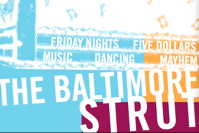
Luke Albao was the judge, who was in great juxtaposition to the venue was impeccably dressed. For the final judging, there was a soul train to the song ” Bad Romance” by Lady Gaga in which Luke gave a thumbs up or thumbs down via a chicken wing he was eating who were the winners. The mayhem promised in the promotional logo was delivered, winners recieved a free copy of the Boilermaker Jazz Band’s new CD “Nice Work If You Can Get It”.
What I Took From This
The Baltimore Strut is like that back alley, family owned, Chinese restaurant that you love. Sure the location may not be the best or meeting health code regulations. But the place has character, family sense of pride and togetherness, and is bloody delicious.




 It's The Way That You Do It