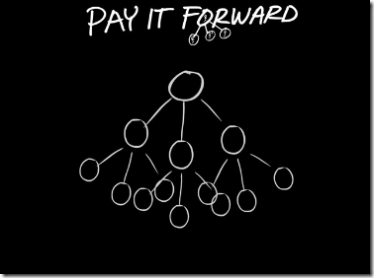
As the new year approaches I can’t help but reflect upon common themes of what has consisted my experiences of being a member of the swing dance community in years past. One I want to touch on in particular is the concept of paying it forward.
To quote wikipedia, paying it forward is defined as:
The concept of asking that a good turn be repaid by having it done to others instead.
When I first started dancing Southern California I went to a venue called Rock Harbor, which was a free venue that the instructors were local dancers who generously donated their time. One day I noticed two of the instructors there dancing Collegiate Shag, a dance I had seen previously and was intrigued by. Alas, my struggle though was like many people who want to learn Balboa, I had difficulty finding lessons. Those two instructors Alan and Amantha were nice enough to change the lesson the next week to teach Shag so I could learn the basic step and set me on the path to delving into the dance.
Last night when I was out dancing and I noticed a girl off on the side trying to figure out a Shag double rhythm basic and struggling with it. I offered to help and a few minutes later she was doing okay enough to follow a basic in open and closed position and seemed thrilled. It was only maybe five to ten minutes tops of my time at most.
Raldoph Waldo Emerson once wrote,
“In the order of nature we cannot render benefits to those from whom we receive them, or only seldom. But the benefit we receive must be rendered again, line for line, deed for deed, cent for cent, to somebody.”
For myself my best way of repaying the gift that Amantha and Alan gave me is to render the same gift they gave to me onto others. I encourage those of you who have experience in the dance community to do the same. It is a simple act that fosters growth in our community and invaluable to the individuals that it assists.
The number one request (besides aerials) that most swing dance instructors get from newer to intermediate dancers are flashy moves, flashy moves, and… flashy moves.
I’ll admit for awhile as a swing dance instructor I would teach nothing besides reinforcing technique in aboslute basic moves. While that had the advantage of drilling in solid fundamentals, it had the disadvantage of boring most of my class to death.
For the classes I taught that weren’t the first time dancer crash courses, I changed my methods of how I taught. I would choose moves that while they looked impressive/flashy, would be demanding of a certain technique point I wanted to drill in. Particularly on the point that they would fail spetacularly if people did something such as trying to run around their partner or if a lead tried to muscle a follow around.
This quote from Bug’s Question of the Day by Byron Alley hits the nail right on the head about how I feel about this topic as well,
But even then, it’s important not to imagine that people need to master their basics before attempting more advanced moves. Often it’s the opposite: people need to attempt, and quite possibly fail at, dancing at a higher level in order to appreciate the value of fundamentals. Show them moves that simply FAIL if the technique is not there. Failure is a necessary part of learning, especially a vernacular dance like Lindy Hop. It gives dancers a better understanding of the frontiers of the dance.
(Caveat: there’s a difference between encouraging failure and getting people hurt.)
I will admit though this method of teaching isn’t all rainbows and sunshine. I have recieved criticism in the past that teaching in this way creates an intimidating and discourging envionrment for students. Personally I beg to differ and think that doing this establishes a sense of humility in dancers and fosters a respect for technique because the students gain an context to understand why it is important.
In swing dance this is the idea of taking technique from other dances and attempting to apply it in way that is (usually) detrimental to making social dance work.
As a swing dance instructor whenever I get new students who have a background in areas such as ballet or gymnastics I am always excited, yet apprehensive. This is because, while they have a significant advantage over their peers in terms of experience with learning things visually, they have the unique challenges of separating technique (that does not apply well to Lindy Hop) from their past experience and in the cases of being a follow, allowing others to initiate motion versus using leads as a prop.
When you have too many frames, sometimes its hard to see the picture.
In the past I struggled how to teach people who went through this problem. I conveniently learned the answer when I took a semester of Ballroom dance. My difficulty in that class lied within the fact that I kept trying to apply Lindy Hop technique to dances that it didn’t make sense to, such as Rumba. What allowed me to get past this mental block was my Ballroom instructor at the time told me to picture dances like outfits such as formal wear or beach appropriate attire. Within those outfits certain characteristics and things worked within the idea portrayed. It sounds silly, but it worked. Whenever I did a different dance a mental switch would flick and I would utilize certain techniques, such as toes would become pointed in Irish step-dance.
For those of you who teach and have students who struggle with the idea of not mixing up technique from other dances with swing dance, give this analogy a shot. For individuals attempting to learn Swing Dance or perhaps dances outside your comfort zone such as Hip-Hop or Bhangra, the idea of picturing each dance as a separate entity can assist you greatly as well.
Let me start off this post with a personal story. In my first Jack & Jill competition that I made finals I was paired with a follow named Josephine who I had never danced with before in my entire life. The format of the finals was which in phrase battle style which meant for two sets of eight counts of 8 we would have to dance alone in front of a crowd with no idea of how the other person would react. To add onto that a fair amount of the people I was competing with were paired with people they regularly danced with at regional dance events. To say that I was in a slightly intimidating and nerve-wracking situation would be an understatement.
An interesting trend that my friend Annabel Truesdell noticed and I agree exists as well, is competitions in the United States are cutting out warm-up songs before competitions. The main reason I am assuming for this is since more events are creating more divisions, time becomes a pressing issue and those warm-up songs add up.
Opinions
I figured to get a good representation of how competitors in the community feels about the topic, I’ve asked several individuals who regularly compete across the United States for their opinion on the issue with the following question,
What’s your opinion about warm-up songs before competitions? I’ve noticed this trend of some events are cutting them out to save time, but have noticed some competitors complaining about it in result.
These are the responses I received:
Alice Pye who writes for the blog The Rantings of A Lindy Hopper and regular competitor at Lindy Hop events around the United States such as ILHC & Camp Hollywood.
“I need them definitely. Especially for jack and jills, obviously and also form the promoter/organizer point of view if you take that minute to give everyone a warm up song in the beginning, you’re pretty much guaranteeing a great show for the rest of the competition. I think cutting that warm up cuts a lot more than that one minute, it cuts the fun out of the rest of the comp.” – Alice Pye
David Lee who regularly competes at Balboa, Collegiate Shag, and Lindy Hop events across the United States at events like ILHC, All Balboa Weekend, and Hot Rhythm Holiday.
“Yes, it helps to have a warm-up song. It is a lower pressure environment to get to know your partner’s connection and the warm-up song is usually a little slower.
For example at ILHC this year, we went straight to spotlights. I danced the lindy J&J with a partner I have never danced with before in front of the whole community of lindyhoppers. A warm-up song would have helped me smooth out some of the edges. Generally if you go straight to spotlights, it is going to be fast and faster for the final all-skate.
I think a contest should test all tempos of your abilities. For example, the first year of ILHC used a slow and fast spotlight. Westies test the range of a dancer’s abilities by using a classic and contemporary song. It would be nice to see more contests that show the entire range of tempos that lindyhop is danced to rather than fast and faster.
The tempos of contests is a separate issue, but the warm-up song has been filling the role of the slow song in previous contests. If the trend is to eliminate the warm-up song, then we need another way to show off lindyhop to slower tempos.” – David Lee
Laura Glaess an international instructor who regularly teaches, competes, and judges at competitions from ULHS to the Lonestar Championships.
“Hmm… I feel like I can kind of see both sides. As a competitor, you really want that warmup song. If it’s a Jack and Jill, you need to get an idea of what the other person is like. If it’s a strictly, you want to use it calm down. However, as an organizer, you’re considering all of the people who are sitting there, not dancing. If you’ve got a load of comps, all of those warmups can add up.
I think if the event doesn’t have that many comps, give everyone a warmup song. It’s only a minute. If the event is really stuffed, I think the Jack and Jills should still get one. It’s an investment in the show they’ll be putting on.” – Laura Glaess
Morgan Day a.k.a. Super Mario who regularly competes in Lindy Hop, Balboa and Collegiate Shag competitions on the West Coast.
“As a competitor I’m for them. Personally, I think 90 seconds isn’t a significant time in the competition when you have a phrase battle that goes on for 6 minutes. Some event organizers might want to cut them so they can jump right into the “show” part of the competition, but a dance competition isn’t a pre-planned show (like what they do at Camp Jitterbug). A warm up songs lets dancers (especially amateur dancers) get into competition mode smoothly. That’s my $0.02.” – Morgan Day
Mary Freitag who writes for the blog Art and Dancing and who regularly competes and teaches at Lindy Hop and Balboa events across the United States.
“I like warm up songs for jack and jills, and I think that they aren’t really necessary for strictlys. Whenever I have done finals of a jack and jill and they don’t have a warm-up, I can never really get in the groove with my partner….even if I have danced with them a bunch before. Warm-ups really do help for jack and jills, even if it is just 1 minute! However, with strictlys you already know your partner and usually are dancing together for the songs right before the strictly anyways, so don’t really think they are needed.” – Mary Freitag
The Cost of Cutting out a Warm-Up Song
I agree from personal experience with the sentiment that most of the dancers who gave me responses wrote which is for Jack & Jill’s (especially in the case of newer dancers) that the warm-up song is an investment that organizers should put in to create a better quality experience for the audience that the competitors are trying to entertain and for the competitors who may be dancing with somebody for the first time in their lives.
Each choice has repercussions, the deciding factor is if the benefits outweigh the costs.
The opportunity cost for cutting out this warm-up means likely some of the competitors will have a case of the jitters and may not dance to their full potential that they would with one. As many of the dancers who responded agreed, that one minute is not a significant cost for the benefit of increased entertainment value for the crowd and a more likely positive experience for the competitors.
However in terms of a Stricly competition I would say like Laura wrote that it is a nice benefit to allow competitors to calm down with their partner. However like Mary wrote most people who compete in Strictly competitions already know their partner and usually dance with them right before the competition anyways. If there are not that many competitions that weekend and time allows for it, I can only see benefits from allowing for warm-up songs, but it is completely understandable if they are cut from the schedule due to time constraints during busy events like ILHC.
Alternative to Traditional Warm-Up
David Lee in my brief chat with him made a suggestion which I think has a lot of merit and has a similar format to what many people who enter Strictly competitions already do,
“One other option for warmups is to gather the competitors beforehand, match, and then give them one song of social dance time before the competition.” – David Lee
What this does is not cut into social dance time, yet provides competitors a chance to know briefly the individuals they are dancing with. There is a third benefit that I realized the more I thought about this, which is this type of warm-up is also not in front of a crowd making it a much more low pressure environment then a traditional warm-up.
Warm-ups Worthy Investments
When it comes down to it at least for Jack & Jills’ if organizers are forced to cut out warm-up songs I think it would be more efficient to better organize the weekend then cut them because even if in the worst case scenario that there are 5 J&J divisions and each warm-up takes an unrealistic 3 minutes. That is still only 15 minutes out of an entire weekend to provide your attendees with a better quality experience. If that still seems like too much of an investment on part of organizers, implement David’s idea to still provide competitors with that sense of comfort and not cut into your event’s schedule.
I think a quote from my conversation with Alice best sums up my sentiment on the matter,
“You really have to choose the right corners to cut ’cause sometimes you think you’re cutting something out, but it’s actually holding a lot of other things in place…” – Alice Pye


 It's The Way That You Do It