Carnation Plaza

Fifty-seven Years Of Magic

Dave a collector of vintage Disneyland photos wrote on his website about Carnation Plaza,

 When the Bandstand was moved from Central Plaza over to Adventureland and Magnolia Park, the Carnation Plaza Gardens were constructed and opened on August 18, 1956. A plethora of talent has performed under the tent of this area, including Artie Shaw, Benny Goodman, Harry James, The Osmond Brothers, Lionel Hampton, Tex Benecke, Cab Calloway, and Stan Kenton.

Photo of Carnation Plaza pre-renovations by  Gregg L Coope
Photo of Carnation Plaza pre-renovations by Gregg L Coope

For those of you not so lucky to be from California, in Disneyland  there was this place known as Carnation Plaza, which has been referred to as “The Longest Running Swing Dance Venue”.  A notable part of the Southern California swing dance scene for years, case in point you can see California swing dance legend Hal Takier dancing to the song Avalon there in 1987.

For a more comprehensive view, there is a small documentary on the topic of Carnation Plaza called “A Stage that Walt Built”.

However, here is my personal attempt to give you a glimpse of what Carnation Plaza was and still means to Southern California.

Date Night

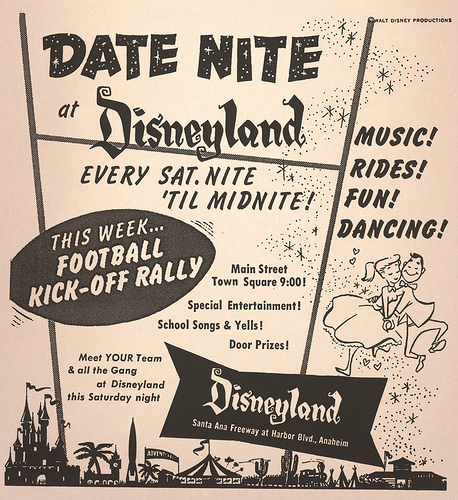
Beginning in 1957, Date Nights were a staple of Disneyland culture continuing almost until the 70s. Advertised in local newspapers they were claimed as a way to become a BMOD (Big Man On Dates). In 1967 for $6.50 in the United State one could get 10 rides and full admission to the park which included dancing.

Source: http://www.buzzfeed.com/leonoraepstein/disneylands-date-nite-of-the-50s-will-make-you-wish-you-had
Entrance of Disneyland looks great, attendees not so dapper these days.
datenight2
As seen by the school yells, this was when the collegiate school spirit was part of Southern Californian culture.

In an article on Mouse Club House, the author Scott Wolf wrote,

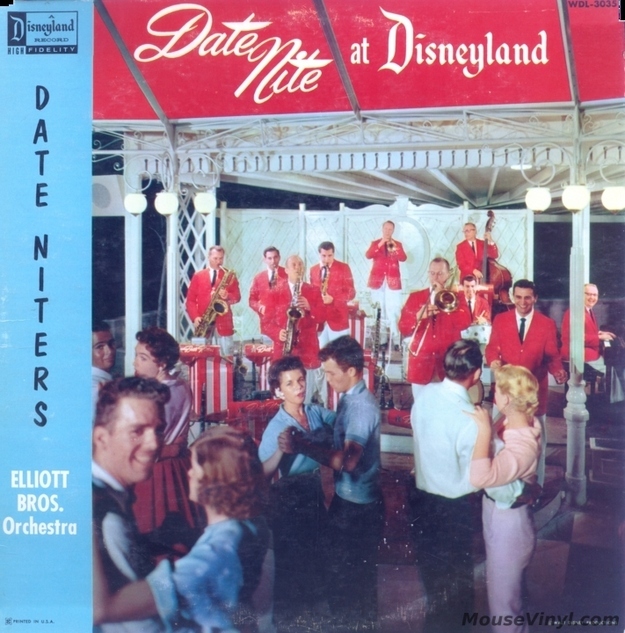
Music has always been an important part of the Disneyland experience, with the traditional Disneyland Band performing there since opening day. And while that band remains an essential element of the overall ambience of the park today, on June 28, 1957 things really got swinging! For the first time Disneyland would extend its operating hours until 1am on Friday and Saturday nights for Date Nite, in an attempt to attract young couples as a dating hot spot. Couples could purchase Date Nite discounted tickets which permitted admission only after 5pm. Carnation Plaza Gardens became the chosen central Date Nite location and the local Elliott Brothers band were brought in as the Date Niters who had the ability to perform everything from the slow dances to rock ‘n’ roll to the “La Raspa,” which became a Date Nite tradition.
datenight4

On Stage Magazine

To give a better picture of what Carnation Plaza was about, here is an article from On Stage magazine, which features an interview with Stan Freese who booked professional swing bands for several years at Disneyland.

The Stage that Walt Built
At Disneyland’s Carnation Plaza Gardens, performers can stand in the footsteps of giants.

Stan Freese calls the Carnation Plaza Gardens Stage his “home away from home.” That’s not too much of a stretch.

Freese has been helping put on shows at the historic Disneyland venue since 1974. Today, he books the professional swing bands that fill the stage every Saturday night. The job never gets old, thanks in large part to Freese’s appreciation of the star-studded history of the stage, which opened in 1956.

“This is the longest-running big band stage in the world,” he says, rattling off a list of the stars who have graced the venue over the years. The roster includes Cab Calloway, Bob Crosby, Jimmy Dorsey, Artie Shaw, Lionel Hampton, Les Brown, Buddy Rich, Woody Herman, Stan Kenton, Harry James, Eartha Kitt, and Benny Goodman–whose orchestra was the first big-name group to perform on the stage, back in 1961.

Freese, now 66, enthusiastically hops around the large stage, recreating how things looked when big bands performed there seven nights a week. “Right here is where Louis Armstrong sang ‘Hello, Dolly!'” he says. Stepping to his left, he continues: “Over here is where Count Basie and Duke Ellington played the piano. Right on this stage, looking out at the castle.”

The “castle,” of course, is the famous Sleeping Beauty Castle–the ultimate symbol of Disneyland fun and fantasy–and located “just a stone’s throw” from Carnation Plaza Gardens, as Freese puts it. The stage itself is about 20 feet wide and can accommodate 35 to 40 musicians; larger groups spread out onto the terrazzo dance floor. They perform for audiences of up to 150 people under a canopy of gold and burgundy, which adds to the festive atmosphere.

The history and the surroundings only enrich the experience for the student bands, orchestras and choruses that perform on the Carnation Plaza Gardens Stage. “They are walking on hallowed ground, playing in this hallowed venue,” says Freese. “They should all know when they come here how exciting this stage really is.”

Jim Hahn, director of instrumental music at Tuffree Middle School in Placentia, Calif., has been bringing bands to Disneyland for more than 20 years and understands the importance of sharing the Carnation Plaza Gardens Stage legacy. “Every time we go,” says Hahn, “I explain the history of that stage to the kids.”
Hahn, a saxophone and clarinet player, performed on the stage himself in 1981 with the Glenn Miller Orchestra. It was the first visit ever to Disneyland for the Philadelphia native. “I was in awe, knowing all the bands that had played that stage,” he says. “It was mind-blowing.”

Every spring Hahn brings two jazz ensembles to play at Carnation Plaza Gardens; in the fall, he brings a marching band to perform in the Disneyland parade. It’s more than history and fond memories that keep him coming back. In Hahn’s opinion, everything about the experience is top-notch. “It’s nothing short of the Disney standard,” he declares.

Hahn has particular praise for the sound quality and the location of the Carnation Plaza Gardens Stage in the bustling heart of Disneyland. “It’s a loud stage,” says Hahn. “It attracts a lot of people.”

The effect never wears off on Hahn. “As many times as I’ve taken the kids there, it’s still–as corny as it sounds—it’s still a thrill.”

Wendy Shepherd, choral director at Wilson High School in Tacoma, Wash., says the experience of playing Disneyland can be “life-changing” for students. She has been bringing her Scintillation Show Choir to perform on the Carnation Plaza Gardens Stage for 10 years. “As a child, to dream of the magic of Disneyland, and then as a young adult to achieve the goal of performing there and working with the Disney choreographers, is immeasurable,” Shepherd says. “I have students who are in their late 20s who Facebook me now, and to this day, recall their experiences, the joy, the achievement of their dream, the way it moved their lives positively.”

The thrill has never worn off for Stan Freese, either. Born and raised in Minneapolis, he made his first trip to Disneyland at age 12, when he marched in the parade with his school band. “It was just great,” he recalls. “I had no clue I was going to work there.” A tuba player, he performed as a soloist in the Soviet Union in 1969. That led to his Disney job interview and his role as leader of the original Disneyland Band, starting in 1971.

In Freese’s early days at Disneyland, the Carnation Plaza Gardens Stage was still bringing in national talent for its night-time big-band series. There also was a period in the 1970s and ’80s when pop acts like the Osmonds, the 5th Dimension and the Pointer Sisters played there. These days, the evening shows are performed mostly by swing bands that Freese books from Los Angeles, Orange County and as far away as San Francisco.

Whether the performers are professionals or students, they enjoy first-class treatment. Buses come straight off the Santa Ana Freeway into the Disneyland back lot, where students and gear are unloaded. On the back lot, the students can avail themselves of the dressing and rehearsal facilities as they prepare for their big moment on the Carnation Plaza Gardens Stage.

“The whole thing is magic,” Freese concludes. “Now it’s just up to the kids to have fun and make great music to become part of that heritage.”

Walt Disney

A little known fact about Walt Disney is that he was a fan of jazz. In fact in 1935, he produced an animated Disney short named Music Land, which attempted to bridge the gap between classical music and jazz.

As a matter of fact, Walt himself was a patron of Carnation Plaza as well.
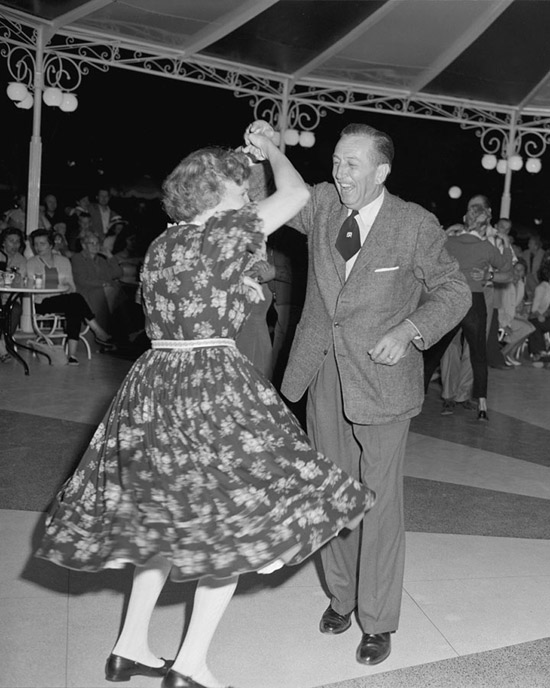
1958 Walt Disney enjoys a dance at Carnation Plaza

Besides supporting Jazz in different ways such as recordings, Disney was friends with many of the musicians who played at his park including Louis Armstrong.

Louis Armstrong and Walt Disney

A Sweet Note

While it looks different these days due to recent changes, dancing in Disneyland is still a notable part of the culture of swing dancing in Southern California and of Disneyland itself. I would like to leave you with a quote from the parks founder, Walt Disney,

To all who come to this happy place; welcome. Disneyland is your land. Here age relives fond memories of the past …. and here youth may savor the challenge and promise of the future. Disneyland is dedicated to the ideals, the dreams and the hard facts that have created America … with the hope that it will be a source of joy and inspiration to all the world. – Walt Disney

A Few Thoughts on Recent Ambidancetrous Discussions

Not too long ago there was a tumblr post on Ambidancetrous advocating the idea of teaching beginner classes where you have students try out both roles. In addition on the blog The Lindy Affair there was an interview with Anne, a member of Yale’s ambidancetrous scene where she describes her community.

Positive Results from this Community Discussion

What I enjoyed about these posts is that they encouraged discussion in person, on tumblr, on facebook, and even most recently on the Yehoodi talk show. I took the time to talk to several of my students, dance instructors I am friends with, fellow dancers I know, and even a few non-dancers as to how they would feel about the advantages and disadvantages of teaching in this manner. We also explored the tangental conversations that sprung up from exploring this line of conversation.

What I enjoyed the most is that it seriously challenged my views and methods of how I teach dance, which as an instructor I am always trying to test and improve.

My Views As A Student and Participant in the Swing Dance Community

In a previous post I wrote that a few months after I started dancing as a lead, I took several classes as a follow after being thrust suddenly into a teaching role. Until recently, I had forgotten an important fact: that when I enrolled in these classes, I asked the instructors’ permission to take the classes as a male follow. Nothing on the website stated that this was forbidden and neither of the instructors indicated in their speech that I had to choose the role of a lead. Regardless I thought it was the polite thing to do to run it by them first.

When I was learning how to follow, my classmates were generally polite. Once in awhile I would get a question like, “So why are you learning how to follow?” One thing I really appreciated was that I had a few instructors actually point me out in classes and mention what I was doing was a great idea for improving as a dancer. However, there were some notable negative experiences: once I had the unpleasant experience of having a guy outright refuse to dance with me in a workshop class because I was in the rotation as a male follow. Another incident that left a particularly bad taste in my mouth was I when was asked to compete as a lead instead of a follow in a competition because “we don’t have enough leads”.

Organizers, if you label your competition result sheets like this you are doing it wrong. They also may be relabeled.
Organizers, might want to consider the chance that a female lead or a male follow might make finals. This will prevent us from having to relabel things.

Based on my personal experiences I do have to agree that there are definitely social pressures to choose the gendered stereotypes for partnered dancing within classes.  There are still a significant amount of instructors, for example, who use gendered language for roles in classes. It is a tad odd for me, a male follow, to be referred to as a lady during class.

As a student or participant in a community, I will fully admit I have a bias. I’m a natural extrovert and it makes me not as empathetic to others as I should be at times. However, I have had to learn as a teacher, that not everyone is as comfortable in an unfamiliar social situation. Most newbies when they are taking their first dance class already have enough apprehensions to deal with; adding onto the heap the idea that people might see them as the odd one in the group could steer them from a role they were curious about in order to fit in with their class and appease anxieties they may have.

I Like My Vegetarian/Vegan Friends

On a tangent I am addressing this post “Why a lead who doesn’t follow is like a vegan making barbecue.” The author writes about the idea that instructors should know both roles in order to be effective at their job. I agree with this point, please no more classes where I have leads telling me “you just follow” as advice on how to understand that role.

However where I disagree with this blog post is that it implies that you need to pick up the other role to be a better dancer. Learning the other role in swing dancing competently is not the only avenue nor a necessity to becoming a better dancer. I have many vegetarian/vegan friends and peers who are amazing dancers, as in they compete and place at the big name competitions like ILHC and such. However in spite of being fairly experienced dancers, when they dance in their non-primary role some of them are absolute rubbish.

I’m not going to disagree that learning the other role does provide some advantages, especially in terms of being considerate to individuals in dancing. However I disagree with the tone this post takes where it implies that one is at a serious disadvantage if they do not learn both roles.

My Views As A Teacher in the Swing Dance Community

To give a short background of my teaching experience I have been teaching swing dance for about 3+ years on the East Coast of the United States. Usually local drop-in classes, monthly series, and the occasional one-day workshop out of my local area. As just a general dancer I travel a lot and tend to go to larger national/international competition events and nearby smaller regional events.

What this background means is that as a teacher, skill acquisition and/or improvement for my students is a high priority. For other instructors, creating an inclusive environment where students feel welcome or ensuring their students have fun may be more of a priority. Now I am not saying that I do not factor those other two things in when I teach; in beginner classes making sure my students have fun and are comfortable is my main priority. Beginner classes are the equivalent of sticking your foot in the pool to see if the water is okay, and I know the majority of people taking their first swing dance class aren’t there to throw down in a competition the next month. However, making sure that I provide the base fundamentals of the dance I am teaching and allowing my students the opportunity to succeed is something I am not willing to compromise on.

I think that teaching a beginner class with students learning both roles in a 45 min to 1 hour time frame (typical for swing dancing) is not an optimal idea. This is based on my experience as someone who has danced and competed in both lead and follow roles in the last few years, taught beginner classes where people learn both roles, and has been teaching for a few years. This has been further reinforced by discussions I have had with other instructors.Interestingly enough though, for Blues it seems to work perfectly fine.

The main reason why I think it works for Blues and not so much for Lindy Hop is while both dances take a considerable amount of skill to do well, as a new dancer Blues has a lower barrier of entry. Certain dances are easier to social dance at the beginning of one’s dance education. In my beginner 6-count swing drop-in dance classes a noticeable portion of my class struggles to do one role barely competently. While there is overlap between the two roles of lead and follow, it is a fact that each role does inherently pose unique challenges. When I have had students trying to tackle all of the challenges of the roles of both lead and follow in a 45 min to 1 hour time span for a typical 6-count swing beginner class, often a notable portion of my class did not get to the level of competency that I am satisfied with as an instructor.

Am I completely against the idea of an ambidancetrous newbie class for Lindy Hop? Nope. I think a beginner 6-count class for Lindy Hop can be taught ambidancetrous if you have more time, such as 1h and 30 minutes and/or if the class has a considerable amount of already experienced dancers in rotation. Another option is teaching a weekly series instead of a drop-in class, because you will have more time to work with students.

Closing Thoughts

Overall while I think exploring the idea of teaching both roles to students in a class is an interesting concept with a potential for positive results such as allowing one to be an effective instructor, gives insight to dancers about the challenges faced by both roles, and addresses issues of gender equality within the swing dance community. However based on my experience an instructor and a dancer who dances both roles I do not believe this should be at the expense of possibly leaving new students not receiving a basic amount of knowledge in their beginner classes.

Aut Inveniam Viam Aut Faciam

I have always wondered if other people in the Hammond Building found it strange to hear the sound of desks sliding and screeching across the floor for over an hour.

About four years ago in State College, Pennsylvania I was a new lead and frustrated that follows I danced with couldn’t feel me lead a rock step. The result of that was I decided to take the matter into my own hands. An immobile object wouldn’t compensate for my shitty leading, so I drilled leading rock steps on classroom disks at the top floor of the engineering building in an attempt to get my body to understand the feeling of using my body to create a stretch during a rock step.

The Benefits of an Isolated Scene

The running joke in State College was “we were four hours from everything” and with Washington D.C., Baltimore, Pittsburgh, and Philadelphia in that range it wasn’t far from the truth.  As a scene we had 1 hour classes followed by a usually 2 hour dance twice a week and one monthly large dance. Our big deal event was our semester workshop which had international instructors for absurdly low prices such as $20 dollars for a weekend workshop of 8 classes. While it wasn’t the worst situation in the world, it still was no L.A. or Washington D.C. where you have a large community of dancers and regular instruction from nationally recognized instructors.

What it did give us is the gift of forcing those of us who wanted to improve to take ownership of our dancing improvement. We would do stupid things to get in dancing with advanced dancers like leave after colleges classes at like 5pm and drive four hours to Washington D.C. to dance at the Jam Cellar (which at the time as a newbie I was convinced was like the Mecca of dance), stay to the bitter end, and then take shifts driving back to make it home in time for 8 AM classes the next day. I believe I visited Washington D.C. about three different times before I actually saw what it looked like in the daylight.

One memory that stands out in my mind was feeling left out after attending a workshop weekend that during the shim sham I had no idea what it was or how to do it. That became the catalyst which caused me the following week to use the video below and teach myself the entire routine.

The important concept I got from living in a somewhat small/isolated scene is it was not my communities’ responsibility or whatever instructors’ responsibility to help me to improve, it was mine. If I watched a video and thought I looked like shit there was always a mirror to remind myself of whose fault it is.

The Problem

The problem I have noticed in swing dance communities in general is a sizable portion of dancers are not proactive. What I mean by that is they expect to be spoon-fed and given the answers from instructors. Yes, you can learn that way but it is a slow route and not conducive to getting past intermediate at best. Even worse I would argue you are likely to end up more looking like a poor imitation of another dancer instead of developing your own voice or personality in movement.

I’m not saying to completely abandon teachers or classes, obviously those have value. What I am saying is there is a definite value being able to develop yourself as a dancer outside of formal swing dance class and many of those skills such as being able to visually learn and recreate movement have multifaceted applications. When you have classes as your only source of learning then the material your teacher’s present and possibly the social dance floor are your only source of input. However when you choose to attempt to learn something anything you can grasp is a source of inspiration; Frankie Manning, Dean Collins,  Willa Mae Ricker, or Jewel McGowan. Even non Lindy Hop sources are game, one dancer I have personally have pulled from is Maurice Mouvet.

Over the years I’ve had requests for me to teach people some things like swingout variations or solo jazz routines and often my thoughts are, “It’s on youtube, you could learn it tonight instead of waiting around for me to show you.”

An interesting trend is a lot of amazing dancers (including a few from State College) have always had this attitude in dance and in many cases they actively seek out opportunities to work and collaborate with others outside of a traditional workshop and classroom setting whether that is locally or involves travel. Jon Tigert wrote in his blog about his experience when he was in a tiny remote town in Italy for two and a half months and out of the dance loop. Did he use that as an excuse to rest on his laurels and complain about how there was no one to dance with? Hell no, instead he worked his ass off at improving his quality of movement through solo jazz.

Don’t Dream It Be It

Here is my challenge to you dear readers. Take something you have always wanted to learn (within reason, please don’t crack skulls learning aerials off of youtube) and do it. No partner? Post a facebook status, ask people in your classes, or worst case scenario work on solo quality of movement. Tranky Doo, Big Apple, or California Routine? There are videos for all of those online. If you actually take me up on my challenge write in the comments about it or even better show me on video or in person. I’ll leave you with this quote from Mr. Tigert,

So you are wondering how you can become a better dancer, even if you don’t have a partner, or you can’t afford classes. Get off your butt, stop reading blogs and watching videos, put in your earbuds and just dance. – Jon Tigert