Tiro to Tranky Doo?

Tranky Doo What Are You?

This past week with a couple of friend at Penn State I spent about 3+ hours polishing up my Tranky Doo. It is a jazz routine that I have taken a lesson on the first third of the routine from Shesha Marvin and learned the rest half-assing it in public online. However like most people in the world with the second half of the Big Apple, I could get through it albeit looking at someone more experienced and presenting it myself sloppily at best.

For those of you unfamilar with it Atomic Ballroom has a great description as follows,

“The Tranky Doo is even more fun than it sounds! A silly series of mostly jazz steps, this line dance was choreographed by Pepsi Bethel in the Savoy Ballroom during the 1940’s. Lindy hoppers will often spontaneously begin this routine and, much like the Shim Sham, individuals will join in once they recognize its beginning moves. Traditionally the song was danced to Erskine Hawkins Tuxedo Junction, a mellow tune, but the routine’s versatility allows it to be danced to a number of more upbeat songs such as Ella Fitzgerald’s Dipsy Doodle. The Spirit Moves, a widely studied video record of vintage dancing, has popularized the Dipsy Doodle because it was the score used for the Tranky Doo.”

One of the things that I love about the Tranky Doo is the room for self-expression or in some cases cohesion. Philly always looks adorable when you see sometimes they have certain quirks that most of them do together when they perform it. Yet some individuals can bring out a plethora of crazy creativity when it comes to the simplest of movements like the mambo-step.  Anyways here are a long list of videos that I think are great if you are looking to get some Tranky Doo creative inspiration.

Below I have listed many different recorded Tranky Doo performances vintage & contemporary that have inspired me and I hope it does the same for you.

Vintage Tranky Doo Videos

Spirit Moves (Al Minns, Pepsi Bethel and Leon James)

The 1950’s documentary produced, directed, edited, and narrated by Mura Dehn shows the choreographer of the routine Pepsi Bethel and two legendary dancers Al Minns and Leon James performing the Tranky Doo.

Al Minns and Leon James on DuPont Show of the Week (1961)

Al and Leon start with the Tranky Doo but go into other dances such as shimmies and snake hips. Mike Faltesek & Nathan Bugh did a wonderful tribute to this performance at Lindy Focus 2010.

Al & Leon Performing During American Musical Theatre Credits

Al and Leon perform during the closing credits for American Musical Theatre to the song “When the Saints Go Marching In”. This was part of the promotional campaign for Marshall Stearns’s book “The Story of Jazz” that they both were interviewed for.

Unknown ??

Unfortunately I am at a loss when it comes to the historical information to this version of the Tranky Doo. However the performance is smooth as butter and is the only other performance I have seen to a live band. If you know any information about this please provide it to me and i’ll tack it on here and give you credit.

Contemporary Tranky Doo Videos

CCX 2008 Tranky Doo by Mike, Stefan and Bethany

The funny thing about this clip is I had friends in two different states (Pennsylvania/California) say that this is best performance of the Tranky Doo they have seen hands-down. I couldn’t agree with them more. My friend Annabel Truesdell insightfully commented the other day something to the effect that while they are all doing the steps, they are adding in their own personalities. I’ve noticed when a lot of people try to add their personalities in routines, they sometimes err into the region of going off on a tangent. None of these three make that mistake, on top of that they bring a truck-load of energy to the performance.

The Tranky Doo Performed by Shesha, Emily, and Mikey

This was the first version of the Tranky Doo I ever saw online a few years back. I just love how all their personalities shine through. Jo is yelling and hip shaking, Mikey makes a eagle caw noise on the eagle slide and uses his face to accent movements, and Shesha really uses his height to create some good lines.

Austin Swing Syndicate’s 10th Anniversary Dance

http://vimeo.com/5238135 (Sorry embedding will not work for this clip)

What I particularly love about this clip (besides that it is in high-def) is the way that Laura Glaess really uses her dress to its full effect in accenting her motions. In addition a lot of them are ‘selling it’ to me and not just going through the motions.

New Years – Tranky Doo-Lindy Focus VII

Bobby White owning every shimmy, rock, and box steps. I know I overstress this in my blog, but it is the key point that separates someone from doing choreography and performing.

MoKanSwing (Nina Gilkenson and Mike Faltesek) 

Most teachers when reviewing a lesson at the end of class usually glaze over the topic. They give a good review but lacking the energy they had in the class. Nina and Mike give it all in an end of a class review and bring a lot of energy to the table in this Tranky Doo. It is also one of the few videos shot at the rare side angle.

Hat Trick Tranky Doo (ILHC Cabaret Division 2010)

Props for the dapper hats, extra props for doing the Tranky Doo while using them for hat tricks. Also 1:14 is simply magical, the level of coordination that takes is impressive.

Sving du Nord 2007 (Dax Hock & Jojo Jackson)

What I like about this one is they seamlessly transition in and out of social dance during it and they are both paying attention to each other and using that within the performance. Some useful comments from the danceprimer blog where they note the smoothness of the performance and the inclusion of Shim Sham & Big Apple steps.

SHSC 2009 – Jazz Root Week – Dax & Alice Tranky Doo

This is a good example of a Tranky Doo performance in a class that from appearances literally just learned the routine. In addition I am a sucker for the beautiful shadows shown in this performance. Watch at 1:40 for how Alice accents the “When you think you’re crazy” lyrics in the Dipsy Doodle, hilarious.

Solo swingtanzen mit Ali&Katja aus Darmstadt un Heidelberg

If you couldn’t figure it out by the title, this is a Tranky Doo performed in Germany. Ali & Katja lead what appears to be a class of recently taught students. At 0:50 there is some pretty fancy footwork for the break by the gentleman in the front right. He does a fun walk variation at 1:48 as well. Also love the blue/red lighting as well.

Mike & Frida – Chevy Chase Ballroom (2003) 

Unfortunately the person filming this clip only give us less then a minute of this Tranky Doo performance. However it is to probably the fastest song I’ve seen it performed to, and both Falty and Frida bring their A-Game, I don’t know how Frida does it but her applejacks look so controlled yet wild simultaneously. The commentary on the clip while slightly obnoxious, is also particularly hilarious.

KBF2011 Line Dance #1 Tranky Doo (Korea Balboa Festival)

Last but not certainly not least our friends from the Korea Balboa Festival throw down. Watch the girl in the red skirt and bow; she uses her skirt to accent her movement, looks like she is having the time of her life, puts her personal touch into the routine, and even has time to tease the guy in front of her at 0:37.

Overall

I watched around 30+ Tranky Doo videos and still had a hard time narrowing it down to the large amount of ones I posted. If you want to look at the rest that are not linked on here, check out this following link.

If you want to learn the Tranky Doo you can check yehoodi or an OC Swing Dance Club page for a list of printable choreography. In addition here are a bunch of youtube videos as well that you can follow along.

If you need an extreme detailed breakdown FreeSwingDanceLessons.com gives you what you need in these seperate videos.
So if you know the routine already take a gander through the videos and try some new things out. If you don’t know it yet, you now have more then enough resources to learn it. Carpe Noctem folks.

The Swingeroo (International Jitterbug Championships)

With ILHC and Camp Hollywood fast approaching, the idea of competition is in the air. This prompted me to share with you all about one of the biggest competitions back in the actual swing era besides the Harvest Moon Ball, The International Jitterbug Championships also known as the The Swingeroo.

Swivel Magazine Article

Peter Loggins originally wrote about this topic for Swivel magazine, a swing dance publication which was produced in the 90’s. An online version of this document can be found here and is posted below for your convenience.

The Biggest Contest

by Peter Loggins

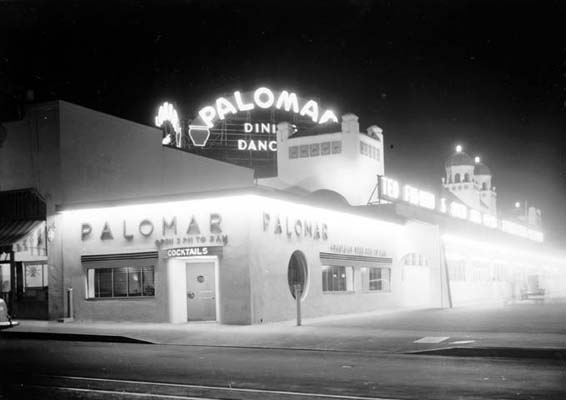
In the summer 1939 Los Angeles was a hot bed for big bands and swing dancers alike. With Artie Shaw’s Orchestra on the bill, the Palomar Ballroom on Vermont and 3rd was possibly THE center of attention in the beginning of June. Upon entering the Palomar to see the great big band, dancers were greeted by promotional posters advertising the “International Jitterbug Championships” To Artie Shaws and Ken Bakers Orchestra’s ! To be held June 18th 1939 at the Los Angeles Memorial Coliseum, Cash prizes over 2,500 dollars to be awarded !!! Dancers looked upon this contest as a chance to finally prove themselves.

Excited dancers chatted amongst themselves to see who would be the favorites and who had the most confidence. Early favorites were Jimmy Renkin and his partner, and Dean Collins and Jewel McGowan. In the weeks to come dancers started practicing their routines using all the tricks in the book to help them catch the eyes of the judges. The big debate was over who’s style of dancing would suit Artie Shaw’s Orchestra, swing or lindy? Roy Damron and Snooky Bishop were favorite show stoppers, coming from Alhambra and representing their troupe, “The Alhambra Alligators.” Hal Takier and Betty Roeser, from Redondo Beach, represented the famous “Ray Rand Swingers,” which the great Maxie Dorf was also part of. On many occasions Hal and Dean argued over who would win the upcoming contest that brought so many, many sponsors under the main Palomar leadership.

By Sunday the 18th over a thousand dancers had entered the contest. People from all over the United States had made the trip; representing over 20 states and 6 foreign countries! Tensions were high the night before, and many dancers could not sleep due to nervousness, however, all they had to do was do what they did best….. just dance. Lying awake at night, dancing in their heads, going over and over the routines they had been practicing only made them toss and turn in their beds. Restlessly they awaited sunrise, which would eventually heat the summer air above 80 degrees. Morning finally came.

The trip to the Coliseum was as emotional as 5 years prior, when the Coliseum hosted the 1932 Olympic summer games. Upon entering the great structure the dancers were met by over 26,000 fans. The middle of the would-be football field held the grand 12,000 foot dance floor, with one side hosting the band stand for the orchestras, and the other side hosting the judges’ platform. The Judges were dance directors sent in by different movie studios, and as they took the platform you could see Bill O’Donnell from Warner Brothers, Hermes Pan from RKO, Carlos Romero from Paramount, Nick Castle and Geneva Sawyer from 20th Century Fox along with other dance directors from other major studio’s. With over 1,000 dancers entered in the categories of Professional and Semi-Professional, smaller divisions were put together in order to run small groups of dancers at the same time, making them work their way up the ladder to the finals.

At 9:00 a.m. Ken Baker’s band swung into gear, kicking off the first rounds. The temperature was in the 70’s and rising. Early on, dancers Freddie Christopherson and his sister Betty won their Division. Jake Arkon and Marion Goldytook their Divison as well, upsetting one of the favorites: Dean Collins and Jewel McGowan. Another team to win their division was Hal Chavoor (Takier) and Betty Roeser, upsetting another favorite, Roy Damron and Snooky Bishop.

After all the Professional Division first rounds finally ended it was time for lunch and intermission while Artie Shaw’s Orchestra took to the band stand. As soon as Artie broke into one of his more popular songs thousands of fans broke through police lines and onto the field causing a mild riot. Dancers from the stands were swinging all over the huge dance floor and not until they returned to their seats did the contest continue.

The Finals finally came in the late afternoon. Under the 80+ degree Southern California sun, Artie Shaw’s Orchestra played away as the division finalist danced against each other at the same time. At 6:00 p.m. the event came to end as the dancers’ final steps made the Coliseum attendance applause with approval.

The Awards Ceremony was next and was held at the Palomar Ballroom. Starting with the Navy Divison, the winners were Danny Stephenson and Annabelle Hoffman. The National Champions came next: Herman Harrison and Ernestine Davidson, a black couple from Los Angeles who had the crowds roaring with laughter when Ernestine, who weighed nearly 200 lbs, went through their airsteps and routines with her partner Herman, who hardly tipped the scales at 100 lbs.

At last it was time to announce the winners of the Granddaddy of them all: The International Championships! First came the runners up: Hal Chavoor (Takier) and Betty Roeser, “The Spanish American” champions known for their fast foot work and ability to put on a good show at mach speed. Then the Big Winners were announced……… Jack Arkon and Marion Goldy from Los Angeles. Jack and Marion lived in the “Miracle Mile” area of Wilshire Blvd. and had localized many of the favorite spots in L.A. since the mid 1930’s. Winning the International Jitterbug Contest lead them to perform in Ken Murray’s, “Black Out,” and at the El Capitan theater to name couple, not to mention appearing with Artie Shaw’s Orchestra and the other winners in the weeks following the contest.

This day in history is now nothing more than a few rare, fragile, and yellowed newspapers gently tucked away, and an old memory that only a few alive can share. The Coliseum is vacant of fans and Mr. Shaw doesn’t play the music that used to move the feet of dancers. Well, at least this event did take place, although long ago, and it gives us all something to dream about as we drive past the Coliseum: the biggest Jitterbug Contest in history……

Images of the Swingeroo

One of the difficulties of researching about this event is while it was held in the Los Angeles Coliseum, it was sponsored by the nearby Palomar Ballroom so some resources (to my personal belief) have incorrectly labeled pictures as at the Palomar Ballroom for the same event. Below are some photos from the Los Angeles Public Library Photo Collections of what I believe to be from the event.

1939 (Notice the shag in the background)
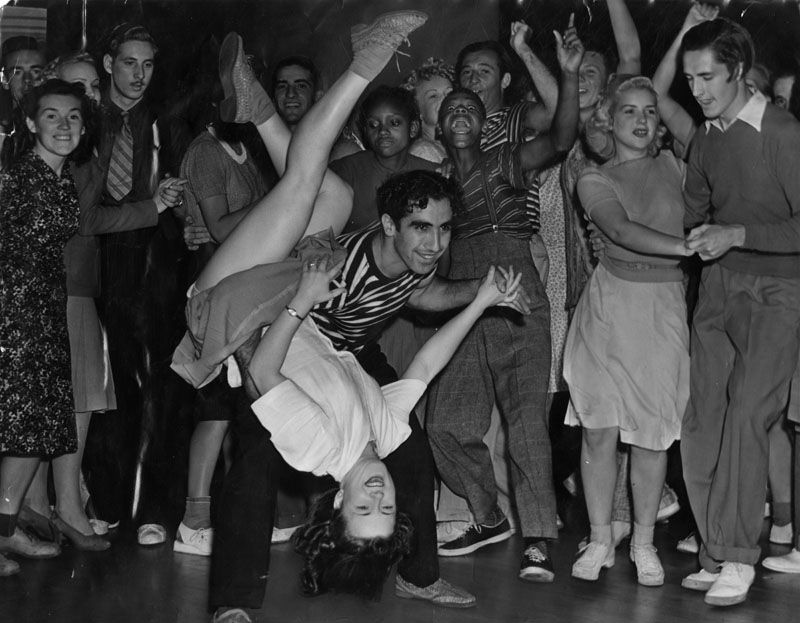
Out of this world" hep-cats, the best in the U.S.A. and six foreign nations, are "jamming" Los Angeles for an International Jitterbug convention. Photo shows Hal Chavoor (Takier) and Betty Roeser, Pacific Coast champions, "going to town" as fellow swingsters admire. Photo dated: 1939.
1939 - Notice the Kansas sign, people from all over the United States attended this competition.
Hal Chavoor and Betty Roeser, Pacific Coast champion jitterbug dancers, are shown when they qualified for the International Jitterbug Championship to be staged at the Coliseum. Photo dated: June 9, 1939.

Perspective

Here are the following square feet measurements of several iconic ballrooms associated by swing dancers across the United States:

  • Avalon Casino Ballroom (California): 10,000 or 18,000 sq. ft (I’ve seen it listed differently on several sites)
  • Palladium Ballroom (California): 11,200 square foot (Now called the Hollywood Palladium)
  • Glen Echo Spanish Ballroom (Washington D.C.): 6,500 sq. ft
  • Century Ballroom (Seattle): 2,000 sq. ft
This contest was held on a 12,000 sq. ft dance floor set up at the Los Angeles Memorial Coliseum, with a crowd of 26,000 people! Most national/internationally recognized competitions are lucky if attendance breaks 1,000 people these days.
1959 - Red Sox vs. Dodgers at the LA Memorial Coliseum

The first time I encountered the Los Angeles Memorial Coliseum was oddly enough several years before I started swing dancing when I was a member of the rave community in southern California. At an event known as the Electric Daisy Carnival, I remember walking through the main gates and stopping of awe of the vastness of the crowd and the size of the coliseum, it was simply breathtaking.

I can’t even imagine walking through those same gates, hearing the legendary Artie Shaw performing with his full orchestra, and having come into view a massive dance floor with some of the best swing dancers in the world like Dean Collins competing while tens of thousands of swing dancers cheered them on.

Sadly on wikipedia and websites documenting the history of the Coliseum does not list this event. It is not mentioned in lieu of the Olympic and football related merits of the place. However I am sure to all who competed or watched that day or to those of us who have a curious interest in swing dance history, The Swingeroo has meaning.

References 
  1. Los Angeles Public Library Photo Collections, http://digital.lapl.org/
  2. Jitterbuzz.com http://www.jitterbuzz.com/thifor.html
  3. Swivel Magazine’s Website, Peter Loggins’s article The Biggest Contest, http://replay.web.archive.org/20001008151248/http://www.swivelmag.com/swivel_home/dance/biggest.htm

A Good Fit – Venue Atmosphere Choices

This past Tuesday I visited The Green Door, a swing dance venue in Carlisle, Pennsylvania with four friends for their “Song Request Night”. For a dollar donation toward a charity, one could request a song for the night. A bunch of friends from York/Lancaster came out and fun times were had all around. However the way the night went down picqued the idea of redefining my definition of ‘What is right for a swing dance venue/organization?’, but before that I have a slight backstory.

Warnings  

When I first started swing dancing about three years ago I asked the president of the PSU Swing dance club at the time what venues were around us if I wanted to dance on the weekend. He mentioned that the Green Door existed and that he placed in a Jack & Jill there, but to never go there. Now I do not usually like talking about places in a negative light but this backstory has a point, most of the venues in central Pennsylvania (with the exception of one) have always had the stigma here at Penn State from previous leadership that “If you want to travel go to a big city like Philly/D.C.  or else deal with bad music and low quality of dancing.”

I will candidly admit I have reinforced that myself with venues in the past in Pennsylvania and California using terms like ‘neoswing/groovy music’ and ‘east coast swing’ in a derogatory sense. Lately I have been trying to relax my penchant for as they say being a ‘hater’, which leads me to my experience yesterday.

When In Rome

My friends and I arrived in time for the newbie lesson, because if you took the lesson there was a discount on the cover charge. This lesson happened to be on West Coast Swing, which if you don’t personally know me I think is a legitimate dance but in the modern context has divorced itself too far from its roots to be called a ‘swing dance’ anymore. Nevertheless I took the lesson, had fun, and threw in some body-rolls for good measure. The music of the night was an interesting mix though, possibly because it was request night. There was a good variety of westie-music, blues, vintage swing, soul, country, top 40’s songs, and a waltz. What was fun to notice was completely different groups of dancers were out on the floor depending upon what was being played. Irregardless though everybody seemed to have a fun time and i’d say the night was a success.

For anybody who knows me personally they probably did a double take after that sentence. “Wait, he went to a venue that they taught westie, played for a good portion of the time non-traditional swing dance music, and didn’t complain about the experience to the point of excess?”.  The answer is yep, I enjoyed my dances to the vintage swing music myself and friends requested and just goofed around to everything else.  While it was not my picturesque idea of a swing dance venue, it seemed everyone had a good time. That combined with a conversation I overheard outside of the venue was the spark that made me contemplate the idea of what is ‘appropriate’ for a swing dance venue.

Eavesdropping and Revelations 

When I was outdoors I overheard an older gentleman talking about how he worked to get waltz/foxtrot instruction on a once a month basis at the venue. At first he got multiple complaints of, “This is a swing dance venue!” and such. But he said after time people relaxed their complaints and let him teach and have a waltz/foxtrot song played at least once a night.

If you don’t know me personally or haven’t inferred from my blog posts, my usual definition of an ideal swing dance venue was one that only promoted swing dance, had lessons that emphasized technique, played quality music (either vintage or modern bands that are respectable like Jonathan Stout and his Campus Five), and a good atmosphere.

As a dancer I travel a lot to events in Virginia/Washington D.C./New York/Ohio/Pennsylvania. Many intermediate and above dancers on the East Coast, especially the ones who travel to competitive events like ILHC (International Lindy Hop Championships) also hold the standards I listed above. But the most important fact is, in Central Pennsylvania I am also a minority.

One of the hardest things I have had to deal with (and still do) as an instructor and an organizer is realizing that not everyone joins swing dancing to become an amazing dancer. I usually date people outside of the swing dance community and have a circle of friends outside of it, my weakness as an extrovert is I came to dance for not the same reasons that the majority of people do and therefore neglect their perspective at times.

Who am I to say that the older gentleman’s experience or the wide eye newbie who likes dancing to top 40’s experience is inferior if they are enjoying themselves? While I do dance to have fun, my main objectives of dancing these days is often improvement and to the music I have a taste for, which fortunately for myself is what is usually DJed at larger Lindy Hop events. However this is irrelevant for people who are just looking to get a little exercise, meet new people, and have fun.

Ideas to Mull About

This topic the idea of how keeping everyone happy from newbies, experienced dancers, people who like multiple dances, to only Lindy Hoppers is a problem that has been rehashed over the years several times. I have friends in the travel circuit who live in isolated areas and say they barely dance in their home scenes because their local scene is sub-par to them.

On one hand my organizer tendencies tell me to do what I can to support my local community and improve it as a whole. But on the other hand my traveling dancer tendencies tell me to just drive the extra hour to Baltimore or some other established place that caters to my tastes.

While I try to promote the ideas and standards kept by my peers in the international swing dance community, as of late I have been coming to the realization that maybe not the best swing dance atmosphere is one that maintains that, but addresses the needs of the community it serves.

How to balance those two is something I struggle with. I’d love to hear any comments or thoughts any of you guys have.


Charm City: My Foray Into The Baltimore Strut

Urbandictionary.com’s top rated post describes Baltimore as,

The greatest city on earth. Sure its a little dirty, but thats a city for ya.

Having attended Boston Tea Party the last two years and ILHC last year, I can tell you the Baltimore swing dance scene is a force to be feared and loved. (Still debating if I am afraid how much I love them, or love how much I am afraid of them.) From streaking through dance floors, throwing epic parties with Albuquerque, to entering contests en masse, they always bring energy to wherever they show up.

Incentive to Strut On Down

Michael Seguin originally posted via Facebook that folks coming down from Philly this past weekend would only have to pay 5 bones (dollars) for cover to see the Boilermaker Jazz Band.  Realizing that State College is an additional 1 hour and fourty minutes away and that I am a cheapskate, I asked if we could get the discount as well. In his infinite generosity, he decided to grant all Pennsylvanians and Delawarians the discount. Afterwards I rounded up four other friends and by Friday afternoon we were off for our first foray to the Baltimore Strut.

Baltimore Strut

The most difficult thing about the night was actually finding the venue, which they affectionately refer to as “a dive”. The Dance Rink is no Spanish Ballroom, however the place has character (and unisex bathrooms). A quote I got when asking about the venue I think does the place justice,

“It is a weird, funky space, but Baltimore has the energy these days!”

As promised, when we got to the door we were only charged five dollars and there was ice cold water and soda. The Boilermakers as usual did an excellent job, they kept the energy levels up and dancers excited. I particularly enjoyed their performance of the Benny Goodman classic, “Goody, Goody“. Also kudos to Sarah Sullivan who also spun some good tunes during the band breaks.

After the band was done playing, they did something I usually strongly disagree with, which is play non-swing dance music. However in the case of the Baltimore Strut, it oddly meshed really well with the event’s personality and I didn’t mind it at all. Even danced a few of the songs myself.

Blues Kickin’

One of the highlights of the night was the contest the strut put on, which was a “Blues Kicking” competition.  If you are unfamiliar with blues kicking, an excellent example is below at 0:56:

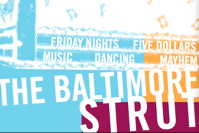
Luke Albao was the judge, who was in great juxtaposition to the venue was impeccably dressed. For the final judging, there was a soul train to the song ” Bad Romance” by Lady Gaga in which Luke gave a thumbs up or thumbs down via a chicken wing he was eating who were the winners. The mayhem promised in the promotional logo was delivered, winners recieved a free copy of the Boilermaker Jazz Band’s new CD “Nice Work If You Can Get It”.

What I Took From This

The Baltimore Strut is like that back alley, family owned, Chinese restaurant that you love. Sure the location may not be the best or meeting health code regulations. But the place has character, family sense of pride and togetherness, and is bloody delicious.

Benny Goodman Radio Broadcasts

Lately I have been on the hunt to find recordings of live performances by swing era jazz bands for my personal collection and for DJing. In that hunt I have stumbled on what I consider a treasure trove of live recordings, at this link:

http://www.imaginaryplanet.net/weblogs/idiotprogrammer/2010/06/free-legal-benny-goodman-mp3s/

Before and during WWII many jazz artists like Benny Goodman and Glen Miller did live broadcasts on the air. While amazing, unfortunately if you wanted to DJ any of this stuff you would have to self edit the songs in between annoucements and commercials from companies like Camel Caravan.

However the folks over at http://www.archive.org/ were kind enough to edit and in most cases label songs from many of Benny Goodman’s broadcasts during the WWII era.

While some of the songs due to recording technology at the time are probably not the best to DJ at certain venues, one can appreciate the different feel these live recordings have from recording sessions.

If you plan to use the blog linked, my recommendation is scroll down to “More Free Benny Goodman MP3 Compilation Downloads”.  To quote the blog’s suggestion,

Benny Goodman (unspecified 795 10 songs without names!) The amazing thing about this one is that it contains 10 live broadcasts of 30 minutes each from Manhatten, presumably in 1937! All are commercial-free  except the last one (Camel Caravan).

The best part of this all (at least according to the blog), all of these are free and legal! If you have any suggestions for other live recordings, please comment below. Otherwise, enjoy!

LA: Back In The Day

A few days ago I wrote a post about a flier which was handed out as part of the efforts to quell the tensions during the “Style Wars” in the late 90’s/early 2000’s.

However without context it is a far reach to not see the people getting involved in this debate without seeming a bit loony. So to help put you in the shoes of a late 90’s LA swing dancer I have this article written by John Cooper for Swivel Magazine [1].

I Did Derby

I DID DERBY
by John Cooper
As it appeared in Swivel Magazine

“Derby.” “Derby.” “Derby.” If you live anywhere near the United States and you like Swing, you’ve heard of The Derby, right? And if you live near Los Angeles and like Swing, you’ve been to The Derby, right? Wrong! Some of us just have never made it over. I mean, come on! I live seven entire miles from the place! Yet I can’t just zoom over there in five minutes! It’s gotta be a fifteen minutes drive easy. So, anyway… every swing lover/swing dancer of legal age I know has been to the Derby… EXCEPT ME!!! That is until this past Monday night when I became Derby de-virginized. It went something like this…

Mora’s Modern Rhythmists, the Monday night house band at The Derby was having their new CD release party that evening. Since I wrote the liner notes to Dean Mora’s new CD, I wanted to be there for the big occasion.Yes, I’d meant to go numerous times in the past, but stuff happens. I mean we all know stuff happens.

So… I announce to my friends that I’m going, really going this time, and I go. Monday is always a zonky day for me and I almost skipped it, but when I got home, I had an e-mail from Peter Loggins that said simply, “Monday.Mora.Derby.Be There.” So I go.

I motor over. I know where it is. No mystery. I cruise on down Los Feliz Blvd. I make a left on Hillhurst. WOW! Better than a pretty woman: two beautiful parking spaces right on the street! And I maneuver my land yacht right into the loading zone. I knew it was too good to be true because I’ve lived in Los Angeles to long to believe in the power of positive parking. I cruise out of the Fool’s Paradise and just guide my machine into the parking lot.

I eyeball the place from the outside. I walk around the building looking for the entrance. Not that door, that’s a restaurant. Not that door, that’s an exit. How do I gain entrance? I do 360 degrees around the building. Look! Up that flight of stairs! People! I walk up the steps that have measured a million swing feet. I announce myself. I am in!

Now… I had no notion of how the place would look. I just knew that the dance floor in the main room was considered small and the back room was off to the left as I would enter. I went to the right to the main room. Oooohhh! Pretty nice! A big circular bar dominating the room. A vaulted ceiling. The band stand at the opposite end of the room. Nice. I head out to take a look at the back room where the Lindy lesson is already in progress. Erik and Sylvia are at it again. The room is packed with ‘progressing’ Lindy Hoppers. Even as I lean against the wall, I am in the way of several rock steps and the humidity is killer in there, like a night in the tropics. I exit back to the main room and stake out a choice seat at the bar. I order a delicious Mai Tai. I see Dean Mora setting up his men. I saunter over and say “Hi.” Friends and people I know are beginning to arrive. They either see me or I see them.Handshakes, hugs and dropped jaws are the order of the evening. “You’ve never BEEN here before?” No. “I’ve never SEEN you here before!” First time. And on and on.

Soooo many people I know are there tonight for Dean’s CD party. We meet and greet. Peter and Lisa. Debbie and Darren. Rusty Frank. Chuck Cecil. Lisa Johnson. Tip and Holly. Hilary Alexander. Jeff Beauregard. Nicole and Bill. Hey! There’s Chekov from “Star Trek” out there! There’s famed movie swing dancer John Mills milling around! Then… an announcement by Dean Mora, and his Modern Rhythmists tear into a track from their new CD and the party is underway!

The dance floor holds a dozen or so couples comfortably. Most every one is doing Hollywood style Lindy and/or Shag. Dean’s snappy band and attire make the room glow almost as much as the perspiration on the foreheads of the pounding feeted patrons.Very few posers here on Mondays, it seems. Just people into the dancing and into the music. Real music! ‘Quality Shout.’ Oh, yeah!

After an hour, the second set begins with more (A) great music and dancing. More people I know have arrived. There’s an Australian TV crew wandering about and shooting Erik and Sylvia on the dance floor, while Dean Mora jovially suggests to the camera crew that they would do well to get him in the shot, too.

Soon, Dean is giving away CDs to patrons who can answer Swing history questions. If you don’t know Duke Ellington’s first name, you lose. If you know where the Palomar Ballroom was in Los Angeles, you win. If you don’t know what band was playing there the night in 1939 when the Palomar burned to the ground, you lose. (By the way, in order: Edward, between 2nd and 3rd on Vermont, and Charlie Barnet.)

Another hour passes into Derby memory. Peter Loggins and I exchange money for Jan Savitt and Charlie Barnet records. I eye a stack of “Swivel” magazines to take back to my store. Mora’s Modern Rhythmists are cracking like a whip. The Swing and the good feelings engulf the room.There’s Rory. There’s Adrian. There’s Minh. There’s Shawn and Cassandra. There’s Morris. All real people doing real dancing, not posing, to real music. You saw “Swingers?” Forget it! It’s a hoax! It’s not ‘money’ (What a fake-a-roo phrase that was.) This is the real Derby, at least on Monday nights. Men and women who take the time, trouble and expense to dress ‘vintage’ and to learn an established form of dance properly and devote themselves to it, not obsessively or stupidly, but out of love and a sense of sheer joy.

I stayed until the end, but even the ‘end’ was not the ‘end,’ for the dancing continued even after the Dean and his men had packed up and left. Moves were practiced, stories told, dances danced. Plans and partings until tomorrow or the next time. Hugs, kisses, hand shakes and promises of more visits. “See? I TOLD you you’d like it!” The dude was right, I did.

Unfortunately I never had the privilege of dancing of dancing at the Derby in Los Angeles. However you ask any dancer of 5+ years in California about the Derby (or Old Memories/Monsters of Swing) they will have a gleam in their eye as they spin a few yarns.

The Derby was simply legendary at the time, even “Swingers” director Doug Liman wrote in an LA Times interview [2],

Though no film could ever do the Derby justice, I am proud to have been part of a film that will continue to invite people into that magical world frozen in time. – Doug Liman”

Socalswing

An amusing tripod site, http://socalswing.tripod.com/ was the precursor to the forum JiveJunction which for awhile existed as Yehoodi’s rival forum until mysteriously disappearing becoming Ruben Browns personal homepage.

The site has some interesting sub-pages that offer insight into the culture of the late 90’s/early 2000’s Southern California swing dance scene. One that caught my attention was a page (http://socalswing.tripod.com/youmightbe.html) listing offshoots of a popular joke “You might by a (insert noun) here if….” modified for the So Cal swing dance scene. My personal favorite was, “You might be a Hollywood style Lindy Hopper if….”.

Some of the winning ones in my mind were,

  • the faster the song, the better.
  • you can’t hear the “clang clang clang” section of a certain Andrews Sisters song without picturing Jewel McGowan swiveling.
  • you become convinced that someone requesting “Zoot Suit Riot” at a Bill Elliot show is one of the seven signs of the coming apocalypse.
  • you can walk into a club full of 400 people and say, “There’s no one to dance with.”
  • you have come to realize you will never win a contest again as long as Josh & Theresa, Minn and Corina, and Jeremy and Debbie are in it.
Another unique page was The First Church of Lindy Hop – Los Angeles Congregation. I could try to explain it as part insight to the obession with Hollywood style Lindy Hop, part inside jokes, and part good old fashioned So Cal craziness. However I recommend you take a look at it yourself (http://socalswing.tripod.com/church.html). The fact that there are links to two other defunct congregations in Orange County and Riverside, delights and scares me at the same time. A sample of the fun collections of writing on this page is as follows,

Matthew 7:15, Beware of false prophets, who come to you in vintage clothing but inwardly are flaming West Coasters.
-Guru Reuben

Even though I have given you a small taste of what it was like back then my advice if you want the whole picture is talk to someone who danced there. I promise you most of them will be more then happy to talk your ear off with stories about Monsters of Swing, The Catalina Jazz Dance Festival, Old Memories, and et cetera. I’ve just given you a small glimpse into a much larger picture.
Big Bad Voodoo Daddy at the Derby

Footnotes:
[1]. Originally posted at swingorama.com the San Diego swing dance forum. http://www.swingorama.com/sd/viewtopic.php?p=38063&sid=79d204e314e25d54ddd202a31c1fd2d0 

[2] L.A. times article written 2009 The Derby in Los Feliz likely to close soon http://latimesblogs.latimes.com/music_blog/2009/01/the-derby-closi.html

Hollywood Style Swing Flier

“What style are you?” was a popular question that was asked instead of “Would you like to dance?” back in late 90’s. Ask any old-school dancer about “The Style Wars” here in the United States and you will probably elicit a groan that will reach Herrang Dance Camp in Sweden.

I won’t rehash the details here, but Jerry Almonte has a nice article in his Artistry in Rhythm series, in his blog Wandering and Pondering that touches the issue. Yehoodi like always, has a post about the style wars.  Bobby White even lampooned it in a Jam Cellar email, coining the term Savollywood.

Savollywood: (SUH-vol-lee-wood) (ProperNoun): A failed late-90s amusement park where all the men were given baggy cargo pants and newsboy hats, and women went on rides that took them through twelve-count side-passes and half-assed whips. – Bobby White

For the longest time I was looking for a picture of a flier handed out at some workshops in the early 2000s which had a great explanation of what Hollywood Style was all about, but to much avail could not find it. Recently I stumbled upon and I am putting it up so, hopefully it will not be lost again.

A key point that Jerry noted about Hollywood Style, is it was not just a dance style but to some people a life style. Hence why for some people, emotions ran high over people who may have criticized it. Katy Perry who is not as well known for her teenage hobby, swing dancing writes in this interview,

“I used to go swing dancing, Lindy Hop style at the Santa Barbara Rec Hall and I would be taught by seasoned dancers, involved in the scene. They were like rockabilly but not as annoying. These girls would get out of vintage Cadillacs, wearing pencil skirts, bullet bras and cardigans. “

This flier, among other things were an attempt to get people to spend less time debating about how to dance and more time actually dancing.

However as usual  the community moved onto arguing about newer topics such as should follows wear or not wear heels? the merits of Wiggly Hop Groove style Lindy Hop.

Jerry also noted in his blog post, Poke Alex probably sums up the aftermath of the whole “Style Wars” best in this post on yehoodi,

Yeah, if I remember correctly nobody “won.” I think for the most part people realized that not only was the battle stupid, it was really about nothing.

Erik & Sylvia originally coined the “Hollywood” term as a buzzwordish way to identify the style that they taught and pay homage to the fact that they borrowed a lot more from Dean Collins and his gang than from Frankie Manning and his.

Then a bunch of idiots (read: Lindy Hoppers) decided that “Hollywood” equaled “Dean Collins”, and therefore “Savoy” equaled “Frankie Manning”. Furthermore they inexplicably decided that not only were the styles completely 180-degrees different from each other, each with its own technique and feel, not just in the movement but in the lead and follow. The real kicker was when everybody decided one was inherently better than the other.

How it all got to that point is a mystery along the lines of Stonehenge or crop circles.

Anyway, a couple of years later it all finally wound down. Justin and Jenn in particular were instrumental in that, by carrying around to their workshops a video they made that showed both Frankie & Dean, side-by-side, in the same position relative to the camera, doing swingouts at the same speed. They were able to demonstrate the lack of difference in their technique sufficiently for some people to quiet down about it. Eventually the whole debate just cooled off and vanished.

Nobody could win because there was no real argument in the first place. – Poke Alex

Ability to See the Picture: Visual Learning

Visually Learn (Swing Dance Definition): The ability to learn something in swing dance via one’s own sense of vision. 

People Who Can Learn How to Dance V.S. People Who Need Dance Instruction

“Eyes are more accurate witnesses than ears” - Heraclitus of Ephesus

It is a strong belief of mine that when it comes to being a swing dancer, once of the skills that separates people who can learn how to dance and those who need dance instruction is the ability to visually learn.

Besides being the main avenue of dance instruction back in the actual swing era, there are many advantages to acquiring the skill of being able to virtually learn. One of the advantages of acquiring this skill is in group lessons you can understand material at a much faster rate then people who need to wait for descriptions will require. In addition you may pick up on stylistic variations the instructors are doing and possibly details about the move they are not mentioning for time/simplicity reasons.

Another advantage of improving your ability to visually learn is not being limited to group/private lessons & instructional videos as avenues to learn. Your learning avenues expand to your fellow dancers at your local scene, your peers in the swing dance community on youtube, and vintage clips of dancers back in the 20’s-40’s. Anything you can watch, can potentially become yours. You become your own teacher and responsible for learning.

Hal Talkier, being awesome as usual.

Lastly, when it comes to learning choreography (which some people dread like the plague) it gives you a serious edge in understanding and storing the material. On a personal note I notice people who tend to struggle with choreography are also those who tend to have trouble visually picking things up and require the instructor to repeat which moves, with what counts, happen after what moves.

Jeremy Otth, utilized visual learning well with Hal's dancing. As well as Laura Keat with Betty's.

By visually learning you; gain the ability to acquire material on average faster in group classes, notice details in the instructors body language that give you additional insight to the material being taught in classes, give yourself many additional learning resources for dance,  allows one to a certain degree become their own teacher, and helps to make learning choreography a less difficult and stressful endeavor.

How to Gain the Ability

The trick to getting better at learning things visually is as you probably guessed, repetition of attempting to learn things visually. It is not something that one can get overnight and like all skills is something to be refined and maintained with practice.

There are some tricks to getting better at visually learning though and pitfalls to avoid. One of the rookie mistakes a lot of people make is they only watch the footwork. Watch how the body moves, often there are subtle clues on how a movement operates, the legs and feet usually just follow from the origin of motion there. In addition when you watch, pay full attention. Even in group classes when an instructor is demoing something, until they say to try it, don’t jump the gun and try the move at the same time. Instead watch carefully and try to visually absorb every detail they are presenting through their motion. When you actually attempt the move, most likely it will come a lot easier.

If somebody was to take one thing away from this I would say, listening is important however make sure to watch as well.

Things That Make Me Facepalm (As A Swing Dancer)

So I was reading a topic on yehoodi today that made me just mentally facepalm when I read one of the responses. If you are unfamilar with the term facepalm, according to wikipedia it is defined as,

A colloquial term referring to the physical gesture of striking one’s own face in a display of exasperation. It is similar in function to a sigh. In Internet discussions, the term is used as an expression of embarrassment, frustration, disbelief, disgust or general woe. It is also used when the person making the gesture does not believe that words can express the level of idiocy.

Normally I am a pretty easy going guy, however like everybody certain things make me simply boggled with how people do certain actions.

However this is a personal list of pet-peeves/things I find moronic when i’m out and about swing dancing.

1. Constantly Talking Trash on Other Dancers

This is bad enough because it shows you aren’t a polite person. However, I have found in 99% of cases that I run into these people they actually tend to be bad dancers as well, which then strays into the realm of being a hypocrite. I’ll never forget one of the worst first impressions someone ever made on myself is when one person approached me talking trash about the non-amazing dancers at a venue.

2. Making Up Swing Era/Dance History

Unlike a college exam where making up information on the spot might get you some partial credit points, when talking about history in relation to swing dances/the swing era you get no points for at best telling partial truths, at worst making up false information. “I don’t know” is always a better answer then spreading misinformation.

3. Doing Aerials on the Social Dance Floor

Aerials have a few places such as jam circles, performances, and competitions. Right next to my face when I am trying to lead a swingout on the social dance floor is not one of them. I have been trying to be more pro-active about this and I encourage everybody else, if you catch someone doing it politely say something. Most venues have strict anti-aerials on the social dance floor rules, so you can always start the conversation with the excuse you don’t want them to lose their cover charge for the night.

4. Constantly Claiming To Wanting to Get Better, Then Doing Nothing About It

If I had a nickel for every time I have heard someone claiming they wanted to get better at swing dancing, I could probably afford to go to Herrang. I am though a firm believer in the idiom, talk is cheap. I wish I could save many newbies from the $40-$120 private lesson where they expect the magic secret on how to become amazing and tell them one of the biggest secrets to getting better at swing dancing is called consistent practice. People can talk about how much they want to be a better swing dancer and then give reasons of why they can never make it out dancing, but that isn’t going to make them a better dancer. It is actually more likely to make me think of them as lazy and whiners.

5. People Who Insist Late Night Music Must be Slower.

I have no problem with people saying, “Well this area has people who are really into blues dancing, so we play it later on to make them happy.” However something I have gotten from a few DJs and people in certain blues heavy scenes is, “Well when it gets later the music just has to slow down” citing people get tired or worse that its common practice.

Newsflash, what do all these events have in common: ILHC, Camp Hollywood, Boston Tea Party, Hawkeye Swing Festival? Answer, they all feature music you can Lindy Hop to with a decent BPM count after midnight.  I assume when people say late night music has to be slower it is because either they don’t travel much outside of their local scene or they forgot to advertise it was a blues night.

After Hours

Well I am going to end this post with some videos of fast dancing after midnight for the potential haters out there.

DJing for A Collegiate Shag Event

So this past weekend the Penn State Swing dance club threw a unique event, Shagception a full two days of Collegiate Shag workshops taught by David and Chelsea Lee from Washington D.C.

It was a fun weekend which I intend to write a more in depth post about later, but for now I wanted to write about a problem I seriously had to deal with with preparing for this event. How do I DJ for a Collegiate Shag event?

Preconceived Notions

Before I started contacting people my only preconceived notion for what to DJ for a Collegiate Shag event was from Camp Hollywood Shag division competitions I witnessed personally. Namely 2009 where they played Everybody Loves My Baby by Glen Miller and 2010 where they played Oh Lady Be Good! by Artie Shaw. In addition to that I had the All The Cats Join In, Disney short featuring music by Benny Goodman [1] and the song Mr. Ghost Goes to Town from the classic Arthur Murry Shag clip.

Yehoodi Lends a Hand

First thing I did was as usual use the search function in Yehoodi which come up with the topic: “Balboa-Collegiate Shag Music for Practice?“. One useful quote from the topic was,

You need a narrower range of tempos for shag. For shag, on the low end 180 and up. There are some songs that I particularly associate with shag. “All the Cats Join In” Benny Gooodman, “Lady Be Good” Artie Shaw. These are good ones to practice to because they aren’t too fast. As you get more comfortable try practicing to a version of Bugle Call Rag which is on the higher side of the tempo range. – Lamar

So from this I gleaned that for songs that are danceable for Collegiate Shag its probably more comfortable to go 180 BPM. As I have learned personally through trial and error, it is awkward to try to dance Collegiate Shag to slower tempos. Another useful quote was,

I feel shag in songs that have a strong “bounce” rhythm, although you shouldn’t have a huge bounce in your shag basic. – Capt Morgan

I’ve heard this described by different dancers as a “chug” rhythm, a solid four beat or in this case a strong “bounce” rhythm.  For me what this meant was stay away from small group combos and songs that have long periods of dragging out or solos with the rest of the band not coming back in.

SwingDJs.com Helps Out As Well

Another useful resource was a thread titled “Collegiate Shag Please?” on swingdjs.com. One thing I noticed is Artie Shaw’s music is mentioned several times in the thread with recommendations such as “The Carioca”, “The Man From Mars”, “Diga Diga Doo”, “Back Bay Shuffle”, “Free Wheeling”, and “Bird Calls”. What I inferred from this is Shaw tunes are considered a safe bet and will get people out on the floor for Collegiate Shag, similar to how Lavender Coffin will put life back into a dead room at Lindy events (in spite of it being overplayed at times).

An interesting comment from Capt Morgan was,

Collegiate Shag is a dance from the 30’s, and is inherently connected to the music of this era (more so than Lindy Hop). Dancing to Neo-Swing, or Rockabilly, or Bebop just doesn’t fit.

Lorenzo, a Los Angeles swing band musician notes,

I picked some of the songs listed below for the preliminaries of a Collegiate Shag contest, after a discussion with Sailor Mike Mizgalski (two time NJC Shag Champion). The general guideline to pick a good Shag is to look for a bouncy feeling.

Cheers,
Lorenzo

Steamboat Bill, Mora’s Modern Rhythmists (1996) – 200 bpm
Darktown Strutter’s Ball, Sidney Bechet (1945) – 220 bpm
Too Wet To Plow, Cliff Bruner (1944) – 230 bpm
You Just Take Her, Bob Wills (Tiffany Transcriptions 1947) – 210 bpm

Again I notice the pattern of staying above the 180 BPM mark and a consistent rhythm through out most or all of the songs listed.

With a Little Help From my Friends

Unfortunately I did not save the exact transcriptions of the advice (with the exception of Morgan), but Augie Freeman, Morgan Day, and David Lee all helped to provide insightful advice that I shaped my playlist around.

Jonathan Stout as usual laying down a solid rhythm.

Something that Augie mentioned that was particularly useful was not to keep the tempos blazingly fast the whole night. Which I did try to keep that piece of advice in mind for my playlist.

Morgan wrote,

The most important thing is to have a really strong “chug” on every single beat.  Personally I stick with music by Jonathan Stout.  A good range is 170 – 200 bpm for lessons.  If you teach too slow, people won’t get the feeling of shag.

Again the reinforcement of two concepts covered previously in Yehoodi and swingDJs.com.

Difficulty of the Crowd

One big issue I had was I had three very different type of attendees to please for this event:

  1. Ridiclously good Collegiate Shag dancers who were all in this competition.
  2. Newbie Collegiate Shag dancers who in many cases had 1-4 hours of instruction that day.
  3. Random dancers who showed up to the dance who have no knowledge of Collegiate Shag.

So my compromise was play tunes with a really solid “chug” rhythm but try to hug around the 180 BPM range. I threw a few faster ones in the for the advanced dancers like Rigamarole by Mora’s Modern Rhythmists and Digga Digga Doo by Jonathan Stout and his Campus Five.  I also threw in Eddie Lang’s Dinah for those who may have been intimidated by the consistent 180+ range at I stayed at for my set. In addition I included Django Reinhart’s I’se A Muggin because of its laid back feel and the fact I knew there were a few Balboa dancers in the room.

Overall

While in retrospect I would have tweaked a few things with my set, I think it went over fairly well. Two songs that worked fairly well I think that I haven’t seen recommended for Collegiate Shag in the past was Caprice XXIV Paganini and King Porter Stomp, both by Benny Goodman.

If you have DJ’ed for a Collegiate Shag event or have opinions on the matter as a Collegiate Shag dancer I would love to hear them, the more resources we have on the topic the better.

Footnote:

[1] If you DJ All the Cats Join In, unless if you have a ton of newbies my personal opinion is stick with the non Disney-version. The reason why is the Disney sound effects cover up a very beautiful piano solo.