Starcraft II and Swing Dance

Contrary to popular belief I do have other hobbies besides swing dancing. At the great peril of forever shattering a potential image of myself as a hip guy, one of those hobbies is the occasional playing of Starcraft II an online Real Time Strategy game.

Now many of you are probably thinking, “Great, its cool you are a dork that plays video games. What the hell does this have to do with swing dancing though?”

Starcraft II and Swing Dancing both…

  1. Have a competitive aspect in which there are level tiers of competition (Bronze, Silver, Gold, and et cetera for Starcraft/ Novice, Intermediate, Advanced, and et cetera for Swing Dance).
  2. Has regular events where participants match their skill against each other and top participants are rewarded with prizes.
  3. Is the catalyst for a large sub-culture that if one is not a participant they can be completely ignorant to the fact that it exists.
Now I know some of you may think,  “But swing dance is an art, how can people take this ‘game’ so seriously.” I would like to list the fact that many of the top Starcraft II players charge just as much if not more for private lessons then what the top dancers in the Swing Dance world do.
Parallel Worlds 

Finding the parallels through these at first seemingly unrelated areas brings to mind an article written at Joy In Motion titled, “Social Dance as Game“.  They write,

“Every dancer must begin with the basic rules and structure of the dance before they can progress to intermediate and advanced concepts. Even through the advanced level, however, there is a basic structure that must be maintained in order to make communication on the dance floor possible. This structure, instead of stifling the creative flow, actually provides greater opportunity for expression and creativity in the dance.”

Starcraft II holds these same requirements as well. Many inexperienced players will look for quick strategies to ensure victory to ensure a win (6 pool/cannon rush for you gamers out there, non-gamers this is the equivalent of a drape or pretzel), when their macro-management (macro) or as swing dancers call it “technique” is what is holding them back. I’m betting there are a few people out there in the past who have asked a more experienced dancer why is move X or Y not working to find out its because of a technique issue that you learned in your first swing dance lesson. I know that happened to myself when I was learning how to lead an eagle slide socially.

All out war in Starcraft II

The interesting thing is if you read a well-established guide on how to improve at Starcraft II, like Randy Gaul’s article on Team Liquid “How to Improve at Starcraft II 1v1 Efficiently” a lot of the material can easily be applied on good advice on how to improve at swing dancing.

A great example of this is from the section, “Goals and how to achieve them”. I’m going to first post the part which is directly quoted from the Starcraft II guide.

You’re never going to get anywhere if you don’t know where you’re going. Similarly, you’ll never get to where you’re going if you don’t know how to get there. In order to achieve a goal, you first of all have to have a goal. So now ask yourself what your goals are going to be with StarCraft II. Be both realistic and decisive.

So, once you have your goal in mind you can continue reading the rest of this guide. Until then, you must
stay in this 2.02 section until you can continue. If you are stuck, perhaps the following may help you
brainstorm: […]

  • I want to be promoted into league X.
  • I want to become a high level professional player, worthy of sponsorships so I can play full-time.
  • I want to win a few specific local tournaments so I can enjoy the prize money!
  • I want to get into the top 500 players of the ladder on the server I currently play on.

Now, here is a modified version of the quoted part of the article.

You’re never going to get anywhere if you don’t know where you’re going. Similarly, you’ll never get to where you’re going if you don’t know how to get there. In order to achieve a goal, you first of all have to have a goal. So now ask yourself what your goals are going to be with Swing Dance. Be both realistic and decisive.

So, once you have your goal in mind you can continue reading the rest of this guide. Until then, you must
stay in this section until you can continue. If you are stuck, perhaps the following may help you
brainstorm: […]

  • I want to pass the level test into level X.
  • I want to become a high level competitive dancer, worthy of teaching so I can dance as a full time job.
  • I want to win a few specific local competitions so I can enjoy going to events for free!
  • I want to get into the be considered part of the “advanced” leads/follows in my regional area.

Goals sound eerily familiar huh?

I remember at Lindy 500, last year, during a competition class one of the instructors said something similar to, “Competition is a game, if you want to win you have to learn how to play it.” It is interesting how when I compare Swing Dancing to Starcraft II how much that statement hits home for myself.

If you have time I encourage you to read some more of the Starcraft II guide, it actually has some phenomenal ideas of the mindset for improvement. Until then though, I leave you with this quote from the guide,

So the moral of the story is: be humble and keep an open mind. If you can’t do this you don’t belong sitting where you are reading this; you belong in your lower leagues and deserve to stay there. – Randy Gaul
ILHC 2011 LED Talk: Dorry Segev on Building a Scene

A few weeks back at ILHC they had as an alternative to traditional workshop classes featured at most swing dance events. These were LED talks, short lectures that were entertaining and educational about swing dancing. (If you are unfamilar with the background format of the ILHC LED talks, you can find a description at this link.) One talk I want to go into detail about was Dorry Segev’s talk on building a scene and his experiences as one of the main organizers for the Baltimore scene.

Background Story 

Dorry first started by going into how Baltimore was several years back when there were only mainly three serious dancers in the area and they drove to D.C. to dance. Five people, three years prior to when Charm City Swing was founded attempts to start a swing dance scene failed because they tried to start a scene for dancers.

Charm City Swing & Baltimore

He then explained the idea Charm City Swing had when it was founded was to focus on non dancers instead of dancers and to have a framework designed on keeping new dancers happy.  One quote in particular that is vital knowledge to anyone who is an organizer for any dance scene or event from this part of the talk was,

“A beginners worst fear is being in an empty room and everyone is watching.” – Dorry Segev

Several things Dorry mentioned that Charm City Swing did to grow their scene were:

  • Took  full-page ads in the newspaper with such promotional messages as: “Swing dance – Fuck Yeah”, “Hot Girls Swing Dance”, or “Your wife wants you to do it. Charm City Swing”.
  •  Be approachable as possible and the organizers made a serious effort at some point of the night to dance with beginners.
  • Have Lindy Hop demos because they give beginners context of what Lindy Hop is like and where their dancing could go down the row.
  • Have jams because they congregate energy, bring people in and make them feel like they are part of the dance culture, exposes the dance to people, and inspires people to dance better/raises the bar of dancing across the scene. Dorry had a phrase for scenes that don’t have jams, “future ex-scenes”.
  • Have booze because it attracts newbies, makes people feel less apprehensive about dance, and it creates a social atmosphere.
  • Keeping the floor full, its important so newbies do not feel self-conscious.
Welcome to Baltimore.
What I Took Away From This

Creating an inclusive social environment is the main theme I got from Dorry’s talk. The method the Baltimore scene seemed to employ was get people in the door and get them to feel like they are part of the community and part of the swing dance culture as fast as possible. Why I think their strategy works so well it touches on the fact that most people join swing dancing mainly for social reasons and they stick around because they feel like they belong to something.

I am reminded myself every time I take a lesson in a new dance style is that it is intimidating being a new dancer. The more of those barriers of apprehension a scene can remove, the more likely a scene is to gain a dedicated new dancer.  Often it is the little details as well that help do this: having a late meal with other dancers after a dance, an instructor going up and asking a newbie to dance or just chatting with them, being put in the middle of a jam for a birthday celebration, and et cetera.

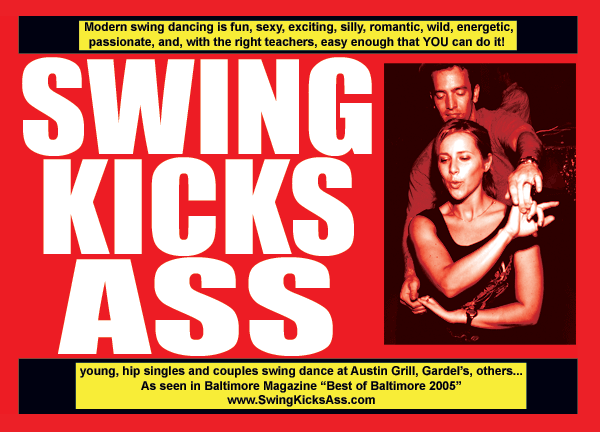
If you have stories about things that helped a scene grow or revitalize itself, please feel free to share in the comment section. I’ve shared Baltimore’s strategies with you today, because it has clearly worked for them: http://swingkicksass.com/

School of Hard Knocks

Friendliness of the instructor, its a phrase that comes up constantly when people talk about why they liked a certain instructor or even hired a certain instructor. I am myself am guilty of that. As an organizer for a college club, after the quality of teaching abilities, usually one of the big factor of why I hire instructors is if they are good fit for my demographic a.k.a. college students.

However personally when it comes to instruction for myself, I could care less how friendly an instructor is. Maybe it is because of my grandfather raised me on too many kung fu movies where a good portion of the instructors believed in hard-work, fundamentals and the school of hard knocks.

Jackie Chan practicing Horse Stance.

There is a topic on yehoodi “Meanest things a dance instructor has ever said” that the topic of how mean or nice an instructor should be comes up.  Two quotes in this yehoodi topic from Damon Stone really stand out to me, the first one is.

“I’d rather someone be direct and even mean and brutal to drive home the point. I hate being coddled. I’m an adult, if I can’t take your honest opinion I don’t deserve to have you as a teacher and probably shouldn’t be taking lessons.”

I was actually talking to my roommate who teaches violin this past weekend and seeing the overlap in musical and dance instruction. He went into anecdote about when he used to take lessons in his younger years, from an instructor who had him play what he was instructed to practice the previous week at the beginning of each lesson. If he didn’t perform up to his instructor’s standards, his instructor would tell him to get the hell out and stop wasting his time.

I chuckled and responded if I I did that in any of my classes, I would probably get the reputation as the worst swing dance instructor on the East coast. His response to that statement struck a note with me though. He commented that; the weeks he earned his teachers ire, he worked harder then ever to improve.

The second quote by Damon that stuck out to me was,

“I’m not sure I’ll ever quite get why intermediate dancers and above are sensitive about their dancing. I mean beginners are just that they want to learn enough to get out on the floor and have fun. By the time you are intermediate you should know everything you need to do that.

If you are taking lessons after that point I’d assume it is because you really want to improve, you want to be a kick-ass dancer. I can’t imagine going into a jazz or ballet, or contemporary, hell even Hip-Hop class and expect the teacher to be all sunshine and rainbows.”

Now, I think the issue at hand is differing opinions. I have had friends in my international dance performance troupe with backgrounds in ballet, jazz, and et cetera go into horror stories about how strict and demanding their instructors were that would send most people I know reeling.

But those are all instructors who see the material they are teaching as a serious art form and if you use their time, they demand respect for their experience and the material they are teaching. However, I would say for the most part not out of disrespect but being truthful, that the swing dance community as a whole are hobbyists.

In result it is often difficult to offer a class with the same serious framework like ballet or music without potentially touching some nerves or hurting feelings. Even often when I hear people talking about other dancers within the community, its usually a long list of their strengths and they are loathe to point out weaknesses.

Personally, I want someone to tell me my dancing is garbage. I want someone to point out my weaknesses and criticize me harshly about them. For me, its not the words of encouragement but these harsh criticisms that drive me more then anything to work harder on my dancing. I want knowledge, not a self-esteem boost.

Slightly Related Clip (For those of you just using my blog to procrastinate):

At 7:30 is the type of instructor I would want..

Student’s Focus

One of the biggest problem I had when I taught my first larger classes (like 50ish people) was at times getting all of their attention so they could hear what my partner and myself had to say and demonstrate.

Over the last few years, I have witnessed some instructors creatively deal with this problem in their classes which I will list below.

Teaching Tricks to get Students to Pay Attention

  • Shave and a Haircut: Described on the wikipedia page as a “7-note musical couplet popularly used at the end of a musical performance, usually for comic effect.”
    The way to use it is teach it at the beginning of the class, then you clap out the rhythm whenever you want the students attention and they respond with either a stomp-off or clapping back the “two bits” (Ba-Ba) part. Repeat as necessary.
  • One, Two, Three, All Eyes on Me: Many of you may be familiar with this from grade school, where teachers sometimes employ this. It is a simple rhyme that grabs attention. The way to use it is at the beginning of class go over the rhyme, then during class employ it as necessary. I remember my grade-school teacher would just say the part and have us students reply “All Eyes on Me”.
  • Side By Side: I actually witnessed this for the first time when taking a class from Erik Robison in California. He explains at the beginning of class when he says the phrase “Side By Side” he wants follows to get to the right of their leads and for everyone to remain quiet and watch whatever he is demonstrating. Its great because the phrase initiates movement, so people who might be zoning out catches on they should pay attention and it gets people in a position to immediately start dancing afterward.
  • Observation Goggles: I got this from watching part of one of Mike Faltesek and Casey Schneider’s classes at Jammin’ on the James last year. At the beginning of their classes they explain the importance of paying attention to the body movement (they or other people you are trying to learn from)and translating it to yourself, they refer to it as putting your observation goggles on and demonstrate what they mean. I can only explain what  this looks like with this picture:
    Observation Goggles

    Its goofy but it works like a charm, especially among a younger crowd.

What I Do Personally

Well I have liked everything, so I combine a little of it all. At the beginning of classes that it is students I am unfamiliar with, I explain I have this thing called “Side By Side”. When I say that phrase to make it easier on both parts for myself teaching and students learning I ask them to:

  1. Follows stand to the right of the lead.
  2. Please remain quiet so other students can hear what I am saying.
  3. Put on your “Observation Goggles” and not just pay attention to what my footwork is doing, but my full body movement.

I’ve found combining both of them works extremely well, at least for myself.

If you have any tricks you use in your classes or noticed other instructors using that works well, please feel free to comment about them.

The Pitfall of Patterns

“Rock-Step, Triple-Step, Triple-Step”

Most people when starting to learn swing dance can remember a certain pattern they were taught in their introductory class, usually the “Rock-Step, Triple-Step, Triple-Step” pattern.Often there is this solid framework because an issue that John White writes about in his blog post Dreyfus Model of Skill Acquisition.

In the post he comments how many novice level dances will often look for hard and fast rules for swing dancing. However as many people learn quickly (especially follows) if you try to dance within only patterns, you are only getting a small subset of the dance known as the Lindy Hop.

Positives and Pitfalls of Patterns

Don’t get me wrong though, I am not saying that patterns are rubbish and should not be utilized in instruction or on the social dance floor. They are great at providing a simple model of dance where dancers can work on fundamental technique and isolate external variables that they would normally have to deal with and could crowd out their understanding of the issue.

However the important thing to convey is in fact that patterns are simple models that are not completely representative of the actual social dance floor. Groovy Movie actually lampoons the idea that you can completely learn swing dance through step patterns here at 3:00:

As a follow if all you try to do anticipate the patterns in class, if you dance with anyone outside of that class it can easily become a difficult dance as many new follows quickly learn. For leads if you just lead patterns you learned in a class, often one can technically be on time but still be completely ignoring the music.

The difficult thing for me as an instructor in beginner classes is still providing newer dancers patterns that provide them an isolated environment for them to get down steps to at least survive one social dance, yet still attempting to provide them with instruction technique and give them perspective of where to use these steps. It is a difficult compromise that I am always attempting to fine-tune each lesson.

The struggle for an dancer who moves on beyond the novice stage is often breaking free from this framework. I remember out in California one of my biggest struggles the first summer I was out there was not defaulting to the six-count footwork from open. I had to have several nights where I completely forbid it from my repertoire and forced myself to do other things.

I could ramble on about this topic for awhile, but I’m curious to hear the rest of your thoughts. But before that I will leave you with this quote.

“All fixed set patterns are incapable of adaptability or pliability. The truth is outside of all fixed patterns.” – Bruce Lee [1]


[1] Mainly known for his prowess in the Martial Arts world, it is actually a not as well known fact that Bruce Lee was an excellent dancer as well and won the Crown Colony Cha-Cha Championship in China at the age of 18.