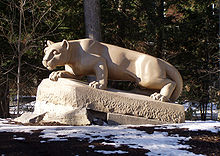
The last few months attending swing dance events as a Penn State student has been awkward and downright frustrating at times. I’ve had people literally in the middle of dances try to bring up the topics such as the Sandusky scandal or my opinion on the former coach Joe Paterno. It got to the point that when deciding what shirts I wanted to wear to dances, time would be spent pondering not wearing one of my Penn State Swing Dance club t-shirts just to avoid the potential hassling that came along with it.
At least for myself, swing dancing is at times an escapist activity for me where I can free my stresses of my daily life whether that be bugs while programming or a tragedy that has befallen my beloved town of State College and many innocent victims. Underclassmen who I teach dance lessons to on a regular basis travel with us to large events, where we are recognized as a group from Penn State. I loathe the idea of them having to deal with this at an event such as Boston Tea Party. With Paterno’s recent death, I fear that this pestering that has quieted down recently may intensify again. The last thing I want, even more then being hassled myself, is my students who to go to an event to have fun and learn from the international Lindy Hop community… to be reminded of the troubles from home.
I apologize if this comes off as a bit of a soapbox rant, but all I can ask is take some consideration before you bring up things in conversation, this goes especially for in the middle of a dance. This just doesn’t apply to just talking to Penn State students and alumni, but anyone who is dealing with unpleasant circumstances.
Recently Southern California lost a dance legend, Hal Takier. Words cannot even begin to describe the debt that the swing dance community owes this man, or how much he was cherished by his community, especially by those in Southern California.
Marcelo from yehoodi gave me permission to edit and re-post something he originally wrote on Yehoodi for Hal 90th birthday, that I think is a well-put tribute.
Hal Takier, is a man whom many (including myself) call the greatest swing dancer who ever lived.
Hal is an incredible man, full of life, insight, and wit. With his wife Marge at his side, Hal has helped those of us who have sought to learn about Los Angeles’s local history and the invention of Balboa come to discover and appreciate this amazing dance and its unique contribution to American history.
Hal’s dancing is now the foundation for hundreds upon hundreds of young dancers (including myself). We are all shameless imitators of Hal’s innovative dancing style, which combined pure Balboa with the rollicking moves of Swing:
Along with the drop seen here, Hal also invented the infamous “Merry-go-round,” several drops, and his singular three-wall flying lindy basic is now known as a “flying Hal.” Hal was one of the dancers in the famous “beach clip,” showing off his insanely fast Balboa style.
Hal was never a professional dancer like Dean Collins. He worked all his life in a rubber factory down in the southern part of LA, driving up to Hollywood to compete in the weekly cutting contests, which he won regularly (much to Dean Collins’s dismay). He belonged for a time to the group the “Ray Rand Dancers,” known for their Balboa and swing combinations. At one point he was considered so good that contests tried to keep him off the floor! That inspired him and his friends to protest the contests that would try to keep them out:
In addition to tons of feature film appearances, Hal’s most famous appearance in movies was in The Maharaja Soundie short from 1943. It’s available on YouTube here:
Hal is also credited with inventing this classic swing pose, in this legendary photo which has appeared in magazines, album covers, and posters:
I had the absolute pleasure to interview Hal and Marge for a documentary I made in film school about his contribution to swing dancing.
I will never forget the one thing he said that is to this day the single most important piece of advice I’ve ever heard from anyone about dancing:
“Enjoy the music. It’s all about the music. When that music gets going….boom. I’m gone.” -Hal Takier
Clips of Hal:
On the same thread Marcelo talks about a few clips of Hal.
Hal dancing with his partner at the time, Betty in the famous “beach clip.” Hal’s the one in the black pants. Randomly: The girl in white who dances with the guy in white before Hal and Betty appear, she’s Vanna White’s mom
– Marcelo
Scroll to the two minute mark and you’ll see Hal dancing with Alice “Scotty” Scott, doing among other things an absolutely dynamite Merry-go-round. Scottie’s drop dancing thing is still super popular. Hal’s in the horizontal striped shirt:
– Marcelo
Hal and Betty Takier dancing at Bobby Mc’Gees, an old school venue in Southern California.
Hal and Marge dancing to the song ‘Avalon’ at the Disneyland Carnation Plaza in 1987. Check out those quick successive spins at 1:23.
In Memorandum
Through the generosity of the scholarship program Balboa Rendezvous had at the time, I had the privilege of meeting Hal and his wife Marge at the Balboa Pavilion two years ago. A role model and a master of his craft, I always saw Hal as the quintessence of what it meant to be a Southern California dancer, a jitterbug. A quote from Marcelo’s documentary gives one of the many reasons I sincerely believe that,
“He’s the best swing dancer of all time ever. 84 okay, and up to last year he was whopping all of us. Everytime he went out, he would dance longer and harder then all of us.”
Avalon, this is a word that if you are a Southern California dancer should be no stranger to you. If you aren’t (or are behind the times, tsk, tsk) allow me to explain. Avalon is a historic city on Santa Catalina Island (often shortened to California locals as Catalina Island), in California, that contains one of the most beautiful ballrooms, The Casino Ballroom in the United States. This picturesque location is immortalized in a jazz standard with the same name as the city, ‘Avalon’.
Perhaps the sentiment I am trying to express can be best summed up by this quote,
“’Avalon’ is practically an advertisement for the resort town on Catalina Island off the coast of California which was a popular resort destination for the film community of Hollywood.” -Chris Tyle
Mythical Origins
Originally Santa Catalina Island was inhabited by the Gabrielino/Tongva Native Americans, until about 1930 when most of them died off or migrated to the mainland for work. [1] However in 1887 a gentleman by the name of George Shatto purchased the island for $200,000 with the intentions of developing it into a resort town. According to wikipedia: His sister-in-law Etta Whitney came up with the name Avalon, which was pulled as a reference from Alfred, Lord Tennyson’s poem “Idylls of the King”, about the legend of King Arthur.
Mr. and Mrs. Shatto and myself were looking for a name for the new town, which in its significance should be appropriate to the place, and the names which I was looking up were ‘Avon’ and ‘Avondale,’ and I found the name ‘Avalon,’ the meaning of which, as given in Webster’s unabridged, was ‘Bright gem of the ocean,’ or Beautiful isle of the blest.’ [2]
– Etta Whitney
To quote Wikipedia about the Arthurian legend origins of this island city,
Avalon (probably from the Welsh word afal, meaning apple; see Etymology below) is a legendary island featured in the Arthurian legend. It first appears in Geoffrey of Monmouth’s 1136 pseudohistorical account Historia Regum Britanniae (“The History of the Kings of Britain”) as the place where King Arthur’s sword Excalibur (Caliburnus) was forged and later where Arthur was taken to recover from his wounds after the Battle of Camlann. Avalon was associated from an early date with mystical practices and people such as Morgan le Fay.
The Last Sleep of Arthur in Avalon by Edward Burne-Jones (1881–1898)
The Casino Ballroom:
Unfortunately in spite of Shatto’s efforts to develop the island he defaulted on his loans and was forced to sell the island. However in 1919 a chewing gum magnate William Wrigley Jr. bought a controlling interest in Santa Catalina Island and its associated properties. [3]
In 1929, Wrigley built the Catalina Casino over the site of a previous dance hall known as the Sugarloaf Casino. Throughout the 1930s the Casino Ballroom hosted many of the biggest names in entertainment, including Benny Goodman, Stan Kenton, Woody Herman, and Gene Autry. [4]
“Catalina was Hollywood’s home away from home, and casino gigs were highly sought after. The concerts were broadcast across the country on radio, enhancing the venue’s popularity. Thousands of concertgoers paid $2.25 each to take the Great White Steamer from San Pedro on the mainland to Avalon. Then they danced to big band music, thanking their lucky stars that the concerts themselves were often free, thanks to the building’s founding father, chewing gum mogul William Wrigley Jr.”
-Rosemary McClure
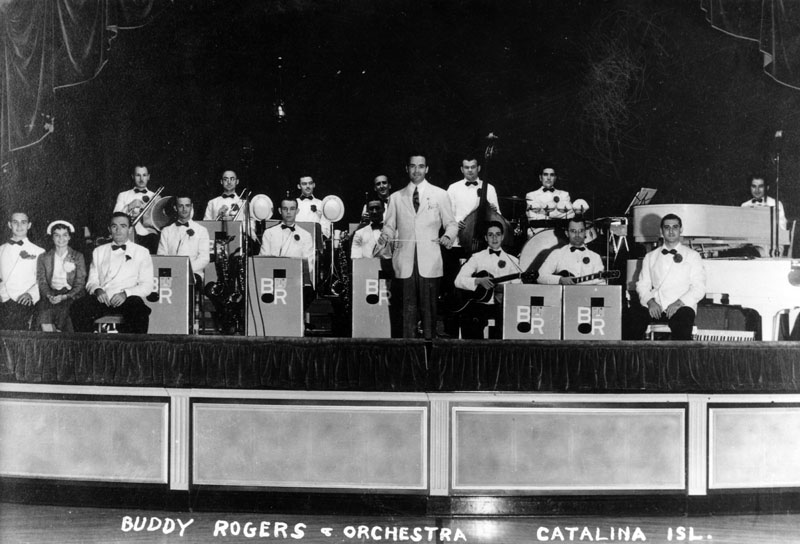
Buddy Rogers Orchestra at the Casino Ballroom
To give one an idea of the grandeur of this place again I will quote the L.A. Times writer McClure,
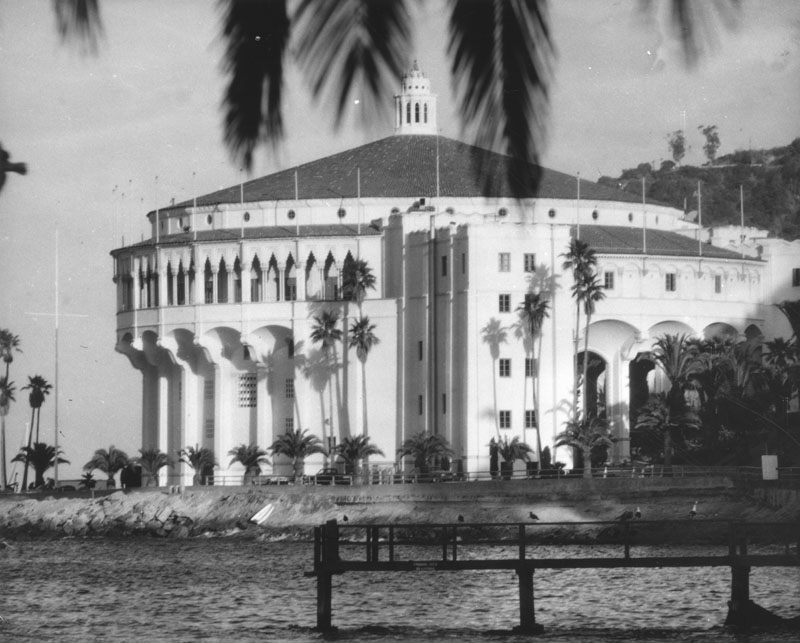
“The casino, 12 stories tall and ringed by balconies that overlook the bay, was believed to have the biggest dance floor in the world when it was built. It was called a masterpiece of Art Deco design that “receives patrons at its doors from seaplanes, yachts and motorcars,” according to a 1929 article in the Catalina Islander newspaper.”
-Rosemary McClure
Exterior of the Casino Ballroom
Interior of Casino Ballroom
An important detail for dancers, the Avalon Ball website writes how the floor was constructed at the Casino Ballroom,
The ballroom dance floor was carefully constructed of maple, white oak and rosewood that rest on a layer of felt and acoustical paper. The felt and paper are installed over a subfloor of pine that floats above the support beams on strips of cork. Such careful attention was given to the dance floor to ensure a smooth and comfortable dancing experience for the building’s many visitors.
The Jazz Standard:
This part of the post is what I am assuming most swing dancers would be familiar with, the jazz standard known as ‘Avalon’. It was a 1920 popular song written by Al Jolson, Buddy DeSylva and Vincent Rose.
“A popular jazz standard, the song has been recorded by many artists, including Cab Calloway (1934), Coleman Hawkins (1935) and Eddie Durham (1936). The Benny Goodman Quartet played the song in their famous 1938 Carnegie Hall concert.The song was included in the biographical films The Jolson Story (1946) and The Benny Goodman Story (1956), and is also being noodled by Sam (Dooley Wilson) at the piano right before he plays As Time Goes By in the movie Casablanca (1942).“
In the original lyrics of the song there are two versus and a repeated chorus, though in most performances of the song that are non-instrumental only the chorus is frequently sung.
I found my love in Avalon
Beside the bay
I left my love in Avalon
And sail’d away
I dream of her and Avalon
From dusk ’til dawn
And so I think I’ll travel on
To Avalon
For reference here is a 1937 performance of ‘Avalon’ by Benny Goodman and his Orchestra:
In a modern context here is the Gaucho Gypsy Jazz band featuring Tamar Korn:
In Context with the Contemporary Swing Dance Community
The Casino Ballroom at Avalon is still used by the Lindy Hop community. Small events are sometimes sponsored there, but it is most notably featured by the Catalina Jazz Dance Festival.
Travel On
When I think of Avalon I get slightly nostalgic because of the history and meaning the place has in a myriad of ways. The song ‘Avalon’ is one of my favorite songs to Balboa to and for myself as a Southern Californian brings memories of home when I am away.
If you have any particular; thoughts, details I missed, or even fond memories of the place, I encourage you to share them in the comments section. If you get the chance I encourage you to travel on, to Avalon.
Footnotes:
[1]: Otte, Stacey; Pedersen, Jeannine (2004). “Catalina Island History”. A Catalina Island History in Brief. Catalina Island Museum. Retrieved January 8, 2012.
[2]: Williamson, M. Burton (December 7, 1903). “History of Santa Catalina Island”. The Historical Society of Southern California (Los Angeles: George Rice & Sons): 14–31.
 The last few months attending swing dance events as a Penn State student has been awkward and downright frustrating at times. I’ve had people literally in the middle of dances try to bring up the topics such as the Sandusky scandal or my opinion on the former coach Joe Paterno. It got to the point that when deciding what shirts I wanted to wear to dances, time would be spent pondering not wearing one of my Penn State Swing Dance club t-shirts just to avoid the potential hassling that came along with it.




 It's The Way That You Do It