Those “So-Cal” Dancers

I remember awhile back I was writing one of Bobby White’s posts on Swungover titled “The Old Timer (Part 2: A Release of Energy)” and got a smirk on my face reading this quote,

I think it’s one reason why so many So-Cal dancers handle competitions well–the one-upness attitude and showing-off confidence has been an important part of their scene ever since the neo-swing craze and before.

I’ll fully admit, as a So-Cal dancer myself I am proud to the point of vanity about my local scene. You can dance every night of the week, we have an amazing hometown band: Jonathan Stout and His Campus Five, and a plethora of badass dancers.

The 90’s

If you aren’t familar with the neo-swing craze/swing revival, go read this wikipedia article.  Then watch this clip from the film Swingers (1996):

Two reasons its important:

  1. It features The Derby, a legendary venue of Southern California.
  2. It presents the idea that swing dancing could be for anybody.

Erin Stevens, wrote in an interview from the now defunct website laswinginfo.com,

The Derby certainly deserves credit for getting the word out to the general masses. The GAP Commercial and the movie Swing Kids certainly had an effect [on the popularity of swing].

[…] There were so many people who wanted to swing dance that it was almost out of control. That was when we realized that we needed to be careful what we wished for. All of a sudden, we went from having 100 people in a class to having 400 people in a class. We soon had a different problem. We had to police our classes more, and make sure we could see the back of the room, all while still trying to get the material out there. We couldn’t teach everything we wanted, because much of the class became about just trying to move the people around.”

A quote from Peter Loggins on an article about Collegiate Shag has a few interesting things to note,

In the late 1990’s we had Shag Contest all around Southern California which was real fun, but it didn’t seem to last long, as most dancers were interested more in Lindy Hop, Swing, Charleston and Balboa.However, there were those countless nights in the back room of the Derby in Hollywood of all of us Shag dancers going off and Jamming! Imagine that on a regular night out….those were the days!

So before I lose you, here are the key points from the revival.

  • 1. Public media through movies (The Mask, Swingers, Swing Kids) and the Gap commercial made swing dance something accessible to the general public.
  • 2. Southern California during the 90’s swing dance had an overwhelming popularity, to the point that classes were full, competitions became very frequent, and venues like the Derby became avenues to learn and show off.

L.A. Old School

So below I am going to post these videos ranging from promotional clips, social dancing to competitions that I think show off this So-Cal flair from its 1998-2002 days. I’ll let you be the judge if we have this “one-upness attitude and showing-off confidence”.

The Hollywood Jitterbugs 1998

Santa Monica Mall Contest 1999

Swing Pit Opening Night 2001

Link: http://www.myspace.com/video/vid/18650186

The LA/OC Lindy Exchange  2001

Apparently we had some out of towners for this event.

Just as an FYI, So Cal also had some of the best advertisement campaigns ever:

We are just better at hiding it these days.

Lindy Binge 2001: House Party

Jam at Camp Hollywood 2002

Jam at Paladino’s 2002

Outside Perspective

Outside Perspective: Documentary on Swing and Jitterbug

My friend Morgan Day, posted on yehoodi awhile back a link to a documentary by David Wittkower on Swing and Jitterbug which was filmed during Camp Hollywood 2006.

What is interesting though, is David Wittkower when deciding to make this documentary was someone who was from outside of the swing dance community.

When I asked his permission on youtube to use his video for my blog post he gave me the response,

“The back ground was this. I was youtube surfing and came across this clip which I really loved watching:


because I love the music and the dancing. Not really a dancer myself, I used to Cajun dance many years ago and I grew up listening to the big bands because my parents were in WW2.
After watching this video (above) I thought it would be great to make a short film about swing dancing. It hasn’t been in any festivals, I made it a few years ago and now decided to put it up on Youtube, along with some of my other films.

I’ve been making films for over 30 years, mostly documentaries, and constantly looking for projects that I either get hired to make or I make them because the subject interests me.”

What I liked about this documentary is it allowed me to get a great quality view of 23 Skidoo!’s team performance that year, allowed for some interesting perspective from Hilary Alexander the event director, interesting interviews with Jack Carey and international dancers from Italy and Sweden, and last but not least Jean Veloz and Ray Hirsch dancing at the very end.

If you have a spare moment I would recommend checking out this documentary besides some great footage of Camp Hollywood, it also offers some insightful messages as well.

School of Hard Knocks

Friendliness of the instructor, its a phrase that comes up constantly when people talk about why they liked a certain instructor or even hired a certain instructor. I am myself am guilty of that. As an organizer for a college club, after the quality of teaching abilities, usually one of the big factor of why I hire instructors is if they are good fit for my demographic a.k.a. college students.

However personally when it comes to instruction for myself, I could care less how friendly an instructor is. Maybe it is because of my grandfather raised me on too many kung fu movies where a good portion of the instructors believed in hard-work, fundamentals and the school of hard knocks.

Jackie Chan practicing Horse Stance.

There is a topic on yehoodi “Meanest things a dance instructor has ever said” that the topic of how mean or nice an instructor should be comes up.  Two quotes in this yehoodi topic from Damon Stone really stand out to me, the first one is.

“I’d rather someone be direct and even mean and brutal to drive home the point. I hate being coddled. I’m an adult, if I can’t take your honest opinion I don’t deserve to have you as a teacher and probably shouldn’t be taking lessons.”

I was actually talking to my roommate who teaches violin this past weekend and seeing the overlap in musical and dance instruction. He went into anecdote about when he used to take lessons in his younger years, from an instructor who had him play what he was instructed to practice the previous week at the beginning of each lesson. If he didn’t perform up to his instructor’s standards, his instructor would tell him to get the hell out and stop wasting his time.

I chuckled and responded if I I did that in any of my classes, I would probably get the reputation as the worst swing dance instructor on the East coast. His response to that statement struck a note with me though. He commented that; the weeks he earned his teachers ire, he worked harder then ever to improve.

The second quote by Damon that stuck out to me was,

“I’m not sure I’ll ever quite get why intermediate dancers and above are sensitive about their dancing. I mean beginners are just that they want to learn enough to get out on the floor and have fun. By the time you are intermediate you should know everything you need to do that.

If you are taking lessons after that point I’d assume it is because you really want to improve, you want to be a kick-ass dancer. I can’t imagine going into a jazz or ballet, or contemporary, hell even Hip-Hop class and expect the teacher to be all sunshine and rainbows.”

Now, I think the issue at hand is differing opinions. I have had friends in my international dance performance troupe with backgrounds in ballet, jazz, and et cetera go into horror stories about how strict and demanding their instructors were that would send most people I know reeling.

But those are all instructors who see the material they are teaching as a serious art form and if you use their time, they demand respect for their experience and the material they are teaching. However, I would say for the most part not out of disrespect but being truthful, that the swing dance community as a whole are hobbyists.

In result it is often difficult to offer a class with the same serious framework like ballet or music without potentially touching some nerves or hurting feelings. Even often when I hear people talking about other dancers within the community, its usually a long list of their strengths and they are loathe to point out weaknesses.

Personally, I want someone to tell me my dancing is garbage. I want someone to point out my weaknesses and criticize me harshly about them. For me, its not the words of encouragement but these harsh criticisms that drive me more then anything to work harder on my dancing. I want knowledge, not a self-esteem boost.

Slightly Related Clip (For those of you just using my blog to procrastinate):

At 7:30 is the type of instructor I would want..

Your Moment of Zen

So I was stumbling around on youtube looking for videos on Jack Carey and came upon this clip uploaded by Doug Silton. If you don’t know, Jack Carey’s claim to fame is being the person who designed the Jack & Jill format for contests which are still used today.

Normally, I wait a few days after a post before I put up another one. However this was too hilarious to pass up. This features legendary dancers Annie Hirsch and Jack Carey talking about a vegetable they found at what appears to be Newport Beach, California. In the clip 1:07 is where the real hilarity starts.

Here it is… your moment of zen.

Tabby the Cat

A jazz step I like because of its kooky name and look is known as a “Tabby the Cat”. I was casually chatting about it with my friend Annabel the other day and she mentioned its rather popular in the swing dance community these days, apparently due to Sharron Davis.  I do not know the exact origins of this move (besides it coming from the song “Tabby the Cat”  Edit: See Peter Loggins comment below for details.), however I do have a feeling it has something to do with Dean Collins.

They are still working on getting the move down.

Dean Collins: The Cat’s Meow

First reason is Dean seen doing the move with fellow dancers Johnny Duncan,  Jenny Duncan, Jack Arkin, and Irene Thomas in a 1945[1] soundie Tabby the Cat, which also featured comedian/pianist Eppy Pearson.

The move is first shown at 0:36, then Dean strolls in and does it with the gang at 1:05

Second is it is a featured move in his shim sham, the Dean Collin’s Shim Sham. You can him do it himself below in a 1983 impromptu performance at about 1:25.

A more modern demo of the Dean Collin’s Shim Sham is below with our friends at the London Swing Dance Society. They do the move at about 1:28.

Modern Uses:

The move Tabby the Cat is great for partnered, solo dancing and a necessity if you want to learn Dean Collin’s Shim Sham. One of my favorite examples of it used in partnered dancing is below by Juan Villafane with Carla Heiney at this past year’s Lindy Focus. He hits it perfectly at 0:33, BAM.

Sharon Davis seems to have adapted it for the blues ascetic.

How to Learn It?

A skim notes version for you fast learners, check out this video from the Houston Swing Dance society.

Footnotes:

[1] The interesting thing about the Tabby the Cat soundie when I was attempting to do research for it was IMDb has 1945 as the year of the clip and only lists the pianist and vocalist. Whereas whoswhoinswingdance.com lists the full cast of dancers but has the year listed at 1939??. I chose IMDb’s date, because the song is listed in wikipedia coming out 1944 {Tabby The Cat (Arr. Dave Matthews) Broadcasat Hollywood Paladium, Hollywood, Ca.}

Event Review: SparX

This past weekend was CWRU (Case Western Reserve University) Swing Club’s annual Lindy workshop weekend. As their promotional website promised, SparX did fly at the event.

SparX 2011

For a college workshop weekend, SparX delivered three tracks (Beginner, Intermediate, Advanced), two bands (Baby Soda & Gene’s Jazz Hot), and two competitions (Jack & Jill and Solo Jazz).

Most college events where one is lucky if there is more than one track or live band.  Case Western pulled off an impressive feat by having an event this big and well run.

Classes

After probably the roughest audition I have ever encountered (about 30-40 minutes of straight social dancing, one song after the other), I got placed in the Intermediate track. Generally I thought most of the classes were a good balance of technique & moves to keep everybody interested.

However what stuck out to my was Mike Faltesek and Casey Schneider’s classes. I have taken several of their classes, multiple times in the past. What I really enjoy about their classes is, no matter how many times I have taken a class they have offered before, I always get something new out of it.

Competitions:

The finals were to live music provided by Baby Soda, the results were..

1st ~ John Holmstrom & Annabel Truesdell
2nd ~ Daniel Repsch & Corinne Shafer
3rd ~ Mark Muthersbaugh & Beth Hartzel
4th ~ Yosseff Mendlesohn & Jesse Hanus
5th ~ Sam Copeland & Ellie Hanus

Some highlights from the J&J were:

  • 1:56  Daniel Repsch & Corrine Shafer throwing down some peckin’
  • 2:18 Mark Mauthersburgh backing it up with Beth Hartzel in tow.
  • 4:25 Jesse Hanus showing some serious sass.
  • 5:48 Annabel Truesdell shimmying it up.
  • 5:56 Yosseff Mendlesohn & Jesse Hanus hamming it up.

The PSU Peanut Gallery

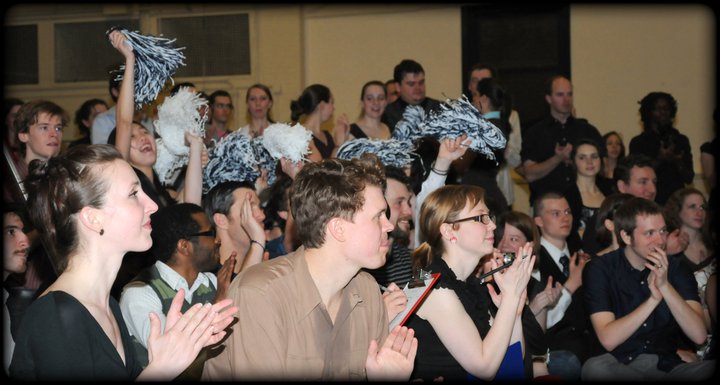
Slight Back story to the Jack & Jill: Some of you might wonder why some of the competitors entering the spotlights got extra loud cheering then the others. People actually at SparX were probably wondering who all the crazy people with blue and white pom-poms were. Well one of the Penn State students, (not going to say names) happened to be a season football ticket holder his Sophomore year and saved pom-poms from every game, thought it would be a fun idea to bring the student section to cheer on any Penn State students or alumni competing at SparX. Needless to say, it was a blast for all parties involved.

The results of the Solo Jazz competition were…

1st ~ Jesse Hanus
2nd ~ Dani Dowler
3rd ~ Mark Muthersbaugh

Some highlights from the Solo Jazz comp for were:

  • 00:52: Mark’s grand entrance. I am not sure what made the outfit more, the longhorn bull belt buckle or the blue sequin jacket.
  • 9:53: As commented on youtube, Ross Hopkins fall hits a cymbal crash perfectly. Coincidence or crazy musicality? I’ll let you guys decide.
  • 10:20: It’s a shame there isn’t a video from another angle. Jessie Hanus does an amazing Josephine Baker impression here and sells it with her facial expressions.

Room For Improvement?

The only negative things I can say about this event would be to trouble shoot the sound equipment with the Friday band a little more and perhaps more food for the late nights. But they were things that paled in comparison to how much ridiculous fun I have been hearing other people claim they had and the marvelous time I had myself.

Student’s Focus

One of the biggest problem I had when I taught my first larger classes (like 50ish people) was at times getting all of their attention so they could hear what my partner and myself had to say and demonstrate.

Over the last few years, I have witnessed some instructors creatively deal with this problem in their classes which I will list below.

Teaching Tricks to get Students to Pay Attention

  • Shave and a Haircut: Described on the wikipedia page as a “7-note musical couplet popularly used at the end of a musical performance, usually for comic effect.”
    The way to use it is teach it at the beginning of the class, then you clap out the rhythm whenever you want the students attention and they respond with either a stomp-off or clapping back the “two bits” (Ba-Ba) part. Repeat as necessary.
  • One, Two, Three, All Eyes on Me: Many of you may be familiar with this from grade school, where teachers sometimes employ this. It is a simple rhyme that grabs attention. The way to use it is at the beginning of class go over the rhyme, then during class employ it as necessary. I remember my grade-school teacher would just say the part and have us students reply “All Eyes on Me”.
  • Side By Side: I actually witnessed this for the first time when taking a class from Erik Robison in California. He explains at the beginning of class when he says the phrase “Side By Side” he wants follows to get to the right of their leads and for everyone to remain quiet and watch whatever he is demonstrating. Its great because the phrase initiates movement, so people who might be zoning out catches on they should pay attention and it gets people in a position to immediately start dancing afterward.
  • Observation Goggles: I got this from watching part of one of Mike Faltesek and Casey Schneider’s classes at Jammin’ on the James last year. At the beginning of their classes they explain the importance of paying attention to the body movement (they or other people you are trying to learn from)and translating it to yourself, they refer to it as putting your observation goggles on and demonstrate what they mean. I can only explain what  this looks like with this picture:
    Observation Goggles

    Its goofy but it works like a charm, especially among a younger crowd.

What I Do Personally

Well I have liked everything, so I combine a little of it all. At the beginning of classes that it is students I am unfamiliar with, I explain I have this thing called “Side By Side”. When I say that phrase to make it easier on both parts for myself teaching and students learning I ask them to:

  1. Follows stand to the right of the lead.
  2. Please remain quiet so other students can hear what I am saying.
  3. Put on your “Observation Goggles” and not just pay attention to what my footwork is doing, but my full body movement.

I’ve found combining both of them works extremely well, at least for myself.

If you have any tricks you use in your classes or noticed other instructors using that works well, please feel free to comment about them.

The Joy of Charleston

One of the things I like the most about watching solo Charleston dancers and by extension solo Charleston competitions, is the amazing amount of musicality and expression that can happen when they dance. The two clips below show some evidence of this.

What I find inspiring about both these clips is besides featuring amazing dancers in terms of technical skill, each dancer is performing and giving away ‘who they are’ to the crowd.

Below I have two more modern examples that I think this is present:

One thing that bothered me slightly lately as a trend in recent solo Charleston competitions, is it seems acrobatics is being awarded over being musical and really layin’ it out on the floor.

Now take my words with a grain of salt, I do not claim to be an amazing solo Charleston dancer or experienced judge of solo Charleston myself.  However I am expressing the sentiment of a conversation that I have had with many dancers on the East Coast, and that even some others have expressed online.

Don’t get me wrong, acrobatics are amazing. Done musically and appropriately they can bring the room to a tumultuous crash of energy. However like aerials in partnered dancing, just done for the sake of looking impressive leaves me with a kind of ‘meh’ feeling.

I’ll leave you with a quote from Rik’s Blog that I linked to, The Click Heard Around the World in which he wrote about Jana Grulichova dancing in ILHC 2010’s solo Charleston comp,

“What she brought, that no one else really had, was 300% commitment to what she was doing, plus a beaming joy to be doing this dance.  It reminded me of the first time I saw Hurley Francois at the first ILHC in 2008.  Jana didn’t need to do any of the acrobatics or flashy tricks that the boys were pulling out in their solos.  She delivered very classic charleston and jazz vocabulary, but amped up to a whole new level.  So incredible”


The Pitfall of Patterns

“Rock-Step, Triple-Step, Triple-Step”

Most people when starting to learn swing dance can remember a certain pattern they were taught in their introductory class, usually the “Rock-Step, Triple-Step, Triple-Step” pattern.Often there is this solid framework because an issue that John White writes about in his blog post Dreyfus Model of Skill Acquisition.

In the post he comments how many novice level dances will often look for hard and fast rules for swing dancing. However as many people learn quickly (especially follows) if you try to dance within only patterns, you are only getting a small subset of the dance known as the Lindy Hop.

Positives and Pitfalls of Patterns

Don’t get me wrong though, I am not saying that patterns are rubbish and should not be utilized in instruction or on the social dance floor. They are great at providing a simple model of dance where dancers can work on fundamental technique and isolate external variables that they would normally have to deal with and could crowd out their understanding of the issue.

However the important thing to convey is in fact that patterns are simple models that are not completely representative of the actual social dance floor. Groovy Movie actually lampoons the idea that you can completely learn swing dance through step patterns here at 3:00:

As a follow if all you try to do anticipate the patterns in class, if you dance with anyone outside of that class it can easily become a difficult dance as many new follows quickly learn. For leads if you just lead patterns you learned in a class, often one can technically be on time but still be completely ignoring the music.

The difficult thing for me as an instructor in beginner classes is still providing newer dancers patterns that provide them an isolated environment for them to get down steps to at least survive one social dance, yet still attempting to provide them with instruction technique and give them perspective of where to use these steps. It is a difficult compromise that I am always attempting to fine-tune each lesson.

The struggle for an dancer who moves on beyond the novice stage is often breaking free from this framework. I remember out in California one of my biggest struggles the first summer I was out there was not defaulting to the six-count footwork from open. I had to have several nights where I completely forbid it from my repertoire and forced myself to do other things.

I could ramble on about this topic for awhile, but I’m curious to hear the rest of your thoughts. But before that I will leave you with this quote.

“All fixed set patterns are incapable of adaptability or pliability. The truth is outside of all fixed patterns.” – Bruce Lee [1]


[1] Mainly known for his prowess in the Martial Arts world, it is actually a not as well known fact that Bruce Lee was an excellent dancer as well and won the Crown Colony Cha-Cha Championship in China at the age of 18.

Dax Hock & Sarah Breck in “Live To Dance” Semi-Finals

If you haven’t heard over facebook, yehoodi, or word of mouth recently, Dax Hock and Sarah Breck were on national television representing Lindy Hop in Paula Abdul’s show, “Live To Dance“.

The song they perform to is “We No Speak Americano” by Yolanda Be Cool. Which, while not traditional swing dance music I can understand the choice because they are trying to appeal to the general public.


Dax and Sarah... and a Plane

What I do admire though, is Dax rising to the occasion in spite of his injury. They both put on a performance to be proud of.

In my opinion they have earned the “Spirit of Lindy” title they have listed on their website.

Update: Here’s an interview with them.