A friend of mine from college was kind enough to send me the clip below that she recorded when she was attending a Caravan Palace concert in Quebec, Canada.
At the beginning couple on the right is Max Pitruzzella and Annie Trudeau, the couple on the right is Thomas Blacharz and Natasha Ouimet.
What I find inspiring about this clip is the fact that they combined Lindy Hop, Charleston, classic Jazz steps, and Balboa all into one routine that won over the crowd. They did an amazing job at bringing swing dance to a modern audience.
Edit: Thanks to MQAvatar on Yehoodi, the second couple was not just identified but also we now have a full clip of the performance.
Edit Deux (Two): Apparently I made a rookie mistake and didn’t search out the world wide web to see if this was covered already. Lindy Dandy already beat me to the chase on this one. Instead of deleting this post, I will leave it up because I figure Max, Annie, Thomas, and Natasha will not mind extra advertisement for them.
If I have learned anything from hanging out with swing dancers at bars, it is they like things cheap. Luckily some instructors in the swing dance community are generous enough to provide online resources at no cost to the viewer. Many of these online videos are a great tool for reviewing and cleaning up routines like the Big Apple. Below I have created a list of sites that have free online instructional videos.
List of Free Swing Dance Resources
Building the Community with Patrick and Natasha:
Patrick and Natasha
Description: Even though the blogs Lindy Dandy and Shuffle Projects beat me to the chase with this on the online blogging world for the Big Apple, this resource is so nice I do not mind listing it again. At the youtube channel PatrickAndNatasha the lovable Canadian Couple Patrick Szmidt & Natasha Ouimet provide high quality in depth videos that break down The Big Apple, The Shim Sham and The California Routine. They have also mentioned on yehoodi of possibly filming the Dean Collins Shim Sham or the Tranky Doo in the future.
What you get for free: Everything!
Advantages: High quality videos, routines performed occasionally to songs of different tempos and seperate videos to break down each move.
Disadvantages: Currently only three lessons. (More in the future though)
Recommendations: If possible throw a donation to their paypal account at the link: Support Building the Community with Patrick and Natasha. Normally for DVD’s on the Big Apple or Tranky do you would be paying a good $15-$30 dollars.
RhythmJuice:
RhythmJuice.com
Description: Created by Dax Hock, RhythmJuice is a website for learning and assistance in swing dance related topics. The description reads off the website reads as follows, “RhythmJuice is a place to get inspired, learn, and take your dancing to a whole new level. We offer unlimited access to an ever evolving learning environment filled with lessons from top internationally acclaimed instructors. Are you aiming to become a better social dancer, teacher, competitor, or are you just taking your first dance steps? Either way, RhythmJuice has content to suit your needs!”. While most of their content requires you to become a paying customer there is still a decent ammount of free lessons on the website.
What you get for free: The lessons under the free tag, about ten of them.
Advantages: Quality lessons in terms of excelent breakdown of technique and moves. In addition if you ask the instructors questions about their lessons, usually responses are fairly fast.
Disadvantages: You have to register for the website and most of the content is for paying customers. (From what I have heard, fairly worth it though.)
Recommendations: If you got the spare cash lying around and a partner who is willing to spend time with you, test out the lessons for a month.
Danceonline.tv
danceonline.tv
Description: A creation by Daniel Newsome, Danceonline.tv is an amazing resource for swing dancers. I think Daniel says it the best in his yehoodi post, “So, for everyone, free Basic Lindy moves, basic blues dance, Big Apple, Trankey Do, Shim Sham, and more. Over 400 videos and adding more every day, all free.” One can (and I have) literally spend hours learning with this website.
What you get for free: An almost excessive ammount of free lessons.
Advantages: Videos are well filmed, there are a lot of them, and the instructors are through in the technique and moves they are trying to convey.
Disadvantages: You have to register for the website.
Recommendations: If you get a lot of use out of the videos, support Daniel’s donation to the community by purchasing one of his DVD’s.
A popular line dance performed world-wide in the swing dance community, as many of you reading this will know as the Shim Sham. Originally a tap dance routine, it was adapted by swing dancers and popularized by Frankie Manning. However there is a large variety of Shim Shams besides the standard one performed by most swing dancers and I am listing as many as I could locate for your viewing pleasure.
Shim Sham (Tap Dance)
Soft-shoe performance by the Killer Dillers at the Swing Brother Swing Festival in Bologna Italy. Courtesy of David L in the comments below.
Shim Sham (Swing Dance)
Dean Collin’s Shim Sham
Performed by Dean Collins himself and Bart Bartolo. Some good notes are in the comments section about this clip by Peter Loggins.
This time Peter Loggins performs it himself along with Lisa Ferguson.
Al and Leon Shim Sham
Slip Slop Shim Sham
*Check out David L’s post in the comment section below for an excellent link to Jerry’s blog in relation to the Slip Slop Shim Sham.
Hat Trick Shim Sham
A new take on the Al and Leon’s Shim Sham, performed by Tips, Taps and Tops (Kevin St. Laurent, Jeremy Otth and Shesha Marvin)
This performance at the 9:20 Special out in San Francisco is interesting because of the contrast provided by the guys doing the traditional swing Shim Sham to the left.
Girls’ Shim Sham
This is from one of my favorite workshops/events, Steven and Virginie in Rochacha (Rochester), NY. If you haven’t gone, you should seriously visit.
Note: If I have missed any feel free to contact me and I will add them to the list. The only one I know currently missing is the the rhythm juice Shim Sham since it only exists on Dax’s website to my knowledge.
A friend of mine has (as he refers to it), “an almost religious habit, which you shouldn’t make fun of me for man” where he watches the clip below on a daily basis.
For him it has paid off, he recently placed the finals of a Jack and Jill where there was some stiff competition. He greatly admires Nick’s dancing and claims Nick’s musicality makes the songs Nick dances to come alive. That in turn inspires him to train hard and continuously hone his technique and dance skills.
Below are two clips that, while not daily, I watch fairly often.
The reason both these clips inspire me are the energy and the uniqueness of each dancer. Often in competitions these days I see people who look extremely concentrated and occasionally look like caricatures of their instructors. When I see people compete or perform, even when I dance myself I want to see who that person is as an individual and the joy of the dance in them.
Clips whether from recent events or back in the 30’s or 40’s can be powerful tools of motivation and inspiration in many aspects of ones own dancing. I also have another friend here in Orange County that before every competition he enters, watches his favorite clips to inspire himself and keep his spirits high.
If you have any favorite clips you like to watch consistently or are inspired by them in ways I have not mentioned, feel free to comment below.
While reading practice tips on a website for guitar lessons I came across the quote below,
“The more you think, the more you stink (practice until it becomes instinct).” – Justin Sandercoe
This stuck out to me as a lead, because in my mental inventory of moves I have two types; moves I lead almost flawlessly and moves that sometimes work. For example, thanks to some help from Nick Williams I am extremely confident in leading six count side-passes and they are a bread-and-butter staple of my dancing. This contrasts to a swingout with a double inside turn which only works probably 70%, and flows smoothly 40% of the time.
Why I tell my students to practice after lessons...
When I lead a sidepass, it is a move I don’t spend a second thinking about. It almost comes to me naturally as breathing. Unlike the swingout with the double inside turn I mentioned earlier. Getting my hand on the follows back early enough, keeping my steps small, not letting my shoulders collapse forward, and other things are distractions I have to constantly pay attention to when leading that move.
I find when I have to think about things when I dance, it often causes hiccups that cause my follow and I not to look smooth. My advice is if you want to have dancing that looks smooth, practice until you can do things without having to think about them. That is when you truly own that motion.
While reading practice tips on a website for guitar lessons I came across the quote below,
“The more you think, the more you stink (practice until it becomes instinct).” – Justin Sandercoe
This stuck out to me as a lead because in my mental inventory of moves I have three types; moves I can do almost flawlessly, moves
So this past Wednesday I put myself back in the seat of the “first time student” by taking a hip-hop class, a dance style I have never tried before.
After waiting for my friends, Verionica who usually does this and Logan who was taking his first dance lesson ever outside of the studio, we walked in. It was slightly intimidating walking into a studio that focused more traditional forms of dance. Windows displayed ballet and modern dancers younger then myself, who had a quality of movement I could only hope to achieve. After paying for the class, my friends and I walked in the room and found an assortment of people taking this Hip Hop class.
Shortly after, the instructor as the sheet described him, “The ‘Legendary’ Cu” walked in and gave a short description of the class. Unknowingly my friend and I came in on the second week of a two week series. In result, the warmup was skipped so we could play catch-up. During the class we learned choreography to the song “Love, Sex and Magic” by Ciara featuring Justin Timberlake which went at a pace that was great for me. Cu was a great teacher and I will probably use a future post to go over his teaching methods, which made the class a great learning environment for Logan and myself who were taking Hip-Hop for the first time. Cu also commented to both of us at the end of the class that we both did a good job. Unkwoingly to us, it was not a complete beginner hip hop class but more a beginner/intermediate level. Afterwards Logan was asking Veronica and myself if either of us were watching to see how he did. We both agreed we were trying to focus more on ourselves, then anyone else in the class.
First Time Students’ Experiences
So for organizers who run a scene and trying to attract new dancers or teachers who are teaching absolute beginner lessons, these are the two things I gleaned from going through the first lesson experience again.
New students feel much more comfortable going to classes with familiar people such as friends, or even being an acquaintance with someone in the class.
Many people come into classes with fears that the material will be difficult for them to learn and can often get self-conscious about how they are doing (especially with partner dancing). A friendly, encouraging teacher goes a long way to create a shift in mentality for students and relax them.
For organizers this means for your beginners classes, first make sure to have a teacher who is friendly and encouraging. Often this first class is the difference between having a new dancer or possibly having someone spread a bad reputation about your dance venue. Also try to create a way that it benefits people attend your classes in a group, or create an insentive for current members/dancers at your venues to bring in friends with them.
For teachers this means when working with beginners make sure to be positive, encouraging, and friendly. Most people are taking their first dance class to have fun and as a social outlet, it is important to keep this in mind.
I don’t dig that two-beat jive the New Orleans cats play. My boys and I have to have four heavy beats to the bar and no cheating. — Count Basie
Recently I have been visiting a lot of venues. These are small scenes that are often somewhat isolated. I have been thinking about the music choices played there by the DJs, which frankly baffle me at times. This post which I read recently over at the blog, The Casual Discourse of a Socially Awkward Lindy Hopper, the author writes about her experience saying some of the things I have been tempted to say in public, but refrained from due to apprehension of the exact situation she experienced.
For those of you who want the quick summary, the author visited a venue she used to regularly attend. In this visit she experienced mostly songs that were simply undanceable. The songs that were danceable consisted of the cliché neo-swing (Big Bad Voodoo Daddy) material that makes most experienced Lindy Hoppers cringe. In result people (including herself) were complaining to other regular swing dancers at the venue about the music. The DJ maturely responded to this by leaving a nasty comment on her facebook wall referring to her friends and herself as “snobs” and defriending her on Facebook.
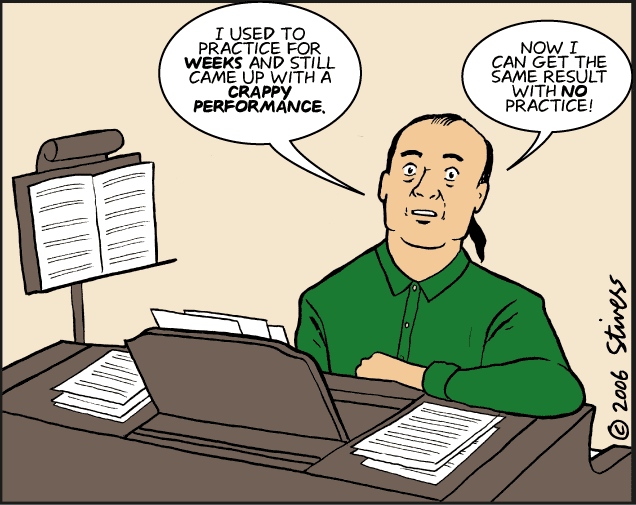
Honestly, I wish there was a more tactful way of going about this then complaining to the venue organizer/DJ or trying to politely suggest to the venue organizer/DJ something. (Better then handing the DJ what is pictured in Figure 1.0 below) But as I am keenly aware of being a DJ myself, it is often a very personal endeavor and unfortunately we can be quick to take offense to people who criticize our abilities.
I am not going to write a guide about how to be a better swing dance DJ, that is covered in multiple places over the internet. Just a message for be organizers and people who are concerned for their local venues or scene in general.
What music is DJed greatly affects not just how your dancers at your venue dance, but the reputation your venue has.
Frankly, one could be surprised how fast things via word of mouth can travel in the Lindy Hop community. I know several venues, in different states, that intermediate and above dancers avoid because of their reputation for bad music. There tends to also be a correlation with bad dancing and bad music as well. How can you expect your new dancers to be able to dance on beat if they rarely hear swing dance music with a decent rhythm section or be musical when they can’t make out clear phrasing? It confuses me how some places will go to great lengths to create an inviting and fun atmosphere then overlook this one big aspect of running a venue.
Carl Nelson, a jack of all Lindy related trades (teacher/competitor/performer/organizer) wrote this in his blog which provides some insight,
As a traveling dancer I’ve seen far too many communities on the decline or, worse yet, falling apart altogether. Why is that?
As dancers we’re all too often misled into believing that a passion for dance is enough, that effective business strategies don’t apply to performance art. Yet what happens when your classes are empty, your teachers are disheartened by the lack of interest (and a paycheck), and your events are poorly attended.- – Carl Nelson
Carl makes the very valid point that running an effective scene is just like a business. DJing, like teaching is something that should be done by someone who takes the position seriously and is qualified. I have seen many venues let people who shouldn’t touch a DJ booth, do so because they do not want to hurt that person’s feelings or create drama. Organizers, avoid that common trap and have people who know what they are doing as DJs. In result you will foster an environment for dancers to improve and a positive reputation for your venue.
When I was at the Caveau de La Hauchette in Paris, the phrase “dance is a language” started to truly sink in. This is due to the fact that when attempting to communicate with in French with follows, I could barely understand them. But on the social dance floor we could speak volumes to each other without uttering a single word.
1950's Caveau de La Hauchette
While I would like to explore that topic more in the future. What inspired me today to write was reading about for languages on average, how long it takes one to be become fluent. Out of the few sites I read most listed one year if you were fully immersed in the language, compared to anywhere from four to five years if you did not have full immersion.
I believe there is a strong correlation with dancing as well because the people who I see improve the most do so through apprenticeships, paying for many private lessons, or the generosity of time donated by dancers advanced enough to be ‘fluent’ in the respective dance. In isolated scenes usually the best dancers are those who go out of town for workshops/exchanges.
Now I am not saying you should only dance with the best dancers and ignore newbies because they are ruining your ‘dance immersion’. But in situations where you don’t ask people to dance because they are ‘too good’ or if you are avoiding travel and such because you like the familiarity and safety of your own scene, push those boundaries and converse with those who have more experience or perhaps a different dialect of the language known as dance.
During the Balboa Rendezvous this past April, I absorbed a lot of new information during the workshops. However the time that I learned the most important lesson of the weekend was not during the actual workshops, but after the Q & A session watching many of the original Balboa dancers during their jam in the Balboa Pavilion.
The one thing that stuck out to me (besides watching a 97 year old man tear up the dance floor) was the fact that none of them used the usual up-holds or down-holds in repetition the way most people are taught during most Balboa workshops, each of them had their own unique steps.
Take a look at this clip provided by onlybalboa.com of Bobby Mcgees, a venue for Balboa dancing a few years back in Southern California to see my point:
One thing I have been doing in result is trying to dance without relying on a certain “basic pattern” for Balboa, constantly switching between different variations of holds.
Sadly though, this had lead to me being annoyed when people claim there is a basic for Balboa or ask me what the “basic step” is.
This story starts out back about a year ago when I was just finished teaching a lesson for my college swing dance club and I noticed a girl standing by the doorway of the room looking in inquisitively. I walked over and gave her the usual spiel about swing dance club but she mentioned that she was just looking in after her PSIDE practice. Being curious I asked her what it was and she explained it was the Penn State International Dance Ensemble, a performance group that does dances from around the world. I had seen one of their performances before on campus, not knowing who they were when they performed Tinikling. I was impressed being that it was the first time I had seen people of non-Fillippino descent perform it and on top of that they did a great job. One thing lead to another and she brought the director over who told me to come out to their spring audition because they had the opposite problem of the swing dance club, lack of leads.
Auditions
Its amusing even though I was a seasoned swing dancer of a year and half at the time, the audition process into PSIDE still intimidated me. Besides the Shim-Sham and the Gangbusters Routine I had no real experience with choreography and they were in dances, which in some cases I never heard of such as Bhangra.
Ohio dancers and myself doing the Shim Sham at Get Hep Swing in Cleveland-Town
In addition once one got past the auditions just to become a performing member, one had to individually audition for each dance they were interested in for the performances. How the auditions worked was for the majority of the dances you had an about an hour to an hour and a half to learn a routine, then you auditioned it immediately after. I remember asking the girl in charge of Tinikling, Kim, for advice before the audition started because it was the dance that originally got me interested in PSIDE and I wanted to be a part of it badly. However the auditions were not as cut-throat as I imagined them to be, everyone encouraged each other and the people who ran the auditions put in a considerable effort to try to prepare everyone for the tryouts.
How Performance Is A Different Animal
The thing about partner dancing is there is this idea of connection between the music and the other person one is dancing with. However that changed with my experiences in PSIDE where I learned performance is this connection between the music and the other people you are performing with, then sharing that with the crowd watching you. While it’s good having technique of the respective dance, one has to remember most of the people watching do not have extensive dancing backgrounds in the dance you are performing (or dance backgrounds in general). They are not going to notice bad technique, they are going to notice who looks tired, looking at the floor or doing something different when everyone is trying to do the same thing.
Tahitian Performance, moving as one.
Besides the fact of the different mindset being a performer then a social dancer, another thing I had to get used to was consistent rehearsals and how the lessons were different from the typical lessons I took for swing dancing. In my history of taking swing dance lessons, the majority of them at the beginner and even intermediate lessons were based on more having on fun while learning the dance at hand instead of approaching it as a serious art form and seriously working at it. PSIDE while fun, was not as carefree as my previous experiences with classes. It was refreshing to be in a room of people who were all trying to seriously work at something. Making a consistent time commitment was a difficult hurdle for myself as well due to my traveling gypsy/vagabond lifestyle of being a swing dancer in an isolated scene in addition to helping to run the PSU Swing Dance Club. Luckily the PSIDE director, Clare was very accommodating of myself missing practices and it worked out for the most part.
How This Changed Me
Before PSIDE I would go to Downtown Disneyland in Anaheim, California when live bands would play, in order to get used to dancing front of a crowd. It helped in the same way that it helped me to be more comfortable with myself in terms of dancing and be fearless in front of a crowd. As odd as it sounds, beforehand I would always feel awkward dancing alone, not just in swing, but in general (ironic considering my dancing origins). Now I can bust out moves with much more confidence regardless of the situation, whether it’s a Solo Charleston jam circle or at a local night-club.
PSIDE also has made me feel more like a “real dancer” and slightly increased my knowledge of what that means. I remember my first few PSIDE practices feeling like the dunce in class during the warm-up stretches because I am not flexible at all, and I could pick out that a lot the people in the class had training in classical dances which I lacked. Through time though I realized everyone in PSIDE had their strengths and weaknesses, what was important is we were using our respective dance backgrounds to help each other as a whole. I got exposed to many different motions outside of my usual range of motion I was used to in Lindy Hop, ranging from hip-shaking and isolations with Tahitian to the extreme body-awareness of Bhangra.
I’ll be candid and admit when I first joined PSIDE it was more to use the organization as a tool to improve my dancing as a whole. But they are a great bunch and I have come to know many of them as my friends. The environment that PSIDE provides allows us to learn from each other and gives a performance outlet for many people who may normally not have the chance. All I can hope is many some of my fellow PSIDE members have learned as much from me as I have from some of them.


![[Figure 1.0]: DJing for Dummies](https://i0.wp.com/www.beatmixed.com/wp-content/uploads/2006/12/djingfordummies.jpg "DJing for Dummies")


 It's The Way That You Do It