One of my favorite swing dance related publications to read of all time is Cameron Seller’s “Reminiscing about Swing: When It was a Subculture“. Cameron gives amazing insight to what it was like to become a member of the swing dance community during the late 90’s in Washington D.C. with all that entailed from finding new venues, meeting new friends, to competition.
What stood out to me though was this article was written on a very personal and honest level. As a newer dancer when I first stumbled upon this a few years ago and took a lot of the perspective in it to heart. I actually (in retrospect unecessarily) set myself as a rule after reading the article that I would refuse to buy any dance shoes until I won my first competition because of this article.
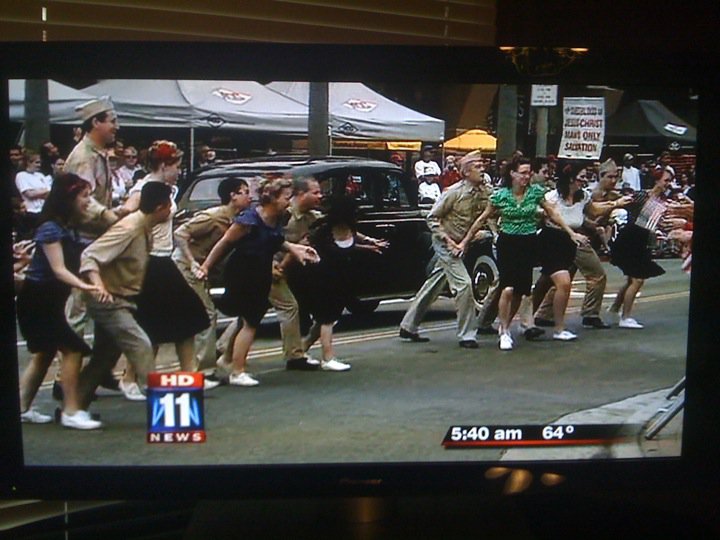
New rule, you aren't a real swing dancer until you get featured on Faux News.
Challenge to Readers
So this post I am going to have a change of pace around here. Instead of me rambling on about something, I want to hear stories from you guys. Exciting right?
What I to read from y’all is similar to what Cameron wrote in his article and what many people have done at http://iamlindyhop.com/. I want you to post in the comment section your story about joining the “swing cult” known as the Lindy Hop community. It can be any length you like, however if you wish to to make it as long as Cameron’s feel free to.
If I get a reasonable response I’ll work quid pro quo and write my own personal experience as a new blog post. I look forward to reading all of your responses!
This past weekend I attended Camp Hollywood XIV, while I could talk about what I got out of the classes I took or how awesome the music was, there is a theme from this weekend that still resonates soundly with me. That theme is the idea of sincerity in ones dancing.
Oscar Wilde wrote in DeProfundus,
Most people are other people. Their thoughts are someone else’s opinions, their lives a mimicry, their passions a quotation.
I have not just seen this in Camp Hollywood, but in competitions across the United States cliches such as; pointing at the judges, non musical or worse badly executed aerials for the sake of flash, and using other people’s material in a non-homage sense.
Can this sadly sometimes pay off and get people awards? Yes. However if all one wants out of dancing is some golden plastic and an ego boost, I can’t help but feel pity for them. Because in a few years no one remembers (or probably cares) who got X place, in Y comp. They remember those moments that took them on a journey and evoked an emotional response.
What inspired me this weekend was in a lot of the competitions this year at Camp Hollywood there were people who carried this spirit of being themselves and sincerity in their dancing. In many cases I was happy to see they were rewarded for it.
While there were many moments that made me smile and inspired me this past weekend, I want to talk about two performances in particular, both from the showcase division.
Camp Hollywood 2011 NJC – Morgan Day & Emily Wigger – Showcase
Even before I get to the routine I just want to add that these two handled pressure with grace. They had not one, but two technical difficulties with their performance. First the contest staff on stage could not get the music to run for around five minutes before the routine. After that first problem the DJ mistook a pause in music as the end of the routine, in result he stopped the music prematurely. The DJ then had to rewind the music to slightly before the pause and they had to start again mid-routine. In spite of those setbacks they both performed admirably.
Morgan and Emily’s routine was not extremely technically difficult nor had mind blowing musicality/moves. What made it special and a moment never to be forgotten in Camp Hollywood history was it was two people who had an original creative idea and sold it on the performance floor.
When the performance was over they received a standing ovation by the entire crowd. In addition when they received 4th place at the award ceremony the crowd booed and started chanting first place. However I think everyones’ indignation was satiated when Morgan and Emily earned the well deserved Golden Budgie award.
The Golden Bugie: An award which is given out by Hilary Alexander, who runs the National Jitterbug Championships and Camp Hollywood, awards to the person or persons who best exemplified the spirit of Jitterbug for the entire National Jitterbug Championships/Camp Hollywood.
Camp Hollywood 2011 NJC – Alice Pye & Peter Kertzner – Showcase
What I loved about this routine is the entire time I was smiling, giggling, or laughing. They took the idea of the older mentor and young newbie and let their personalities shine in those roles. I saw the routine in person, but even re watching the video online I can say with confidence the second they got out on the floor they owned that routine by not showing a second of indecision or nervousness.
On a personal note as someone who used to dance to electronica music at raves “electronic musical recitals” it made me reflect on my own journey changing from the electronic music subculture to the subculture of swing dancing. I think many other people who when they were younger and used to be involved with other subcultures, but fell into the world of swing dance can relate on a personal level to this theme.
Sincerity
In not just the two showcases I mentioned above but from also different competitors that inspired me this weekend, what stuck out was a sincerity in their dancing. They were not out there for validation from others, but the joy of dance. I think that stands the test of time more then any placement or plastic drinking mug trophy can provide.
Footnote:
I would like to thank Patrick Szmidt & Natasha Ouimet for putting up the videos for Camp Hollywood and other previous events they have attended so quickly. They do a great service for the community posting high quality videos of competitions at events for no charge and after hearing them talk briefly in a group discussion I am assured they are good people as well. Even if its only a few dollars, consider throwing them a donation at: buildingthecommunity.patrickandnatasha.com
At this past Stompology, Laura Glaess taught a routine inspired by a clip from the film “Greenwich Village” which I found educational and loads of fun. However when I saw the actual clip online after the event I was captivated by the dancing and the scene that goes on in that film clip. If you haven’t watch the actual clip, it has a slow and mellow intro but, it is a great contrast and build up for what comes after.
Sadly in the film the dancers are not credited, but they are according to IMDB: Al Williams, Freddy James, Sylvester Johnson, Earnest Morrison. What is interesting is IMDB lists all the dancers as part of the Four Step Brothers, yet when I looked at the wikipedia page Al Williams was the only name from the “Greenwich Village” cast list I recognized. Interesting thing is StreetSwing.com’s Four Step Brother page lists all three of them as troupe members with the exception of Earnest Morrison. Yet to contradict that Earnest’s Wikipedia page lists he left a performance troupe he was with to work with the Step Brothers act.
My best guess is that possibly other members were busy at the time with service in the military and unable to perform in the film. But if anyone has a theory, or even better factual information that shows otherwise it would be great to hear from you.
On an ending note though the energy from this clip is infectious and am blown away by the combination of athleticism and precision used by the dancers in the clip. Most people I have shown this clip to have not seen it. If you have friends who are big fans of solo jazz I encourage you to share this with them.
Update:
Stompology has uploaded the video of the routine Laura taught at the event based on “It Goes To Your Toes”. Enjoy!
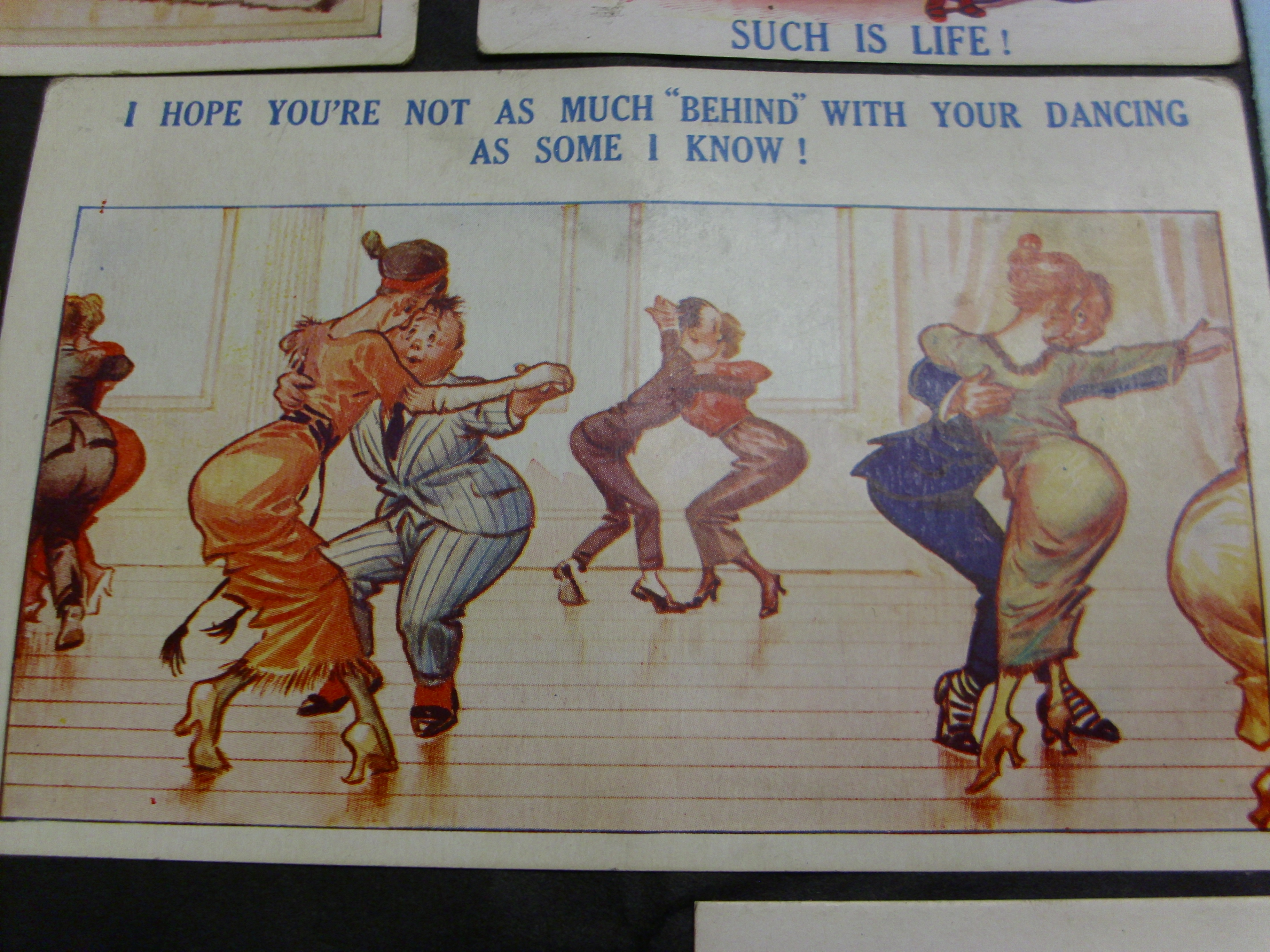
In my travels across the United States one of the interesting misconceptions I have run into when chatting people about Collegiate Shag is that the proper posture is with ones’ butt or “fanny” out. The baffling thing to myself is I know the majority of people who teach Collegiate Shag in the United States and as far as I know, none of these individuals say this in their lessons.
Flier from a Penn State Scrapbook in the 1920's
Source of “Fanny Out” Opinion
It’s reasonable to see where their opinion may have stemmed from, this stylistic choice is featured in a few vintage clips. The two clips that stick out the most to me is here at the 1:35 mark in the 1943 clip from “The Powers Girl” and here at the 1:02 mark in this clip from the 1940 clip from “Mad Youth”.
In addition Ray Hirsch, a legendary shag dancer even mentions in an interview by CollegiateShag.com [1], “Then Shag came along. It had its own little interpretation. You put your fanny out […]” when talking about the dance. Even Kenny Nelson and Tiffany Wine in the Camp Hollywood 2009 Shag finals had that style choice as part of their double rhythm basic [2].
Why a Misconception?
My main counterpoint is this, there are clips (vintage and modern) that feature dancers who do not have their butt or “fanny” out when they dance Collegiate Shag. Example of one vintage clip without this styling is the Arthur Murry instructional video.
I view sticking ones “fanny” out as a valid style choice within the dance, however not as something that is seen as mandatory when attempting to stay within the aesthetic of it.
However I consider myself far from an authority on this subject. If anyone with more experience would like to chime in, your opinion or any information you have on the matter would be appreciated.
The last few months I have been going through the archives in the Special Collections Library here at Penn State for a personal project I am doing to understand the culture of dance during the 1910’s-1940’s that existed at the college. This has involved going through countless yearbooks, scrapbooks, newspaper clippings, and et cetera. I cherish the endeavor because each item from the archive I go through, I gain a little window into the life and perspective an individual from that era. In addition this process gives me a small glimpse into a much bigger picture of why students danced and the culture that revolved around it.
The Pennsylvania State University.
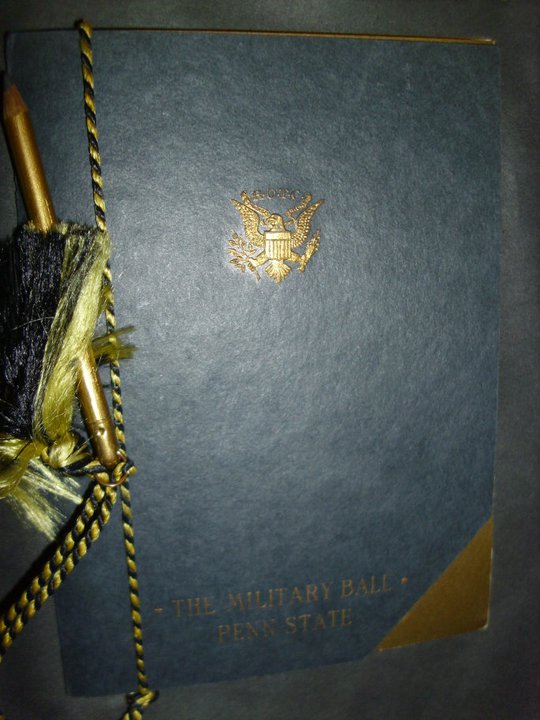
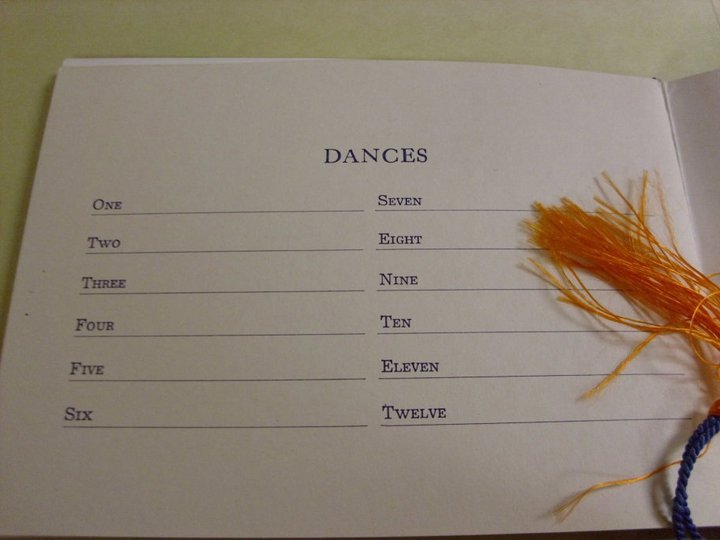
One of the items I frequently came across in scrap books whether it be a military man or an architectural engineer was a dance card. In the case of Penn State these are often small but elegantly designed booklets with a pencil attached to the side that had information such as; location of event, time of event, name of event, theme of event, distinguished guests, contributors to the event, name of band or entertainment, and lastly but certainly not the least a list of numbers followed by lines for names to be penciled in.
Besides being a keepsake, which is evidenced by how many I have ran across in yearbooks, it existed as a tool for social guidelines. Originally it was used by women to record the names of gentlemen she was to dance with at a ball. However in the case of many of the Penn State dance cards, they were owned by men and penciled in women’s names! Anyways, here is a small collection of dance cards I have captured with my camera in my research.
Military Ball (1929)
Military Ball - 1929
This is from a student by the name of Franklin Marsh who graduated 1928, his scrapbook contained two Military Ball dance cards but the 1929 one was in a more presentable condition. A common theme I have noticed from the late 20’s to the 40’s is involvement with the military as a reason for gathering for social dance. This particular dance was in celebration of a birthday as shown in the picture below.
Military Ball Description
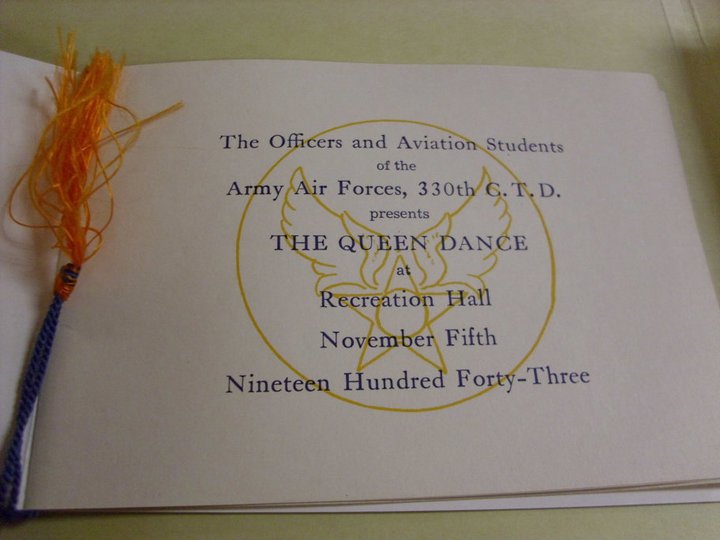
Queen Dance – Air Force Event (1943)
Dance card cover for Queen Dance. (1943)
A trend I noticed toward the WWII era was an increase in military dance events that mainly focused on pride within their branch of the military. The Navy, the Air Force, and the Army at Penn State during this time period all had separate events with often details previously left out in the past such as lists of officers attending. An interesting detail is toward the late 30’s I noticed a shift from more handmade ornate dance cards to almost mass manufactured ones.
Dance card cover for Queen Dance. (1943)
This dance had a tradition in which a young lady would be declared queen and would be mentioned in next years dance card as the retiring queen. I have been trying to locate an Air Force pilot from Penn State during this time to get more details about the event.
Dance list inside dance card for Queen Dance. (1943)
As mentioned before here is the list inside of the dance card for names of the individuals one wanted to dance with to be “penciled in”.
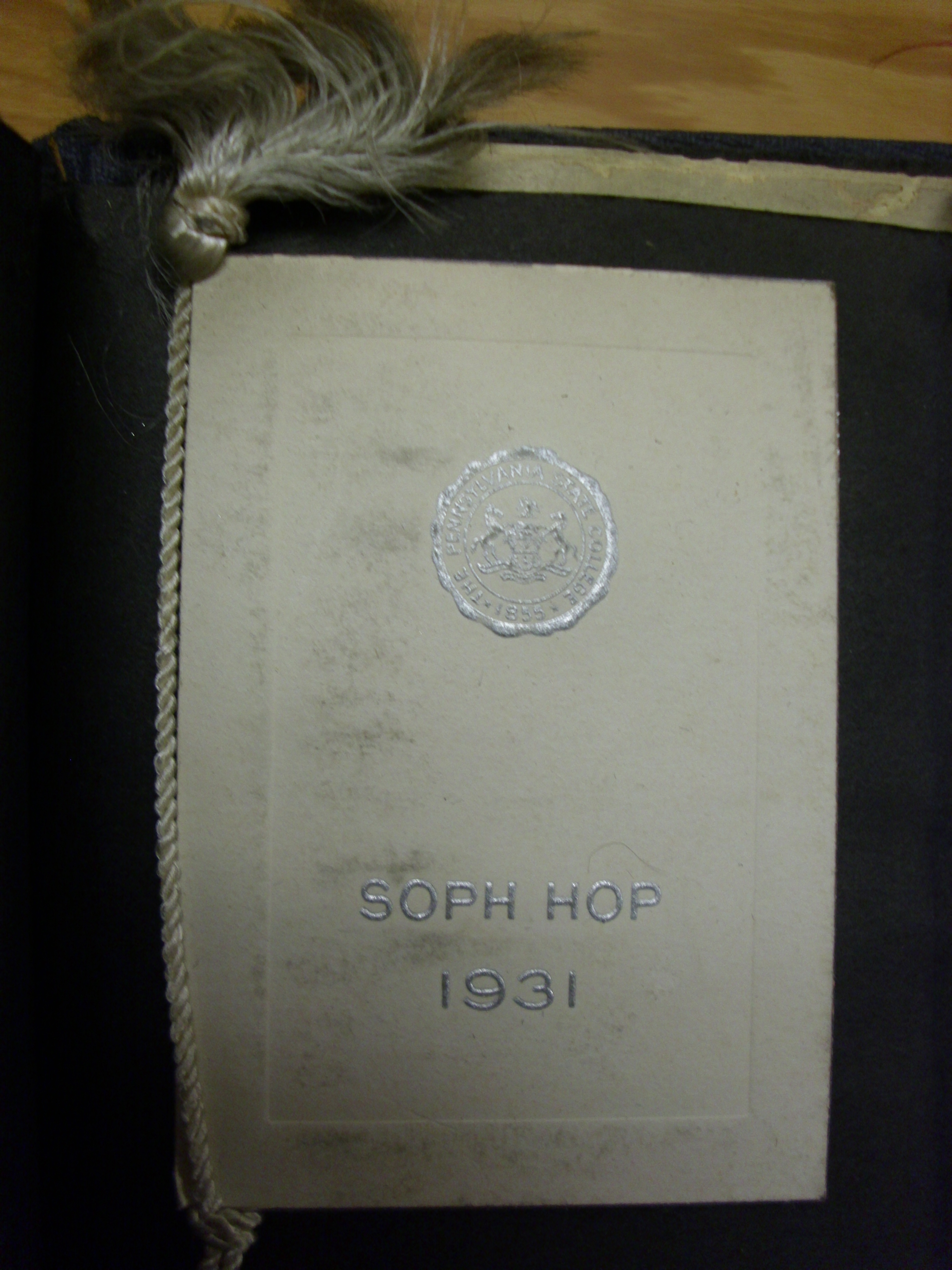
Soph Hop (1931)
Sophmore Hop (1931)
Senior Proms and Junior Promenades were commonplace at colleges in the 1920’s/1930’s and were often the social event of the year for the respective class. The Sophomore class at Penn State felt left out and in result had an event known as the Sophmore Hop or affectionately nicknamed the “Soph Hop”.
Sophomore Hop, inside of dance card. (1931)
As mentioned previously in this particular dance card a list of important guests are mentioned, which in this case are the class officers of the Sophomore class of 1931. Also to note is Ted Bartell is providing the music who used to play trumpet in the Paul Whiteman band, before starting his own group [1].
Future Use?
Given the numerous amount of these I have found in scrapbooks at Penn State, its a clear sign to me that they were great mementos and held much sentimental value to those who attended dances at Penn State. Personally I would love to see a return of them being at dances hosted by the swing dance community, maybe sans the rigorous social guidelines that came with the original balls they were used at. They could encourage people to interact with each other and exist as a reminder to those of attended an event of the fun times and memories they created.
Jesse Hanus over at Groove Juice Swing wrote an excellent article about how her their organization in Rochester utilized dance cards to their benefit. I encourage you to read it and hopefully apply the idea to your own scene.
In spite of erupting volcanoes [1], this past weekend Stomopolgy a.k.a. Stompo in Rochester, New York went off without a hitch. For those of you who are unfamiliar with the event, it is a rarity because it is a weekend that focuses only on solo jazz dance. (Its also the name of a catchy song by Lionel Hampton. [2])
As an attendee of past events run by Groove Juice Swing, I had expected a high caliber event in terms of organization. One thing I liked is they had youtube videos to add on to the Stompology Stomp-off, a solo dance routine created by the instructors for the event. It is great because; it is an amazing promotional tool, it fosters a sense of community and camaraderie for those who learn then perform it at the event, and lastly it is a great warm up/learning experience/or review for those going to a solo jazz dance weekend.
I’ll admit though the idea of a how a solo dance weekend is conducted was unfamiliar to me. I had a nagging fear in the back of my head that it would be the crazy energetic routine from hell the entire weekend. However my apprehensions were dashed because this was not the case and there was a good variety of classes, so either days of workshops did not become monotonous.
Classes
I’ll admit I only took six classes this year, partially because I had a little too much fun at the Saturday late night. However like I mentioned above I was pleased in the fact that very few of the classes were the traditional routine classes I find at most weekends. In addition even within the routine classes the instructors focused more on the transitions in between moves, technique behind a move, and how to add in style to make the move your own instead looking like a copy cat.
My favorite class was one I didn’t originally plan to take which was Solo Blues with Evita Arce. But I stuck around for it due to partial laziness of walking to the next building over and coaxing by my one friend from Charlottesville, Virginia.
In the class we learned two short sequences of choreography and then a transition to piece them together. But one of the important points of the class for myself was how Evita illustrated through example of how details such as gaze or hand placement can drastically change the look and feeling of the movement one is trying to present.
Another unique part of the class was we were split up into six different pods and asked to perform the choreography to a song we didn’t know to whatever counts we felt were appropriate. It was a memorable experience seeing how each individual interpreted the song and in the cases of the later groups adjusted their performances based on what they saw in previous pods. The class had a very experimental/modern dance/theater feel to it but I felt gave me a lot of new ideas and concepts to digest and work on.
Dances
For the Friday night dance they had the band the Crescent City Connection which I enjoyed, however some of their songs did drag on for awhile. The Saturday night dance the band Gordon’s Grand Street Stompers played.A noteworthy song for them was their rendition of “Be Our Guest” from the Disney classic movie “Beauty and the Beast”. Sadly they had a beautiful rendition of Avalon which was played the solo jazz finals, however that was probably a delight for the competitors. On a side note a nice touch was they had performances by local dancers and the instructors for both nights.
As usual the late night dances and hang out time at the Lindy Compound were amazing. If you want a further description of that experience check out my previous review of Steven and Virginie last year. At the Compound and the main dances I just want to give a shout out to DJ Rob Moreland who did a great job at keeping the energy going the entire weekend.
Grill Jam
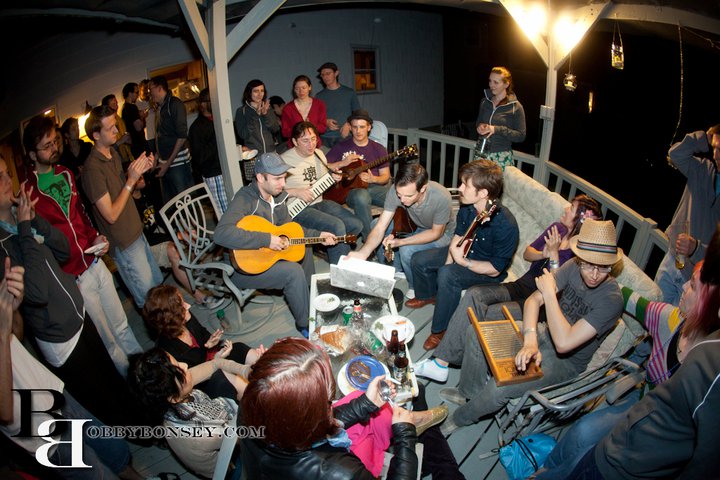
This year was Rochester’s 4th Grill Jam as well, the premise is everyone brings along food to grill and musical instruments if they are inclined to a local Rochester home. After a weekend of classes and dancing, it is a great kick-back event, a good way to build a community and get to know people who attended the event, and if you brought a bathing suit to go swimming.
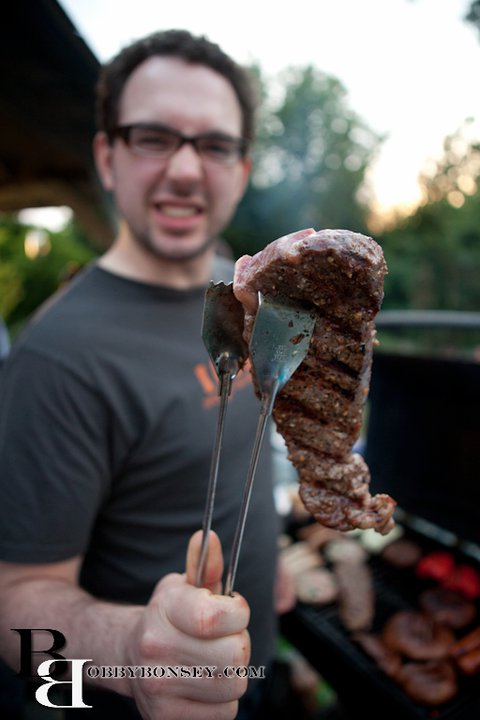
My highlight of the night was when Evita Arce and Nathan Bugh sang Crazy Rhythm together during the music jam. I could attempt to describe the event further, but I think these photos courtesy of event photographer Bobby Bonsey [3] do a much better job.
Ross Hopkins, legendary host and epic grillmaster.Epic Meal Time... Rochester StyleMusic jam, featuring songs such as Nagasaki and Crazy Rhythm
Overall
In spite of the many difficulties the organizers faced, Stompology was a great event in my opinion which I received a good education in solo jazz dancing and had a good time as well.
Footnotes
1. Unfortunately due to a volcano erruption, one of the main instructors Mike Faltesek was stranded in Australia. The organizers though managed to bring Mikey Pedroza, as well as Mike Roberts and Andrew Nemr as guest instructors to fill in.
2. Stompology: Lionel Hampton
3. I’d just like to say if you haven’t yet check out Bobby’s albums of Stompology and of Lindy Focus. Besides a high caliber of work, one thing a friend of mine pointed out that I agree with is when Bobby is taking these photos during events he is not intrusive whether it be during competitions, the social dance floor, or at a Sunday house party.
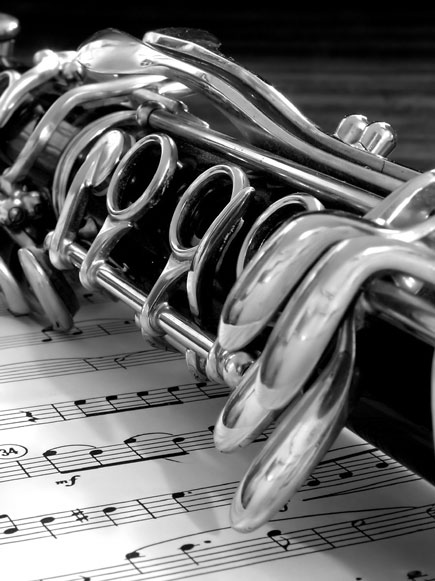
Mainly due to a life time curiosity to learn how to play a particular instrument and slightly because I wanted to understand music from a jazz musicians perspective, for about a little over a month I have slowly been learning how to play clarinet. Just last night I managed to play for the first time an entire scale (Bb major) without making a horrible noise or getting off time.
Clarinet the source of my joy and frustration as of late.
For a novice clarinet player this is difficult for several reasons. First is learning embouchure, which is ones ability to control facial muscles and shape lips to produce a good tone out of the clarinet. Second is just remembering the key fingerings for each note. Third is something referred to as “crossing the break”, if you want a detailed explanation you can find it here. However basically it requires you to have solid embouchure and key fingering. Until you put in consistent practice to gain the technique to do it well, often attempting to “cross the break” induces horrible noises and out of breath swearing.
Basketball and Jazz
Recently through a blog post featured at http://astudyinmovement.com/ I was linked to a Wired article that touches on several important points such as how due to the spontaneous and improvisational nature of Basketball and Jazz they are misconceived as simple and the importance of practice to developing the skills required by both subjects to be good at improvisation.
The Wired article writes,
The problem with our bias against improv, both in jazz and basketball, is that it fails to recognize all the mental labor behind these forms of entertainment. That jazz quartet might make their music look easy – the players are just playing – but that ease is an illusion. In reality, those musicians are relying on an intricate set of musical patterns, which allow them to invent beauty in real time.
With about 20-30 minutes of practice, for 4 to 5 days out of a week, after slightly over a month, and with one lesson from someone who was a trained clarinetist I was able to play one scale. Any of the songs in the jazz fakebooks I have, I can’t even think about touching at my skill level. Besides gaining immense respect for my jazz musician friends like Chloe Feoranzo, it reinforced my belief that creativity stems from having a foundation to draw upon for it.
The control of certain factors allows one to open themselves up for creative choices. Having good embouchure allows a clarinetist to choose what notes to play. A dancer who has a foundation in the ability to keep their weight over their feet will have the ability to vary their footwork. In contrast when a clarinetist has bad embouchure, they do not get the choice of what tone they want to make (often its none or an ear piercing one). A dancer who cannot keep weight over their feet is forced to either choose a position and footwork pattern to keep balance or to plummet to the floor.
One thing the Wired article writes that is important to take note is how consistent practice allows basketball players and jazz musicians to make split second decisions that are far more successful then people without their backgrounds. Ever notice a lead who seems to take any possible slip-up a follow gives and turns it into a move? Or ever notice a follow that no matter who the lead is, the leads ability seems to be improved much more then usual? Like musicians and basketball players, I think dancers through deliberate practice and experience on the social dance floor start through patterns gain the ability to improvise to new situations.
Common Misconception
Too often I hear this blanket statement, “Well X has been dancing for Y time. So that is why he/she is good if you danced for that long you would be that good as well.”
Garbage, I know people who have been dancing for almost 6-10 years and can get smoked by some people who have danced under a year. The ability to dance well and to have creativity does not come to one suddenly at a certain date like legal drinking rights. It comes with a serious investment in, quality practice on technique and improving ones dancing ability.
If you have any comments or opinions on the subject, please post them here. I find personally the more things I discover through the learning process as a novice, I realize how important it is to drill in fundamentals versus the immediate gratification of going for fun but more difficult stuff such as songs for musicians or flashy moves for dancers.
So last Wednesday I received what the doctor told me was a mild acromioclavicular joint separation injury, or commonly known more by its street name as “Shoulder Separation“‘.
AC joint separation injuries are rated from 1-6. Luckily mine was only a 1.
Luckily when I made an appointment at Penn State’s student medical center they had a doctor who specialized in sports injuries and had handled dancers before. The bad news was I had to keep my left arm in a sling for 1-3 weeks to rest my shoulder. The good news is as long as I kept it in moderation and carefully monitored my shoulder I could still dance!
Dancing With Only One Arm
After coming to the realization that I would dancing one armed for 1-3 weeks, I couldn’t help but think of Jimmy Valentine. If you don’t know his story, Peter Loggins writes a great article about him on his blog the Jassdancer. Jimmy was an amazing one-legged swing dancer who threw down in competitions like the Harvest Moon Ball and in jam circles, a legendary dancer in spite of his injury.
So feeling inspired the last week I have been dancing only using my right arm as a lead. Only having my right hand means all my swingouts have to either start from closed, cross-hand, or right hand to right hand. All visual cues that I could possibly give my left hand were now non-existent. I have had to rely on the free-spin version of many turns such as the tuck-turn or inside-turn.
One of the big things I have learned from being able to only lead swingouts right handed is many follows often use the letting go of the left hand as a signal for a free spin on a swingout. In result I have been leading a lot of forward swingouts. When not the forward swingouts, I have been having to lead crystal clear swingouts to not be misinterpreted. What is also interesting to see is how follows handle the left hand not being there, sometimes when I am going for her left hand my follow will present the right hand or vice versa. Lastly I have been dealing with the struggle of tensing up because I still mentally out of habit am trying to use the left hand for things before I stop myself.
It’s been a good learning experience. For myself I have learned what moves I know for my cross-hand and right-to-right hand repertoire. I’ve learned for teaching and for social dance what visual/physical cues some follows rely on from the left hand for certain moves. Lastly its a limitation that forces me to be creative with my dancing, I have noticed I have been focusing more on footwork lately since the number of moves I can lead consistently have been cut down.
In about a week or two I can start using my left arm again to dance, but for now I am enjoying the unintended benefits I am getting from the situation.
This past week with a couple of friend at Penn State I spent about 3+ hours polishing up my Tranky Doo. It is a jazz routine that I have taken a lesson on the first third of the routine from Shesha Marvin and learned the rest half-assing it in public online. However like most people in the world with the second half of the Big Apple, I could get through it albeit looking at someone more experienced and presenting it myself sloppily at best.
For those of you unfamilar with it Atomic Ballroom has a great description as follows,
“The Tranky Doo is even more fun than it sounds! A silly series of mostly jazz steps, this line dance was choreographed by Pepsi Bethel in the Savoy Ballroom during the 1940’s. Lindy hoppers will often spontaneously begin this routine and, much like the Shim Sham, individuals will join in once they recognize its beginning moves. Traditionally the song was danced to Erskine Hawkins Tuxedo Junction, a mellow tune, but the routine’s versatility allows it to be danced to a number of more upbeat songs such as Ella Fitzgerald’s Dipsy Doodle. The Spirit Moves, a widely studied video record of vintage dancing, has popularized the Dipsy Doodle because it was the score used for the Tranky Doo.”
One of the things that I love about the Tranky Doo is the room for self-expression or in some cases cohesion. Philly always looks adorable when you see sometimes they have certain quirks that most of them do together when they perform it. Yet some individuals can bring out a plethora of crazy creativity when it comes to the simplest of movements like the mambo-step. Anyways here are a long list of videos that I think are great if you are looking to get some Tranky Doo creative inspiration.
Below I have listed many different recorded Tranky Doo performances vintage & contemporary that have inspired me and I hope it does the same for you.
Vintage Tranky Doo Videos
Spirit Moves (Al Minns, Pepsi Bethel and Leon James)
The 1950’s documentary produced, directed, edited, and narrated by Mura Dehn shows the choreographer of the routine Pepsi Bethel and two legendary dancers Al Minns and Leon James performing the Tranky Doo.
Al Minns and Leon James on DuPont Show of the Week (1961)
Al and Leon start with the Tranky Doo but go into other dances such as shimmies and snake hips. Mike Faltesek & Nathan Bugh did a wonderful tribute to this performance at Lindy Focus 2010.
Al & Leon Performing During American Musical Theatre Credits
Al and Leon perform during the closing credits for American Musical Theatre to the song “When the Saints Go Marching In”. This was part of the promotional campaign for Marshall Stearns’s book “The Story of Jazz” that they both were interviewed for.
Unknown ??
Unfortunately I am at a loss when it comes to the historical information to this version of the Tranky Doo. However the performance is smooth as butter and is the only other performance I have seen to a live band. If you know any information about this please provide it to me and i’ll tack it on here and give you credit.
Contemporary Tranky Doo Videos
CCX 2008 Tranky Doo by Mike, Stefan and Bethany
The funny thing about this clip is I had friends in two different states (Pennsylvania/California) say that this is best performance of the Tranky Doo they have seen hands-down. I couldn’t agree with them more. My friend Annabel Truesdell insightfully commented the other day something to the effect that while they are all doing the steps, they are adding in their own personalities. I’ve noticed when a lot of people try to add their personalities in routines, they sometimes err into the region of going off on a tangent. None of these three make that mistake, on top of that they bring a truck-load of energy to the performance.
The Tranky Doo Performed by Shesha, Emily, and Mikey
This was the first version of the Tranky Doo I ever saw online a few years back. I just love how all their personalities shine through. Jo is yelling and hip shaking, Mikey makes a eagle caw noise on the eagle slide and uses his face to accent movements, and Shesha really uses his height to create some good lines.
What I particularly love about this clip (besides that it is in high-def) is the way that Laura Glaess really uses her dress to its full effect in accenting her motions. In addition a lot of them are ‘selling it’ to me and not just going through the motions.
New Years – Tranky Doo-Lindy Focus VII
Bobby White owning every shimmy, rock, and box steps. I know I overstress this in my blog, but it is the key point that separates someone from doing choreography and performing.
MoKanSwing (Nina Gilkenson and Mike Faltesek)
Most teachers when reviewing a lesson at the end of class usually glaze over the topic. They give a good review but lacking the energy they had in the class. Nina and Mike give it all in an end of a class review and bring a lot of energy to the table in this Tranky Doo. It is also one of the few videos shot at the rare side angle.
Hat Trick Tranky Doo (ILHC Cabaret Division 2010)
Props for the dapper hats, extra props for doing the Tranky Doo while using them for hat tricks. Also 1:14 is simply magical, the level of coordination that takes is impressive.
Sving du Nord 2007 (Dax Hock & Jojo Jackson)
What I like about this one is they seamlessly transition in and out of social dance during it and they are both paying attention to each other and using that within the performance. Some useful comments from the danceprimer blog where they note the smoothness of the performance and the inclusion of Shim Sham & Big Apple steps.
SHSC 2009 – Jazz Root Week – Dax & Alice Tranky Doo
This is a good example of a Tranky Doo performance in a class that from appearances literally just learned the routine. In addition I am a sucker for the beautiful shadows shown in this performance. Watch at 1:40 for how Alice accents the “When you think you’re crazy” lyrics in the Dipsy Doodle, hilarious.
Solo swingtanzen mit Ali&Katja aus Darmstadt un Heidelberg
If you couldn’t figure it out by the title, this is a Tranky Doo performed in Germany. Ali & Katja lead what appears to be a class of recently taught students. At 0:50 there is some pretty fancy footwork for the break by the gentleman in the front right. He does a fun walk variation at 1:48 as well. Also love the blue/red lighting as well.
Mike & Frida – Chevy Chase Ballroom (2003)
Unfortunately the person filming this clip only give us less then a minute of this Tranky Doo performance. However it is to probably the fastest song I’ve seen it performed to, and both Falty and Frida bring their A-Game, I don’t know how Frida does it but her applejacks look so controlled yet wild simultaneously. The commentary on the clip while slightly obnoxious, is also particularly hilarious.
KBF2011 Line Dance #1 Tranky Doo (Korea Balboa Festival)
Last but not certainly not least our friends from the Korea Balboa Festival throw down. Watch the girl in the red skirt and bow; she uses her skirt to accent her movement, looks like she is having the time of her life, puts her personal touch into the routine, and even has time to tease the guy in front of her at 0:37.
Overall
I watched around 30+ Tranky Doo videos and still had a hard time narrowing it down to the large amount of ones I posted. If you want to look at the rest that are not linked on here, check out this following link.
If you want to learn the Tranky Doo you can check yehoodi or an OC Swing Dance Club page for a list of printable choreography. In addition here are a bunch of youtube videos as well that you can follow along.
So if you know the routine already take a gander through the videos and try some new things out. If you don’t know it yet, you now have more then enough resources to learn it. Carpe Noctem folks.
With ILHC and Camp Hollywood fast approaching, the idea of competition is in the air. This prompted me to share with you all about one of the biggest competitions back in the actual swing era besides the Harvest Moon Ball, The International Jitterbug Championships also known as the The Swingeroo.
Swivel Magazine Article
Peter Loggins originally wrote about this topic for Swivel magazine, a swing dance publication which was produced in the 90’s. An online version of this document can be found here and is posted below for your convenience.
The Biggest Contest
by Peter Loggins
In the summer 1939 Los Angeles was a hot bed for big bands and swing dancers alike. With Artie Shaw’s Orchestra on the bill, the Palomar Ballroom on Vermont and 3rd was possibly THE center of attention in the beginning of June. Upon entering the Palomar to see the great big band, dancers were greeted by promotional posters advertising the “International Jitterbug Championships” To Artie Shaws and Ken Bakers Orchestra’s ! To be held June 18th 1939 at the Los Angeles Memorial Coliseum, Cash prizes over 2,500 dollars to be awarded !!! Dancers looked upon this contest as a chance to finally prove themselves.
Excited dancers chatted amongst themselves to see who would be the favorites and who had the most confidence. Early favorites were Jimmy Renkin and his partner, and Dean Collins and Jewel McGowan. In the weeks to come dancers started practicing their routines using all the tricks in the book to help them catch the eyes of the judges. The big debate was over who’s style of dancing would suit Artie Shaw’s Orchestra, swing or lindy? Roy Damron and Snooky Bishop were favorite show stoppers, coming from Alhambra and representing their troupe, “The Alhambra Alligators.” Hal Takier and Betty Roeser, from Redondo Beach, represented the famous “Ray Rand Swingers,” which the great Maxie Dorf was also part of. On many occasions Hal and Dean argued over who would win the upcoming contest that brought so many, many sponsors under the main Palomar leadership.
By Sunday the 18th over a thousand dancers had entered the contest. People from all over the United States had made the trip; representing over 20 states and 6 foreign countries! Tensions were high the night before, and many dancers could not sleep due to nervousness, however, all they had to do was do what they did best….. just dance. Lying awake at night, dancing in their heads, going over and over the routines they had been practicing only made them toss and turn in their beds. Restlessly they awaited sunrise, which would eventually heat the summer air above 80 degrees. Morning finally came.
The trip to the Coliseum was as emotional as 5 years prior, when the Coliseum hosted the 1932 Olympic summer games. Upon entering the great structure the dancers were met by over 26,000 fans. The middle of the would-be football field held the grand 12,000 foot dance floor, with one side hosting the band stand for the orchestras, and the other side hosting the judges’ platform. The Judges were dance directors sent in by different movie studios, and as they took the platform you could see Bill O’Donnell from Warner Brothers, Hermes Pan from RKO, Carlos Romero from Paramount, Nick Castle and Geneva Sawyer from 20th Century Fox along with other dance directors from other major studio’s. With over 1,000 dancers entered in the categories of Professional and Semi-Professional, smaller divisions were put together in order to run small groups of dancers at the same time, making them work their way up the ladder to the finals.
At 9:00 a.m. Ken Baker’s band swung into gear, kicking off the first rounds. The temperature was in the 70’s and rising. Early on, dancers Freddie Christopherson and his sister Betty won their Division. Jake Arkon and Marion Goldytook their Divison as well, upsetting one of the favorites: Dean Collins and Jewel McGowan. Another team to win their division was Hal Chavoor (Takier) and Betty Roeser, upsetting another favorite, Roy Damron and Snooky Bishop.
After all the Professional Division first rounds finally ended it was time for lunch and intermission while Artie Shaw’s Orchestra took to the band stand. As soon as Artie broke into one of his more popular songs thousands of fans broke through police lines and onto the field causing a mild riot. Dancers from the stands were swinging all over the huge dance floor and not until they returned to their seats did the contest continue.
The Finals finally came in the late afternoon. Under the 80+ degree Southern California sun, Artie Shaw’s Orchestra played away as the division finalist danced against each other at the same time. At 6:00 p.m. the event came to end as the dancers’ final steps made the Coliseum attendance applause with approval.
The Awards Ceremony was next and was held at the Palomar Ballroom. Starting with the Navy Divison, the winners were Danny Stephenson and Annabelle Hoffman. The National Champions came next: Herman Harrison and Ernestine Davidson, a black couple from Los Angeles who had the crowds roaring with laughter when Ernestine, who weighed nearly 200 lbs, went through their airsteps and routines with her partner Herman, who hardly tipped the scales at 100 lbs.
At last it was time to announce the winners of the Granddaddy of them all: The International Championships! First came the runners up: Hal Chavoor (Takier) and Betty Roeser, “The Spanish American” champions known for their fast foot work and ability to put on a good show at mach speed. Then the Big Winners were announced……… Jack Arkon and Marion Goldy from Los Angeles. Jack and Marion lived in the “Miracle Mile” area of Wilshire Blvd. and had localized many of the favorite spots in L.A. since the mid 1930’s. Winning the International Jitterbug Contest lead them to perform in Ken Murray’s, “Black Out,” and at the El Capitan theater to name couple, not to mention appearing with Artie Shaw’s Orchestra and the other winners in the weeks following the contest.
This day in history is now nothing more than a few rare, fragile, and yellowed newspapers gently tucked away, and an old memory that only a few alive can share. The Coliseum is vacant of fans and Mr. Shaw doesn’t play the music that used to move the feet of dancers. Well, at least this event did take place, although long ago, and it gives us all something to dream about as we drive past the Coliseum: the biggest Jitterbug Contest in history……
Images of the Swingeroo
One of the difficulties of researching about this event is while it was held in the Los Angeles Coliseum, it was sponsored by the nearby Palomar Ballroom so some resources (to my personal belief) have incorrectly labeled pictures as at the Palomar Ballroom for the same event. Below are some photos from the Los Angeles Public Library Photo Collections of what I believe to be from the event.
1939 (Notice the shag in the background)Out of this world" hep-cats, the best in the U.S.A. and six foreign nations, are "jamming" Los Angeles for an International Jitterbug convention. Photo shows Hal Chavoor (Takier) and Betty Roeser, Pacific Coast champions, "going to town" as fellow swingsters admire. Photo dated: 1939.1939 - Notice the Kansas sign, people from all over the United States attended this competition.Hal Chavoor and Betty Roeser, Pacific Coast champion jitterbug dancers, are shown when they qualified for the International Jitterbug Championship to be staged at the Coliseum. Photo dated: June 9, 1939.
Perspective
Here are the following square feet measurements of several iconic ballrooms associated by swing dancers across the United States:
Avalon Casino Ballroom (California): 10,000 or 18,000 sq. ft (I’ve seen it listed differently on several sites)
Palladium Ballroom (California): 11,200 square foot (Now called the Hollywood Palladium)
Glen Echo Spanish Ballroom (Washington D.C.): 6,500 sq. ft
Century Ballroom (Seattle): 2,000 sq. ft
This contest was held on a 12,000 sq. ft dance floor set up at the Los Angeles Memorial Coliseum, with a crowd of 26,000 people! Most national/internationally recognized competitions are lucky if attendance breaks 1,000 people these days.
1959 - Red Sox vs. Dodgers at the LA Memorial Coliseum
The first time I encountered the Los Angeles Memorial Coliseum was oddly enough several years before I started swing dancing when I was a member of the rave community in southern California. At an event known as the Electric Daisy Carnival, I remember walking through the main gates and stopping of awe of the vastness of the crowd and the size of the coliseum, it was simply breathtaking.
I can’t even imagine walking through those same gates, hearing the legendary Artie Shaw performing with his full orchestra, and having come into view a massive dance floor with some of the best swing dancers in the world like Dean Collins competing while tens of thousands of swing dancers cheered them on.
Sadly on wikipedia and websites documenting the history of the Coliseum does not list this event. It is not mentioned in lieu of the Olympic and football related merits of the place. However I am sure to all who competed or watched that day or to those of us who have a curious interest in swing dance history, The Swingeroo has meaning.







 It's The Way That You Do It