Facebook Page

Cracking under peer pressure, I have broke down and created a facebook page for this blog. Besides announcing when new posts are up, I will occasionally put links up to dance related things I find interesting.

If this tickles your fancy, like the new facebook page here.

It Goes To Your Toes

At this past Stompology, Laura Glaess taught a routine inspired by a clip from the film “Greenwich Village” which I found educational and loads of fun. However when I saw the actual clip online after the event I was captivated by the dancing and the scene that goes on in that film clip. If you haven’t watch the actual clip, it has a slow and mellow intro but, it is a great contrast and build up for what comes after.

Sadly in the film the dancers are not credited, but they are according to IMDB: Al Williams, Freddy James, Sylvester Johnson, Earnest Morrison. What is interesting is IMDB lists all the dancers as part of the Four Step Brothers, yet when I looked at the wikipedia page Al Williams was the only name from the “Greenwich Village” cast list I recognized. Interesting thing is StreetSwing.com’s Four Step Brother page lists all three of them as troupe members with the exception of Earnest Morrison. Yet to contradict that Earnest’s Wikipedia page lists he left a performance troupe he was with to work with the Step Brothers act.

My best guess is that possibly other members were busy at the time with service in the military and unable to perform in the film. But if anyone has a theory, or even better factual information that shows otherwise it would be great to hear from you.

On an ending note though the energy from this clip is infectious and am blown away by the combination of athleticism and precision used by the dancers in the clip. Most people I have shown this clip to have not seen it. If you have friends who are big fans of solo jazz I encourage you to share this with them.

Update:

Stompology has uploaded the video of the routine Laura taught at the event based on “It Goes To Your Toes”. Enjoy!

Learning to Teach Swing Dance 101

One story I have frequently encountered in the last year of my swing dance travels is individuals being thrown into the situation of teaching swing dance lessons and having to learn how to teach… while teaching. This story mainly has been encountered from individuals coming from college swing dance clubs or smaller and more isolated scenes.  This trial by fire experience for some people can be often an intimidating and stressful experience.

With this post I strive to create a list of suggestions and ideas for people who may have recently found out they will be teaching in the near future or those who eventually strive to teach.

  1. If Possible Teach At First With An Experienced Partner: This is not always possible, but having a mentor in most fields ranging from musicians, business, to sports have numerous benefits. Their previous experience will help you avoid pitfalls they may have encountered when first teaching and you will not have to reinvent the wheel when it comes to teaching methods. In addition your partner will likely be able to fill in gaps for moments you do not expect in a lesson due to inexperience.
  2. Take Introductory Classes Again, Except Focus on The Teaching Aspect: The first large benefit of this is it will force you go over your basics so they are clean for demonstration purposes. Second you will learn examples of visual tools such as exaggerating the wrong type of motion and verbal analogies teachers utilize in class to educate students.
  3. Learn the Opposite Role: I hold the opinion that if you only know how to lead or follow as an instructor, you are missing half the equation. It is frustrating for a student to hear, “Well I don’t know what to say, they just follow it/they just lead it”. What learning the opposite role allows you to understand what possible things can be going wrong within the lead or following of a partnership. A side benefit of this is if you are decent enough at both roles, you gain the ability to teach by yourself.
  4. Practice Being An Effective Speaker: Being a swing dance instructor is not just knowing how to dance. The way you hold yourself when you teach means a world of difference between someone who is perceived as “They know what they are doing.” versus “This person looks nervous and unsure of themselves”. This means when practicing speaking to a class you; project your voice so the whole group can hear, do not have distracting extraneous motion such as fiddling with hair/clothes, and make eye contact with students in your class.
  5. Learn the Importance of Word Choice: How your phrase things to students in your class can mean the difference between them feeling encouraged and understanding what you are trying to convey or them feeling lost and frustrated. Often with beginner/introductory level classes I try to phrase everything positively and use social reasons for motivation. I can rattle on all day about the aesthetic and technique reasons why looking down is bad for ones dancing and leads in my class will continue looking down. However if I list the two points that it you don’t want your partner to get upset when you collide into objects and it reduces the chances they will want to dance with you in the future (social acceptance/safety) many leads in the class start looking around the room to take care of their partner.
  6. Get Feedback From Individuals In Your Class/Other Experienced Dancers Or Instructors: Often when teaching classes people make mistakes not intentionally but out of inexperience or situations out of their hand such as a group of students walking in 15 minutes late. While there will always be that chance of unexpected variables, feedback from all sources will help you realize your strengths and weaknesses as an instructor and allow you to fine tune your lessons.
  7. Continue to Improve Your Own Dancing: Do not fall into what I refer to as “Big fish in a little pond” syndrome. Mostly in smaller isolated scenes I notice people start teaching then immediately think they are above learning and their dancing stagnates. I am a firm believer in that students learn dance mostly visually and the better example you are, the easier it is for them to learn and the less chance they will develop bad habits they will have to fix later.
  8. Continue to Improve Your Teaching Methods: If you do step seven occasionally you will encounter in your swing dance learning perhaps better teaching models then the one you currently use for a six count basic or swingouts. Perhaps you have discovered a better analogy that gets people to not be as tense while they dance. Constantly being in the mindset of “What can I improve?” is always an effective way to becoming a better instructor.
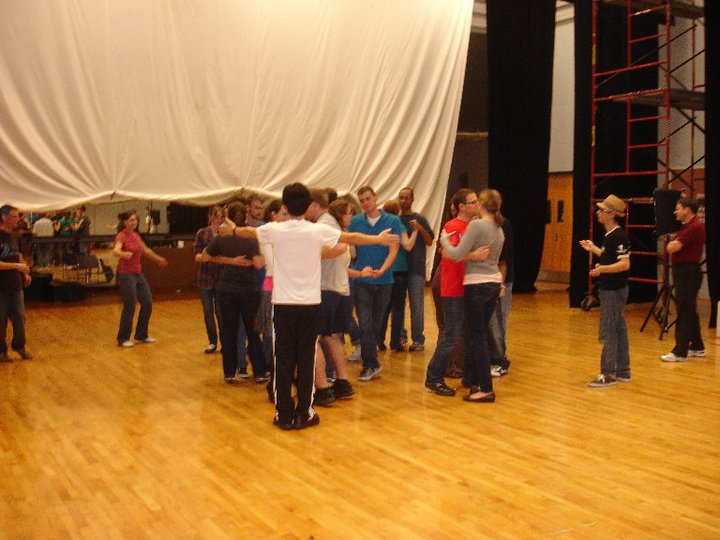
Floorcraft lesson at Penn State

My Story

When I found out about two years ago that after a summer I was probably going to teach classes at my college, I was at first apprehensive but then I did two things that helped me out tremendously. First I took a 4-week series of beginner Lindy Hop as a follow and focused on mainly what analogies instructors used while they taught and how they demonstrated moves and concepts. Second I went up to instructors who I admired their teaching and asked them to give me a brief talk of what advice they would give to a new teacher.

I feel learning from those who had experience versus attempting to figure out how to teach on my own was the most pivotal concept in learning how to teach for myself and it is the message I recommend the most to those who are new to the process. I have two blog posts related to this topic listed here and here. Otherwise if you have any thoughts or suggestions, I encourage you to post them in the comment section below.

Edit: Updated August 6th, 2019 to have more inclusive language for followers and leaders.

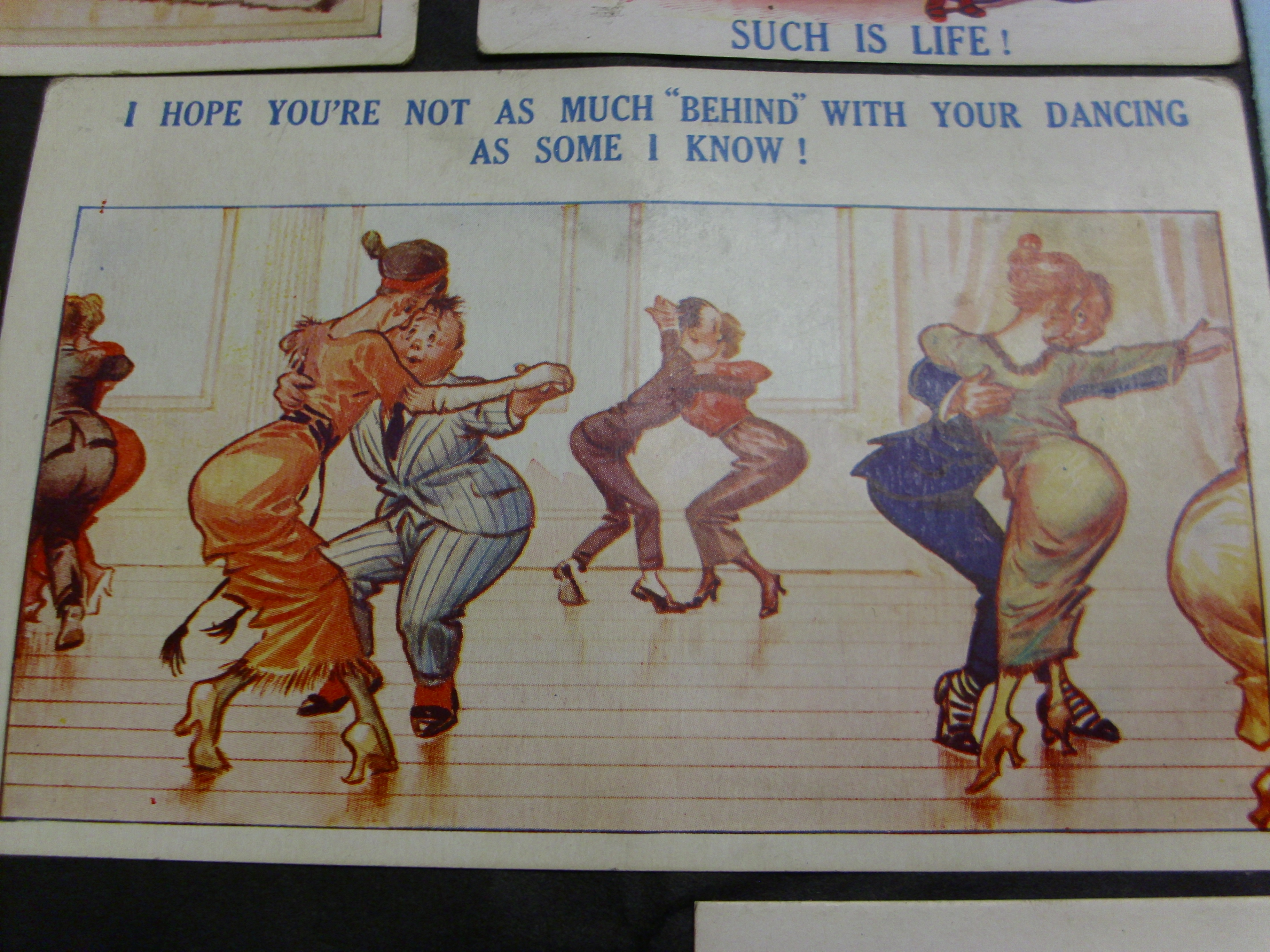
Collegiate Shag: Getting “Behind” A Misconception

In my travels across the United States one of the interesting misconceptions I have run into when chatting people about Collegiate Shag is that the proper posture is with ones’ butt or “fanny” out. The baffling thing to myself is I know the majority of people who teach Collegiate Shag in the United States and as far as I know, none of these individuals say this in their lessons.

Flier from a Penn State Scrapbook in the 1920's

Source of “Fanny Out” Opinion

It’s reasonable to see where their opinion may have stemmed from, this stylistic choice is featured in a few vintage clips. The two clips that stick out the most to me is here at the 1:35 mark in the 1943 clip from “The Powers Girl” and here at the 1:02  mark in this clip from the 1940 clip from “Mad Youth”.

In addition Ray Hirsch, a legendary shag dancer even mentions in an interview by CollegiateShag.com [1], “Then Shag came along. It had its own little interpretation. You put your fanny out […]” when talking about the dance. Even Kenny Nelson and Tiffany Wine in the Camp Hollywood 2009 Shag finals had that style choice as part of their double rhythm basic [2].

Why a Misconception?

My main counterpoint is this, there are clips (vintage and modern) that feature dancers who do not have their butt or “fanny” out when they dance Collegiate Shag. Example of one vintage clip without this styling is the Arthur Murry instructional video.

I view sticking ones “fanny” out as a valid style choice within the dance, however not as something that is seen as mandatory when attempting to stay within the aesthetic of it.

However I consider myself far from an authority on this subject. If anyone with more experience would like to chime in, your opinion or any information you have on the matter would be appreciated.

References:

1. CollegiateShag.com interview with Ray Hirsch, http://www.youtube.com/watch?v=cfMXJTu8958
2. Camp Hollywood 2009 Collegiate Shag Finals: http://www.youtube.com/watch?v=oPTmqw_92ZE

A Tidbit Of History: Penn State Dance Cards

The last few months I have been going through the archives in the Special Collections Library here at Penn State for a personal project I am doing to understand the culture of dance during the 1910’s-1940’s that existed at the college. This has involved going through countless yearbooks, scrapbooks, newspaper clippings, and et cetera. I cherish the endeavor because each item from the archive I go through, I gain a little window into the life and perspective an individual from that era. In addition this process gives me a small glimpse into a much bigger picture of why students danced and the culture that revolved around it.

The Pennsylvania State University.

One of the items I frequently came across in scrap books whether it be a military man or an architectural engineer was a dance card. In the case of Penn State these are often small but elegantly designed booklets with a pencil attached to the side that had information such as; location of event, time of event, name of event, theme of event, distinguished guests, contributors to the event, name of band or entertainment, and lastly but certainly not the least a list of numbers followed by lines for names to be penciled in.

Besides being a keepsake, which is evidenced by how many I have ran across in yearbooks, it existed as a tool for social guidelines. Originally it was used by women to record the names of gentlemen she was to dance with at a ball. However in the case of many of the Penn State dance cards, they were owned by men and penciled in women’s names! Anyways, here is a small collection of dance cards I have captured with my camera in my research.

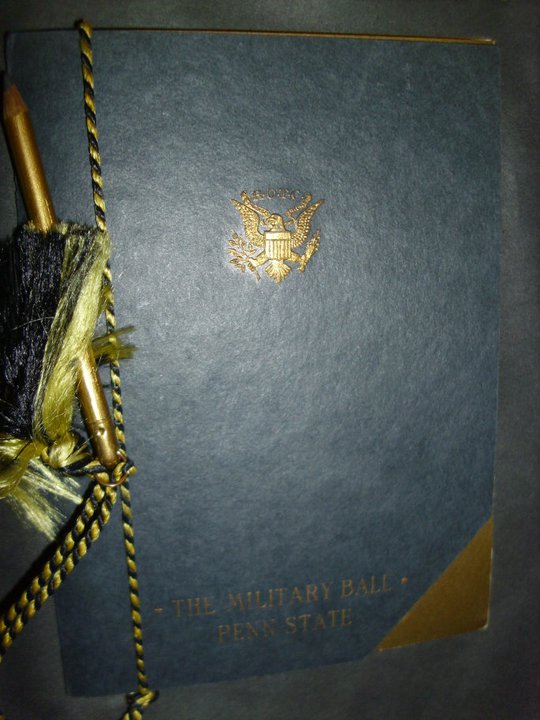
Military Ball (1929) 

Military Ball - 1929

This is from a student by the name of Franklin Marsh who graduated 1928, his scrapbook contained two Military Ball dance cards but the 1929 one was in a more presentable condition. A common theme I have noticed from the late 20’s to the 40’s is involvement with the military as a reason for gathering for social dance. This particular dance was in celebration of a birthday as shown in the picture below.

Military Ball Description

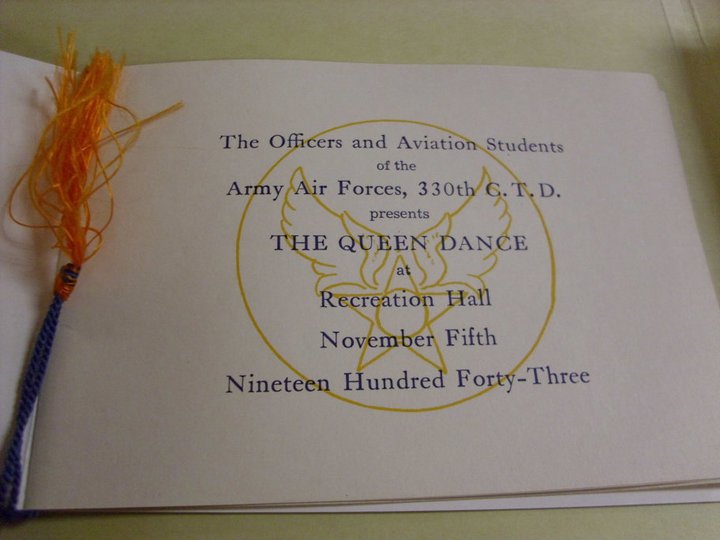
Queen Dance – Air Force Event (1943)

Dance card cover for Queen Dance. (1943)

A trend I noticed toward the WWII era was an increase in military dance events that mainly focused on pride within their branch of the military. The Navy, the Air Force, and the Army at Penn State during this time period all had separate events with often details previously left out in the past such as lists of officers attending. An interesting detail is toward the late 30’s I noticed a shift from more handmade ornate dance cards to almost mass manufactured ones.

Dance card cover for Queen Dance. (1943)

 This dance had a tradition in which a young lady would be declared queen and would be mentioned in next years dance card as the retiring queen. I have been trying to locate an Air Force pilot from Penn State during this time to get more details about the event.

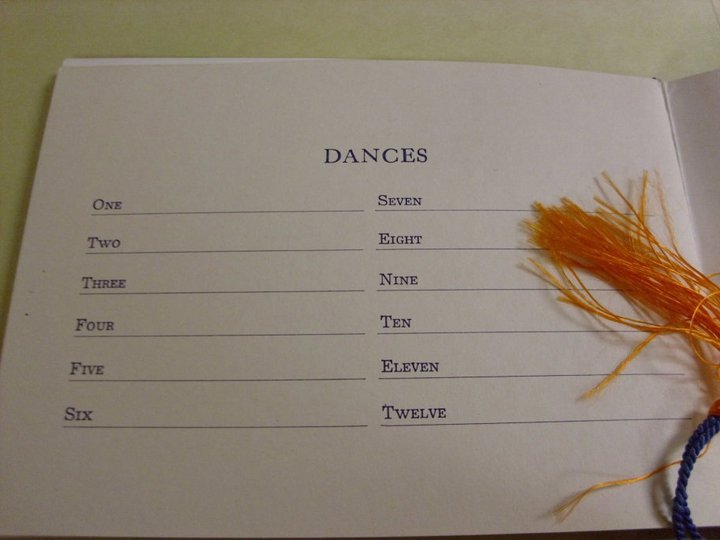
Dance list inside dance card for Queen Dance. (1943)

As mentioned before here is the list inside of the dance card for names of the individuals one wanted to dance with to be “penciled in”.

Soph Hop (1931)

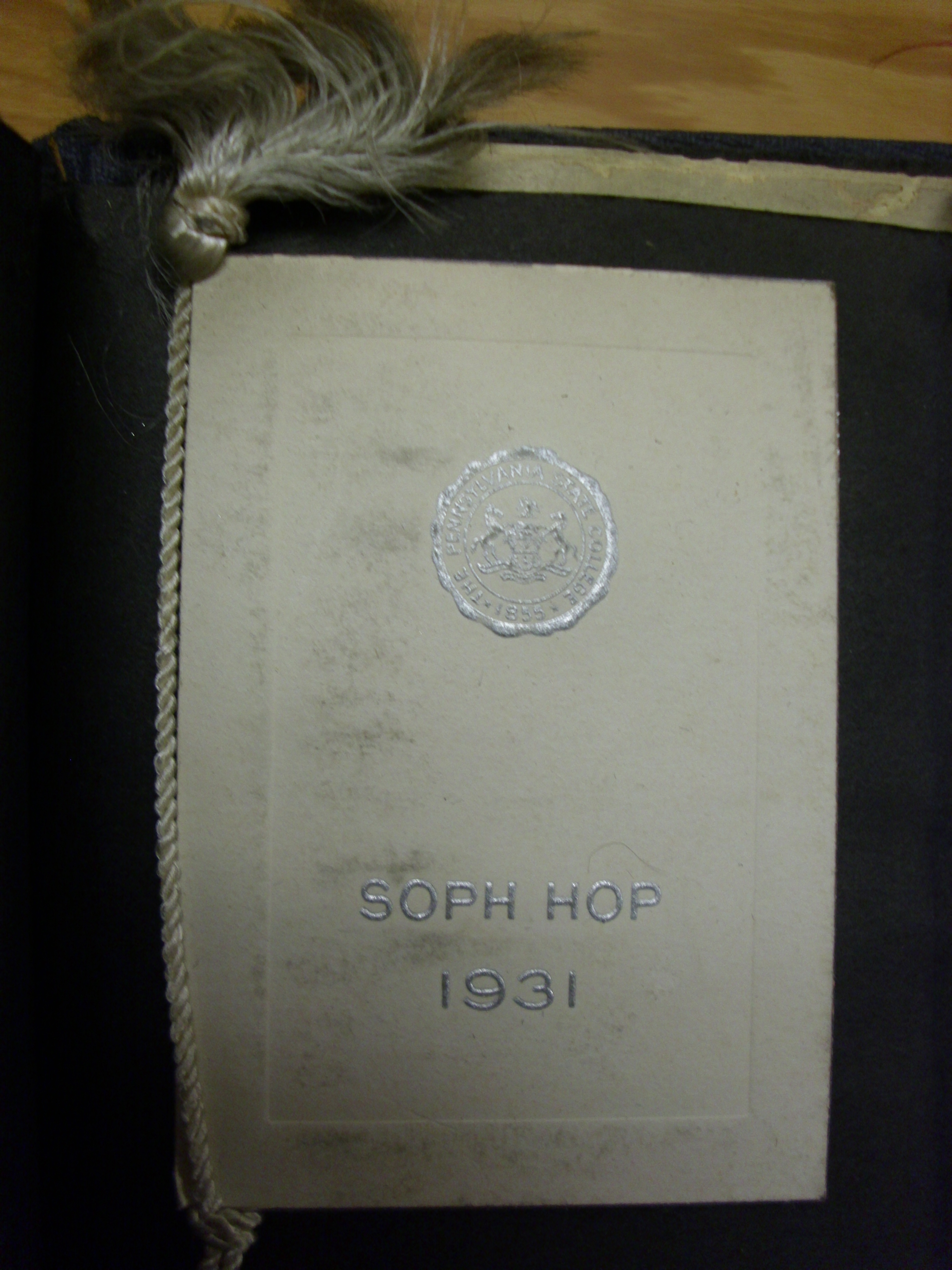
Sophmore Hop (1931)

Senior Proms and Junior Promenades were commonplace at colleges in the 1920’s/1930’s and were often the social event of the year for the respective class. The Sophomore class at Penn State felt left out and in result had an event known as the Sophmore Hop or affectionately nicknamed the “Soph Hop”.

Sophomore Hop, inside of dance card. (1931)

As mentioned previously in this particular dance card a list of important guests are mentioned, which in this case are the class officers of the Sophomore class of 1931. Also to note is Ted Bartell is providing the music who used to play trumpet in the Paul Whiteman band, before starting his own group [1].

Future Use?

Given the numerous amount of these I have found in scrapbooks at Penn State, its a clear sign to me that they were great mementos and held much sentimental value to those who attended dances at Penn State. Personally I would love to see a return of them being at dances hosted by the swing dance community, maybe sans the rigorous social guidelines that came with the original balls they were used at. They could encourage people to interact with each other and exist as a reminder to those of attended an event of the fun times and memories they created.

Jesse Hanus over at Groove Juice Swing wrote an excellent article about how her their organization in Rochester utilized dance cards to their benefit. I encourage you to read it and hopefully apply the idea to your own scene.

References:

1. http://www.raeproductions.com/music/funny.html

Event Review: Stompology

In spite of erupting volcanoes [1], this past weekend Stomopolgy a.k.a. Stompo in Rochester, New York went off without a hitch. For those of you who are unfamiliar with the event, it is a rarity because it is a weekend that focuses only on solo jazz dance. (Its also the name of a catchy song by Lionel Hampton. [2])

As an attendee of past events run by Groove Juice Swing, I had expected a high caliber event in terms of organization. One thing I liked is they had youtube videos to add on to the Stompology Stomp-off, a solo dance routine created by the instructors for the event. It is great because; it is an amazing promotional tool, it fosters a sense of community and camaraderie for those who learn then perform it at the event, and lastly it is a great warm up/learning experience/or review for those going to a solo jazz dance weekend.

I’ll admit though the idea of a how a solo dance weekend is conducted was unfamiliar to me. I had a nagging fear in the back of my head that it would be the crazy energetic routine from hell the entire weekend. However my apprehensions were dashed because this was not the case and there was a good variety of classes, so either days of workshops did not become monotonous.

Classes

I’ll admit I only took six classes this year, partially because I had a little too much fun at the Saturday late night. However like I mentioned above I was pleased in the fact that very few of the classes were the traditional routine classes I find at most weekends. In addition even within the routine classes the instructors focused more on the transitions in between moves, technique behind a move, and how to add in style to make the move your own instead looking like a copy cat.

My favorite class was one I didn’t originally plan to take which was Solo Blues with Evita Arce. But I stuck around for it due to partial laziness of walking to the next building over and coaxing by my one friend from Charlottesville, Virginia.

In the class we learned two short sequences of choreography and then a transition to piece them together. But one of the important points of the class for myself was how Evita illustrated through example of how details such as gaze or hand placement can drastically change the look and feeling of the movement one is trying to present.

Another unique part of the class was we were split up into six different pods and asked to perform the choreography to a song we didn’t know to whatever counts we felt were appropriate. It was a memorable experience seeing how each individual interpreted the song and in the cases of the later groups adjusted their performances based on what they saw in previous pods. The class had a very experimental/modern dance/theater feel to it but I felt gave me a lot of new ideas and concepts to digest and work on.

Dances

For the Friday night dance they had the band the Crescent City Connection which I enjoyed, however some of their songs did drag on for awhile. The Saturday night dance the band Gordon’s Grand Street Stompers played.A noteworthy song for them was their rendition of “Be Our Guest” from the Disney classic movie “Beauty and the Beast”. Sadly they had a beautiful rendition of Avalon which was played the solo jazz finals, however that was probably a delight for the competitors.  On a side note a nice touch was they had performances by local dancers and the instructors for both nights.

As usual the late night dances and hang out time at the Lindy Compound were amazing. If you want a further description of that experience check out my previous review of Steven and Virginie last year. At the Compound and the main dances I just want to give a shout out to DJ Rob Moreland who did a great job at keeping the energy going the entire weekend.

Grill Jam

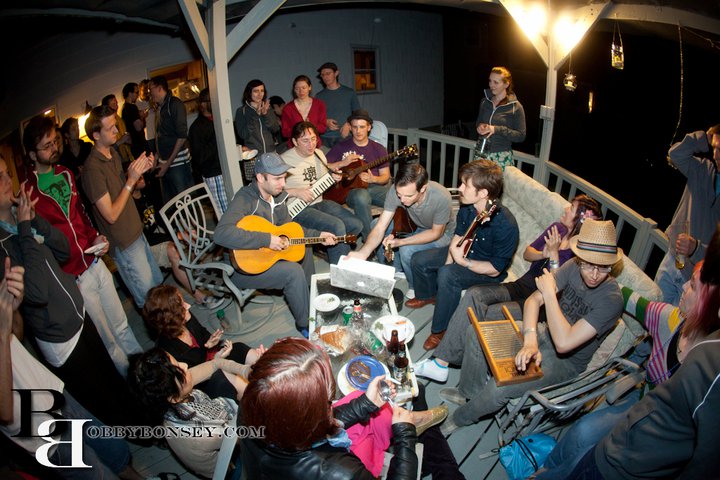
This year was Rochester’s 4th Grill Jam as well, the premise is everyone brings along food to grill and musical instruments if they are inclined to a local Rochester home. After a weekend of classes and dancing, it is a great kick-back event, a good way to build a community and get to know people who attended the event, and if you brought a bathing suit to go swimming.

My highlight of the night was when Evita Arce and Nathan Bugh sang Crazy Rhythm together during the music jam. I could attempt to describe the event further, but I think these photos courtesy of event photographer Bobby Bonsey [3] do a much better job.

Ross Hopkins, legendary host and epic grillmaster.
Epic Meal Time... Rochester Style
Music jam, featuring songs such as Nagasaki and Crazy Rhythm

Overall

In spite of the many difficulties the organizers faced, Stompology was a great event in my opinion which I received a good education in solo jazz dancing and had a good time as well.

Footnotes

1. Unfortunately due to a volcano erruption, one of the main instructors Mike Faltesek was stranded in Australia. The organizers though managed to bring Mikey Pedroza, as well as Mike Roberts and Andrew Nemr as guest instructors to fill in.

2. Stompology: Lionel Hampton

3. I’d just like to say if you haven’t yet check out Bobby’s albums of Stompology and of Lindy Focus. Besides a high caliber of work, one thing a friend of mine pointed out that I agree with is when Bobby is taking these photos during events he is not intrusive whether it be during competitions, the social dance floor, or at a Sunday house party.

Laying Down A Foundation: Tool to Creativity

Being A Novice Musician

Mainly due to a life time curiosity to learn how to play a particular instrument and slightly because I wanted to understand music from a jazz musicians perspective, for about a little over a month I have slowly been learning how to play clarinet. Just last night I managed to play for the first time an entire scale (Bb major) without making a horrible noise or getting off time.

Clarinet the source of my joy and frustration as of late.

For a novice clarinet player this is difficult for several reasons. First is learning embouchure, which is ones ability to control facial muscles and shape lips to produce a good tone out of the clarinet. Second is just remembering the key fingerings for each note. Third is something referred to as “crossing the break”, if you want a detailed explanation you can find it here. However basically it requires you to have solid embouchure and key fingering. Until you put in consistent practice to gain the technique to do it well, often attempting to “cross the break” induces horrible noises and out of breath swearing.

Basketball and Jazz

Recently through a blog post featured at http://astudyinmovement.com/ I was linked to a Wired article that touches on several important points such as how due to the spontaneous and improvisational nature of Basketball and Jazz they are misconceived as simple and the importance of practice to developing the skills required by both subjects to be good at improvisation.

The Wired article writes,

The problem with our bias against improv, both in jazz and basketball, is that it fails to recognize all the mental labor behind these forms of entertainment. That jazz quartet might make their music look easy – the players are just playing – but that ease is an illusion. In reality, those musicians are relying on an intricate set of musical patterns, which allow them to invent beauty in real time.

With about 20-30 minutes of practice, for 4 to 5 days out of a week, after slightly over a month, and with one lesson from someone who was a trained clarinetist I was able to play one scale. Any of the songs in the jazz fakebooks I have, I can’t even think about touching at my skill level. Besides gaining immense respect for my jazz musician friends like Chloe Feoranzo, it reinforced my belief that creativity stems from having a foundation to draw upon for it.

The control of certain factors allows one to open themselves up for creative choices. Having good embouchure allows a clarinetist to choose what notes to play. A dancer who has a foundation in the ability to keep their weight over their feet will have the ability to vary their footwork. In contrast when a clarinetist has bad embouchure, they do not get the choice of what tone they want to make (often its none or an ear piercing one). A dancer who cannot keep weight over their feet is forced to either choose a position and footwork pattern to keep balance or to plummet to the floor.

One thing the Wired article writes that is important to take note is how consistent practice allows basketball players and jazz musicians to make split second decisions that are far more successful then people without their backgrounds. Ever notice a lead who seems to take any possible slip-up a follow gives and turns it into a move? Or ever notice a follow that no matter who the lead is, the leads ability seems to be improved much more then usual? Like musicians and basketball players, I think dancers through deliberate practice and experience on the social dance floor start through patterns gain the ability to improvise to new situations.

Common Misconception

Too often I hear this blanket statement, “Well X has been dancing for Y time. So that is why he/she is good if you danced for that long you would be that good as well.”

Garbage, I know people who have been dancing for almost 6-10 years and can get smoked by some people who have danced under a year. The ability to dance well and to have creativity does not come to one suddenly at a certain date like legal drinking rights. It comes with a serious investment in, quality practice on technique and improving ones dancing ability.

If you have any comments or opinions on the subject, please post them here. I find personally the more things I discover through the learning process as a novice, I realize how important it is to drill in fundamentals versus the immediate gratification of going for fun but more difficult stuff such as songs for musicians or flashy moves for dancers.

Song Progression: Why Don’t You Do Right

One of the things I like to do to pass the time is something I call “Song Progression”. What I do is find as many versions of one song that catches my eye and then play them in chronological order while looking up the history of each. Besides being entertaining, it is educational for myself as DJ to see which artists influenced others and possibly find new finds for my collection.

I was listening to the latest Yehoodi Talk Show the other night and caught a unique version of Why Don’t You Do Right which I will go into further into toward the end of this entry.

The Weed Smoker’s Dream – Harlem Hamfats (1936)

The song was written in 1936 by a gentleman named Kansas Joe McCoy with the title of “The Weed Smoker’s Dream”. Fun fact for those of you who are classic rock fans, McCoy was also one of the co-writers for the song When The Levee Breaks which was famously covered by Led Zeppelin.

Kansas Joe McCoy performed the song with his brother Charlie and other band members of the group famously known as the Harlem Hamfats. Something to note is lyrics to this song are also different (much less family-friendly) then in Why Don’t You Do Right and is listed below,

Sittin’ on a million
Sittin’ on it every day
Can’t make no money givin’ your stuff away
Why don’t you do now
like the millionaires do
Put your stuff on the market
And make a million too

Fay’s a betting woman
She bets on every hand
She’s a trickin’ mother for you every-where she land
Why don’t you do now
like the millionaires do
Put your stuff on the market
And make a million too

May’s a good-lookin’ frail
She lives down by the jail
On her back though she got hot stuff for sale
Why don’t you do now
like the millionaires do
Put your stuff on the market
And make a million too

Why Don’t You Do Right – Lil Green (1941)

Kansas Joe McCoy after putting out the 1936 version of the song rewrote modifying the composition and changing the lyrics entirely as listed below.

You had plenty of money in 1922
You let other women make a fool of you

Why don’t you do right?
Like some other men do
Get out of here and get me some money, too

You’re sittin’ down wonderin’ what it’s all about
You ain’t got no money that will put you out

Why don’t you do right?
Like some other men do
Get out of here and get me some money, too

If you have prepared twenty years ago
You wouldn’t be wanderin’ now from door to door

Why don’t you do right?
Like some other men do
Get out of here and get me some money, too

I fell for you jiving and I too you in
Now all you’ve got to offer me is a drink of gin

Why don’t you do right?
Like some other men do
Get out of here and get me some money, too

The result was “Why Don’t You Do Right” and it was recorded by Lil Green with guitar provided by Big Bill Broonzy.

Lillian Green was born in Mississippi 1919, however her parents died when she was young and in result she moved to Chicago where she started performing in local nightclubs as a teenager. A website Acrobat Music wrote in respect to Green,

“[…] She became noted as a highly individual singer with a fine sense of timing and a distinctively sinuous delivery.”

Why Don’t You Do Right – Benny Goodman Featuring Peggy Lee (1942)

 On July 27, 1942 in New York with Benny Goodman, Peggy Lee covered Lil’ Green’s version of “Why Don’t You Do Right” which later sold over a million copies and launched her into the national spotlight.

According to wikipedia the story of how this came about is below,

Peggy Lee often stated that Green’s recording was extremely influential to her music. In a 1984 interview she said “I was and am a fan of Lil Green, a great old blues singer, and Lil recorded it. I used to play that record over and over in my dressing room, which was next door to Benny’s (Goodman). Finally he said, ‘You obviously like that song.’ I said ‘Oh, I love it.’ He said ‘Would you like me to have an arrangement made of it?’ I said, ‘I’d love that,’ and he did.”

The first video of Peggy’s performance is her trading off with Benny Goodman’s clarinet.

This second video has a different feel by making Peggy the spotlight and putting the band in the background.

Lee had a stage presence that could just captivate you, in the second video notice how she seems to use every facial expression to accent what she is singing in the music. A quote that I think describes her well from her website is,

“Lee’s most lasting influence was the fact that she could be both a pop and a jazz singer. Her main quality was a marvelous sense of subtlety. She never overpowered you. You could hear her voice after it stopped.” – Jazz Critic, Nat Hentoff

Peggy Lee

Why Don’t You Do Right – Who Framed Roger Rabbit (1988)

A box office hit and and wildly popular (a dance move at the time was named after it), the movie “Who Framed Roger Rabbit” was released in 1988.  The plot of the film according wikipedia writes,

“The story is a murder mystery set in 1947, in a surreal world where cartoon characters, commonly called “toons”, are living beings who act out cartoons in the same way that human actors make live-action productions.”

In the film Amy Irving sings a cover of the song “Why Don’t You Do Right” providing the voice for the character in the film Jessica Rabbit.

Due to the widespread popularity of the movie, the song was again brought back in the national spotlight over 40 years later after Peggy Lee’s national success.

References:

  1. Wikipedia article on Kansas Joe McCoy: http://en.wikipedia.org/wiki/Kansas_Joe_McCoy
  2. Wikipedia article on Harlem Hamfats: http://en.wikipedia.org/wiki/Harlem_Hamfats
  3. Memphis History’s article on Kansas Joe McCoy: http://www.memphishistory.org/Music/TheBlues/BluesArtists1/KansasJoeMcCoy/tabid/287/Default.aspx
  4. Weenie Campbell’s website, discussion on “The Weed Smokers Dream” lyrics: http://weeniecampbell.com/yabbse/index.php?topic=661.0;wap2
  5. Wikipedia article on Lil Green:  http://en.wikipedia.org/wiki/Lil_Green
  6. Acrobat Music article on Lil Green: http://www.acrobatmusic.net/?cid=24&NewsId=113
  7. Wikipedia article on Peggy Lee: http://en.wikipedia.org/wiki/Peggy_Lee
  8. Remembering Miss Peggy Lee, article from her personal website: http://www.peggylee.com/solos/accolades.html
  9. Wikipedia article on Why Don’t You Do Right: http://en.wikipedia.org/wiki/Why_Don’t_You_Do_Right
  10. Wikipedia article on Who Framed Roger Rabbit: http://en.wikipedia.org/wiki/Who_Framed_Roger_Rabbit

Dancing With An Injury: (Bye Bye Leftie)

So last Wednesday I received what the doctor told me was a mild acromioclavicular joint separation injury, or commonly known more by its street name as “Shoulder Separation“‘.

AC joint separation injuries are rated from 1-6. Luckily mine was only a 1.

Luckily when I made an appointment at Penn State’s student medical center they had a doctor who specialized in sports injuries and had handled dancers before. The bad news was I had to keep my left arm in a sling for 1-3 weeks to rest my shoulder. The good news is as long as I kept it in moderation and carefully monitored my shoulder I could still dance!

Dancing With Only One Arm

After coming to the realization that I would dancing one armed for 1-3 weeks, I couldn’t help but think of Jimmy Valentine. If you don’t know his story, Peter Loggins writes a great article about him on his blog the Jassdancer. Jimmy was an amazing one-legged swing dancer who threw down in competitions like the Harvest Moon Ball and in jam circles, a legendary dancer in spite of his injury.

So feeling inspired the last week I have been dancing only using my right arm as a lead. Only having my right hand means all my swingouts have to either start from closed, cross-hand, or right hand to right hand. All visual cues that I could possibly give my left hand were now non-existent. I have had to rely on the free-spin version of many turns such as the tuck-turn or inside-turn.

One of the big things I have learned from being able to only lead swingouts right handed is many follows often use the letting go of the left hand as a signal for a free spin on a swingout.  In result I have been leading a lot of forward swingouts. When not the forward swingouts, I have been having to lead crystal clear swingouts to not be misinterpreted. What is also interesting to see is how follows handle the left hand not being there, sometimes when I am going for her left hand my follow will present the right hand or vice versa. Lastly I have been dealing with the struggle of tensing up because I still mentally out of habit am trying to use the left hand for things before I stop myself.

It’s been a good learning experience. For myself I have learned what moves I know for my cross-hand and right-to-right hand repertoire. I’ve learned for teaching and for social dance what visual/physical cues some follows rely on from the left hand for certain moves. Lastly its a limitation that forces me to be creative with my dancing, I have noticed I have been focusing more on footwork lately since the number of moves I can lead consistently have been cut down.

In about a week or two I can start using my left arm again to dance, but for now I am enjoying the unintended benefits I am getting from the situation.

Hiring Swing Dance Instructors: From a College Organizer Perspective

For this post I am addressing a different crowd then I usually do, this post is mainly geared is those who consider themselves swing dance instructors or those who are trying to become them. However, it will still be an entertaining read for those who are interested what goes in behind the curtain of how a college scene hires instructors.

To give you my background I’ve played a part of the contacting and hiring of instructors for five different workshops over the last two years at Penn State.  Two of them were a Lindy/Blues workshop, one was a Lindy/Balboa workshop, one was a Balboa workshop, and the last one was a Collegiate Shag workshop. Choosing one couple out of the myriad of potential instructors across the United States is never a simple task and I wanted to give some transparency to the reasons behind the choices myself and other officers in the organization I participated in made.

Background Information

The funding committee Penn State in the past funded 80% of total operating costs (upgraded to 90% this upcoming semester) of approved events. However here is the kicker, we only are allowed honorarium for four different individuals an academic year. We deal with this by having one instructor and one band for each semester. We don’t hire instructors who live outside of the United States simply because the funding committee will not cover travel outside of the United States and it is a nightmare of paperwork to deal with international honorarium.

What this means is are limited in how many instructors we can hire, but we have the ability to financially afford top-notch instructors who live anywhere in the United States. In addition we can offer these workshops at prices that make most national events look like a kings ransom.

First Half: Convincing Groups of People

The most annoying part of the process for myself is I have to convince two groups of people that a set of instructors is worth hiring. First is the whole council of Penn State Swing Dance Club officers, second is the allocations committee who votes to allocate us funds.

The council of officers for the Penn State Swing Dance Club consists of variety of dancers: seasoned dancers who attend events all over the East coast and keep in touch with the national community, dancers who travel once in a blue moon but generally only stick in state college, and dancers who are self-isolated and never dance outside of state college. All of them have different perspectives of who is a good dancer, what dances should be taught at a workshop, who would be a good fit for our club, and who would draw in the most out of town dancers. For instructors it has to be a set of them that all parties including myself can compromise on. Unfortunately the side effect of this is quality instructors who may be more old-school or just great instructors in general that are not in the national competition circuit may get passed over, this is especially true the further away they are from Pennsylvania.

The allocations committee is comprised of 8-12 people who for the most part have no dance experience whatsoever. Jerry Almonte’s post Your Bio Sucks though is something to take in account, last thing I need is something that looks ridiculous when I am trying to convince a group of people that two individuals are professional dance instructors worthy of tuition money. Having; a website, quotes in professional media such as newspaper reviews about performances/workshops taught by instructors, examples of your dancing on youtube, and a list of awards/honors received are all things that make things easier on our end to get funding.  I mentioned to Mike Roberts and Laura Glaess at the Lindy & Blues workshop they taught at Penn State this past fall, the easiest request hearing I had was with them. This was because I was able to show the committee the Broadway Melody performance they did at Lindy Focus which many of them were able to relate to and found impressive due to having seen “Singin’ In The Rain”.
Second Half: Criteria for the Choices Made

Now that you have the background for the resources my college scene has for hiring instructors and the different sets of people that have to approve the selection of instructors made, I want to go in why personally as an organizer have chosen instructors to present to the council of officers and eventually to the allocations committee.

First off my biggest rule is I do not hire somebody I have not taken classes from personally or at a bare minimum had several respected peers give me the seal of approval. I often contact friends in other colleges/scenes who have had those instructors and ask them to give me the inside scoop of; what it was like working with them, quality of instruction, and how they interacted with the community during their stay. Instructors talk about their experiences with organizers, it goes the other way around as well.

The two biggest criteria for hiring instructors comes down to teaching ability and how good they are at fostering an enthusiastic spirit for dance.

While dancing ability is a factor, what is more important for my community is the ability for the instructors to translate that to the students. This is often tricky at Penn State because of the unique nature of it being a college workshop, yet having ridiculously cheap prices you get people ranging from a typical newbie college student dancer to an advanced out of town dancer who just came into town for a rare chance to get a private lesson from a high quality instructor. This means I particularly look for instructors who thrive in a mixed-level classes environment.

The majority of the Penn State Swing Dance club college students are beginner to beginner-intermediate dancers who often self-isolate themselves to only dancing in Central Pennsylvania at best or only at the college at worst. This means the majority of our crowd has no idea what the national swing dance community is like and has a very narrow view on what is considered “good dancing”. When we hire instructors, whether they know it or not also carry the weight of being ambassadors of the swing dance community and a source of inspiration. We can show our neophytes all the youtube clips we want but, nothing beats the actual thing in flesh and blood. Often for many of our students these events inspire them to make their first trip to an event outside the state of Pennsylvania. Their experience at our workshops are often the difference between if they just remain state-college only dancer or get motivated to join our core of traveling dancers on the East coast.

The last reason which I consider a minor one would be national reputation within and outside the swing dance community.

For our events we like getting as many out-of-town dancers as possible, however unfortunately for the majority of dancers they only want to travel for people who are popular on youtube and/or well known in the national competition circuit. Having a good reputation in the swing dance community besides attracting out of town dancers also makes it easier to convince the council of officers of why a set of instructors is qualified.

Having a good reputation outside of the swing dance community makes is easier to convince the allocations committee of why a set of instructors are qualified as professional instructors. Commercials, appearances in music videos, and appearances in television shoes make an you easy shoe-in for an easy approval during an allocations hearing. In addition for our newbie friendly lessons during a workshop, it becomes easier for a dancer to drag convince their friend who has never danced before to come along.

Summary: 

I hope this gave a good overview of the process of how the selection of instructors for my college scene workshop works, in addition to the many factors that come into play during the process. I’d like to comment that most colleges have the ability to get a similar set-up due to their student activity fees and in some cases can get their entire events free under anti-drinking/alcohol-free programs run by their schools.

If you have any questions I encourage you to ask me in public on this blog or privately at my email address apache.danse@gmail.com.