On How This Blog Has Survived In Spite of my Gypsy Travelling Ways
How my blog has felt to myself this past year.
From Montreal, Canada to New Orleans, Louisiana I have been traveling all over North America due to my wanderlust tendencies and dancing where I can. While trying to balance that, a part time job, and being a student I have attempted to regularly updating this blog. A times it has been often and well-written to my satisfaction, other days it has not.
Personal Favorites
For those of you who may be newer to the blog (or seasoned readers that feel in particular procrastinating), here are a few articles that I think stood out in my writing this past year:
A Tidbit Of History: Penn State Dance Cards: In this post I shared images and slight back stories to my personal research I did in the special collections library of dancing at Penn State in the 1920’s – 1940’s.
Learning to Teach Swing Dance 101: A guide written for the intention of my home scene that gives some tips for instructors who are teaching for their first time, especially those who are thrust into the situation.
Warm-Up Songs: A Worthy Investment for Competition: This particular post dealt with the issue of some competitions having warm up songs vanish and how different competitors in the scene felt about this issue.
When I intentionally created this blog it was due to having an outlet to dance-nerd about things that would bore most people in my local scene to death. If you ever have any suggestions on topics you would like to hear about or even just to shoot me a comment, the comment box is below and my email address is: apache.danse@gmail.com
As long as I am still dancing I intend to keep writing. Thanks to all you readers out there!
A few weeks ago I read reading Glenn Crytzer’s blog post about being bombarded with music in which one of the things he mentions is a challenge for instructors to hire a pianist to play for their lessons.
Lo and behold two days ago I walked into The Spotted Cat in New Orleans to find Giselle Anguizola teaching a beginner swing dance lesson with Brett Richardson on Piano and Paul Tenderloin on Washtub Bass playing music for her students to practice to.
One thing I found interesting is half-way through the class they took a break to grab a drink from the bar or practice what they learned to live music. For a newbie lesson this is great because it lets them socialize with other students and apply what they learned in a realistic environment.
Dancing at The Spotted Cat to Meschiya Lake and Her Little Big Horns.
Anyways below is a short summary of what I perceived as advantages and disadvantages of teaching this way:
Advantages:
Adds energy to the class and makes students excited.
Great marketing tool. Intro swing dance class with live music, sounds a bit more enticing then just intro swing dance class.
Prepares students for dancing to live music. (In New Orleans, if you dance downtown this is the norm 7 days a week. So it is especially relevant for their scene.)
Disadvantages:
For instructors it can be difficult to give feedback because you are essentially trying to talk over an instrument/instruments several feet away.
For most dance instructors hiring musicians consistently for lessons is not an affordable expense.
If you have taken one of these type of lessons at The Spotted Cat or perhaps have taught/taken lessons with live music, please post in the comment section about it.
As mentioned in a previous postDorry Segev said a quote that I believe anyone who is getting into the position of running an event or weekly dance should hear which was,
“A beginners worst fear is being in an empty room and everyone is watching.” – Dorry Segev
Lately a problem I have been noticing mainly at college events is you get to a Friday/Saturday night dance and it is in a rather large hall or gymnasium, yet attendance is barely enough to fill maybe at best 1/3th of the venue. There are a multitude of negative effects that result because of this, a few are listed below:
Newer dancers get apprehensive about dancing because there is not a large crowd for them to blend into.
Energy levels in the room tend to remain slow affecting dancers regardless if they are experienced/new.
The DJ has the trouble of dealing with a likely low energy room.
For people passing by, event does not look impressive and for scenes that advertise with their dances this is a large negative.
There are several ways to deal with this problem, each requiring a different use of resources.
1. Get Better Attendance
While the most obvious answer, this isn’t always the easiest one. The one thing a lot of scenes don’t have is a good habit of consistently advertising for their weekly venues/events. It is one of those habits that you don’t notice how much it hurts you until you neglect it for awhile.
Things you should be checking for if you are trying to advertise to fill up a large room:
Are you advertising early enough? (1 month beforehand minimum)
Is your organization website/facebook group/et cetera updated with information about the event?
Are there fliers posted at relevant places (locally and regionally) advertising your event?
Is there a well-designed facebook event online?
Sadly, in spite of your best efforts sometimes this may not work. You could be a college town trying to compete with after-parties of a football game. Or you could be in the East coast where no matter what weekend you try to schedule your event, there are literally two other dance events happening the same weekend.
2. Schedule A Different Room
Especially if you are paying to rent your dance space, there is no reason to spend the funds on a giant room if you are consistently getting not enough attendance to create a good atmosphere for your attendees.
But many organizations have limited options for where to hold their dances based on availability and other factors, so scheduling a different room is not an option and instead have to work with what they have.
3. Section off the Room
I remember originally seeing this done in Oberlin, Ohio and I occasionally see organizers who value the atmosphere of a room doing this as well. How this works is using chairs and whatever else you have at your disposal, you organize the room so the dance floor is sectioned off.
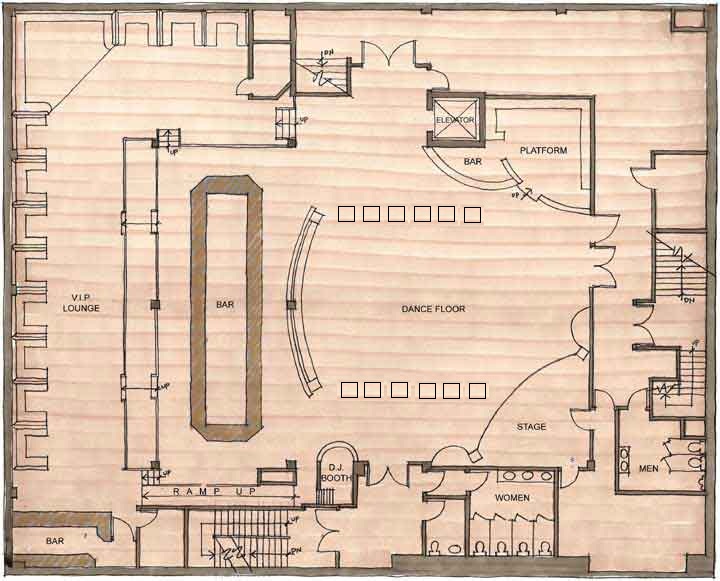
So here is a sample floor plan of a ballroom before the room is sectioned off.
Here is a hastily made MS Paint diagram of the floor plan after the ballroom is sectioned off.
The squares are chairs/potted plants/whatever one has at their disposal. Overall my recommendation is combining suggestions 1 & 3 together. Because suggestion 1 is full of things that should be habits if one is attempting to foster a thriving scene or a memorable event. However it is understandable that one may not always have the time/resources to do so.
If you have any suggestions or tales of how your scene handles the situation of having an event in a large room with problems of low attendance in the past feel free to post in the comment section.
Contrary to popular belief I do have other hobbies besides swing dancing. At the great peril of forever shattering a potential image of myself as a hip guy, one of those hobbies is the occasional playing of Starcraft II an online Real Time Strategy game.
Now many of you are probably thinking, “Great, its cool you are a dork that plays video games. What the hell does this have to do with swing dancing though?”
Starcraft II and Swing Dancing both…
Have a competitive aspect in which there are level tiers of competition (Bronze, Silver, Gold, and et cetera for Starcraft/ Novice, Intermediate, Advanced, and et cetera for Swing Dance).
Has regular events where participants match their skill against each other and top participants are rewarded with prizes.
Is the catalyst for a large sub-culture that if one is not a participant they can be completely ignorant to the fact that it exists.
Now I know some of you may think, “But swing dance is an art, how can people take this ‘game’ so seriously.” I would like to list the fact that many of the top Starcraft II players charge just as much if not more for private lessons then what the top dancers in the Swing Dance world do.
Parallel Worlds
Finding the parallels through these at first seemingly unrelated areas brings to mind an article written at Joy In Motion titled, “Social Dance as Game“. They write,
“Every dancer must begin with the basic rules and structure of the dance before they can progress to intermediate and advanced concepts. Even through the advanced level, however, there is a basic structure that must be maintained in order to make communication on the dance floor possible. This structure, instead of stifling the creative flow, actually provides greater opportunity for expression and creativity in the dance.”
Starcraft II holds these same requirements as well. Many inexperienced players will look for quick strategies to ensure victory to ensure a win (6 pool/cannon rush for you gamers out there, non-gamers this is the equivalent of a drape or pretzel), when their macro-management (macro) or as swing dancers call it “technique” is what is holding them back. I’m betting there are a few people out there in the past who have asked a more experienced dancer why is move X or Y not working to find out its because of a technique issue that you learned in your first swing dance lesson. I know that happened to myself when I was learning how to lead an eagle slide socially.
All out war in Starcraft II
The interesting thing is if you read a well-established guide on how to improve at Starcraft II, like Randy Gaul’s article on Team Liquid “How to Improve at Starcraft II 1v1 Efficiently” a lot of the material can easily be applied on good advice on how to improve at swing dancing.
A great example of this is from the section, “Goals and how to achieve them”. I’m going to first post the part which is directly quoted from the Starcraft II guide.
You’re never going to get anywhere if you don’t know where you’re going. Similarly, you’ll never get to where you’re going if you don’t know how to get there. In order to achieve a goal, you first of all have to have a goal. So now ask yourself what your goals are going to be with StarCraft II. Be both realistic and decisive.
So, once you have your goal in mind you can continue reading the rest of this guide. Until then, you must
stay in this 2.02 section until you can continue. If you are stuck, perhaps the following may help you
brainstorm: […]
I want to be promoted into league X.
I want to become a high level professional player, worthy of sponsorships so I can play full-time.
I want to win a few specific local tournaments so I can enjoy the prize money!
I want to get into the top 500 players of the ladder on the server I currently play on.
Now, here is a modified version of the quoted part of the article.
You’re never going to get anywhere if you don’t know where you’re going. Similarly, you’ll never get to where you’re going if you don’t know how to get there. In order to achieve a goal, you first of all have to have a goal. So now ask yourself what your goals are going to be with Swing Dance. Be both realistic and decisive.
So, once you have your goal in mind you can continue reading the rest of this guide. Until then, you must
stay in this section until you can continue. If you are stuck, perhaps the following may help you
brainstorm: […]
I want to pass the level test into level X.
I want to become a high level competitive dancer, worthy of teaching so I can dance as a full time job.
I want to win a few specific local competitions so I can enjoy going to events for free!
I want to get into the be considered part of the “advanced” leads/follows in my regional area.
Goals sound eerily familiar huh?
I remember at Lindy 500, last year, during a competition class one of the instructors said something similar to, “Competition is a game, if you want to win you have to learn how to play it.” It is interesting how when I compare Swing Dancing to Starcraft II how much that statement hits home for myself.
If you have time I encourage you to read some more of the Starcraft II guide, it actually has some phenomenal ideas of the mindset for improvement. Until then though, I leave you with this quote from the guide,
So the moral of the story is: be humble and keep an open mind. If you can’t do this you don’t belong sitting where you are reading this; you belong in your lower leagues and deserve to stay there. – Randy Gaul
The last few months attending swing dance events as a Penn State student has been awkward and downright frustrating at times. I’ve had people literally in the middle of dances try to bring up the topics such as the Sandusky scandal or my opinion on the former coach Joe Paterno. It got to the point that when deciding what shirts I wanted to wear to dances, time would be spent pondering not wearing one of my Penn State Swing Dance club t-shirts just to avoid the potential hassling that came along with it.
At least for myself, swing dancing is at times an escapist activity for me where I can free my stresses of my daily life whether that be bugs while programming or a tragedy that has befallen my beloved town of State College and many innocent victims. Underclassmen who I teach dance lessons to on a regular basis travel with us to large events, where we are recognized as a group from Penn State. I loathe the idea of them having to deal with this at an event such as Boston Tea Party. With Paterno’s recent death, I fear that this pestering that has quieted down recently may intensify again. The last thing I want, even more then being hassled myself, is my students who to go to an event to have fun and learn from the international Lindy Hop community… to be reminded of the troubles from home.
I apologize if this comes off as a bit of a soapbox rant, but all I can ask is take some consideration before you bring up things in conversation, this goes especially for in the middle of a dance. This just doesn’t apply to just talking to Penn State students and alumni, but anyone who is dealing with unpleasant circumstances.
Recently Southern California lost a dance legend, Hal Takier. Words cannot even begin to describe the debt that the swing dance community owes this man, or how much he was cherished by his community, especially by those in Southern California.
Marcelo from yehoodi gave me permission to edit and re-post something he originally wrote on Yehoodi for Hal 90th birthday, that I think is a well-put tribute.
Hal Takier, is a man whom many (including myself) call the greatest swing dancer who ever lived.
Hal is an incredible man, full of life, insight, and wit. With his wife Marge at his side, Hal has helped those of us who have sought to learn about Los Angeles’s local history and the invention of Balboa come to discover and appreciate this amazing dance and its unique contribution to American history.
Hal’s dancing is now the foundation for hundreds upon hundreds of young dancers (including myself). We are all shameless imitators of Hal’s innovative dancing style, which combined pure Balboa with the rollicking moves of Swing:
Along with the drop seen here, Hal also invented the infamous “Merry-go-round,” several drops, and his singular three-wall flying lindy basic is now known as a “flying Hal.” Hal was one of the dancers in the famous “beach clip,” showing off his insanely fast Balboa style.
Hal was never a professional dancer like Dean Collins. He worked all his life in a rubber factory down in the southern part of LA, driving up to Hollywood to compete in the weekly cutting contests, which he won regularly (much to Dean Collins’s dismay). He belonged for a time to the group the “Ray Rand Dancers,” known for their Balboa and swing combinations. At one point he was considered so good that contests tried to keep him off the floor! That inspired him and his friends to protest the contests that would try to keep them out:
In addition to tons of feature film appearances, Hal’s most famous appearance in movies was in The Maharaja Soundie short from 1943. It’s available on YouTube here:
Hal is also credited with inventing this classic swing pose, in this legendary photo which has appeared in magazines, album covers, and posters:
I had the absolute pleasure to interview Hal and Marge for a documentary I made in film school about his contribution to swing dancing.
I will never forget the one thing he said that is to this day the single most important piece of advice I’ve ever heard from anyone about dancing:
“Enjoy the music. It’s all about the music. When that music gets going….boom. I’m gone.” -Hal Takier
Clips of Hal:
On the same thread Marcelo talks about a few clips of Hal.
Hal dancing with his partner at the time, Betty in the famous “beach clip.” Hal’s the one in the black pants. Randomly: The girl in white who dances with the guy in white before Hal and Betty appear, she’s Vanna White’s mom
– Marcelo
Scroll to the two minute mark and you’ll see Hal dancing with Alice “Scotty” Scott, doing among other things an absolutely dynamite Merry-go-round. Scottie’s drop dancing thing is still super popular. Hal’s in the horizontal striped shirt:
– Marcelo
Hal and Betty Takier dancing at Bobby Mc’Gees, an old school venue in Southern California.
Hal and Marge dancing to the song ‘Avalon’ at the Disneyland Carnation Plaza in 1987. Check out those quick successive spins at 1:23.
In Memorandum
Through the generosity of the scholarship program Balboa Rendezvous had at the time, I had the privilege of meeting Hal and his wife Marge at the Balboa Pavilion two years ago. A role model and a master of his craft, I always saw Hal as the quintessence of what it meant to be a Southern California dancer, a jitterbug. A quote from Marcelo’s documentary gives one of the many reasons I sincerely believe that,
“He’s the best swing dancer of all time ever. 84 okay, and up to last year he was whopping all of us. Everytime he went out, he would dance longer and harder then all of us.”
Avalon, this is a word that if you are a Southern California dancer should be no stranger to you. If you aren’t (or are behind the times, tsk, tsk) allow me to explain. Avalon is a historic city on Santa Catalina Island (often shortened to California locals as Catalina Island), in California, that contains one of the most beautiful ballrooms, The Casino Ballroom in the United States. This picturesque location is immortalized in a jazz standard with the same name as the city, ‘Avalon’.
Perhaps the sentiment I am trying to express can be best summed up by this quote,
“’Avalon’ is practically an advertisement for the resort town on Catalina Island off the coast of California which was a popular resort destination for the film community of Hollywood.” -Chris Tyle
Mythical Origins
Originally Santa Catalina Island was inhabited by the Gabrielino/Tongva Native Americans, until about 1930 when most of them died off or migrated to the mainland for work. [1] However in 1887 a gentleman by the name of George Shatto purchased the island for $200,000 with the intentions of developing it into a resort town. According to wikipedia: His sister-in-law Etta Whitney came up with the name Avalon, which was pulled as a reference from Alfred, Lord Tennyson’s poem “Idylls of the King”, about the legend of King Arthur.
Mr. and Mrs. Shatto and myself were looking for a name for the new town, which in its significance should be appropriate to the place, and the names which I was looking up were ‘Avon’ and ‘Avondale,’ and I found the name ‘Avalon,’ the meaning of which, as given in Webster’s unabridged, was ‘Bright gem of the ocean,’ or Beautiful isle of the blest.’ [2]
– Etta Whitney
To quote Wikipedia about the Arthurian legend origins of this island city,
Avalon (probably from the Welsh word afal, meaning apple; see Etymology below) is a legendary island featured in the Arthurian legend. It first appears in Geoffrey of Monmouth’s 1136 pseudohistorical account Historia Regum Britanniae (“The History of the Kings of Britain”) as the place where King Arthur’s sword Excalibur (Caliburnus) was forged and later where Arthur was taken to recover from his wounds after the Battle of Camlann. Avalon was associated from an early date with mystical practices and people such as Morgan le Fay.
The Last Sleep of Arthur in Avalon by Edward Burne-Jones (1881–1898)
The Casino Ballroom:
Unfortunately in spite of Shatto’s efforts to develop the island he defaulted on his loans and was forced to sell the island. However in 1919 a chewing gum magnate William Wrigley Jr. bought a controlling interest in Santa Catalina Island and its associated properties. [3]
In 1929, Wrigley built the Catalina Casino over the site of a previous dance hall known as the Sugarloaf Casino. Throughout the 1930s the Casino Ballroom hosted many of the biggest names in entertainment, including Benny Goodman, Stan Kenton, Woody Herman, and Gene Autry. [4]
“Catalina was Hollywood’s home away from home, and casino gigs were highly sought after. The concerts were broadcast across the country on radio, enhancing the venue’s popularity. Thousands of concertgoers paid $2.25 each to take the Great White Steamer from San Pedro on the mainland to Avalon. Then they danced to big band music, thanking their lucky stars that the concerts themselves were often free, thanks to the building’s founding father, chewing gum mogul William Wrigley Jr.”
-Rosemary McClure
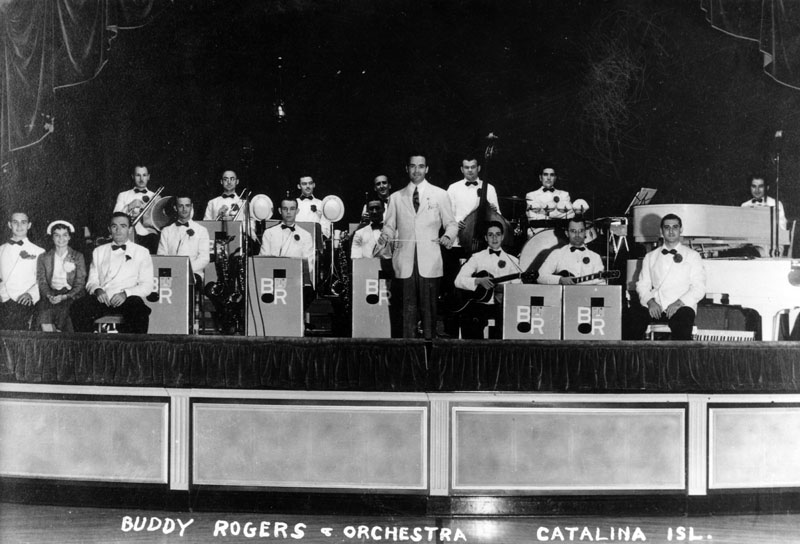
Buddy Rogers Orchestra at the Casino Ballroom
To give one an idea of the grandeur of this place again I will quote the L.A. Times writer McClure,
“The casino, 12 stories tall and ringed by balconies that overlook the bay, was believed to have the biggest dance floor in the world when it was built. It was called a masterpiece of Art Deco design that “receives patrons at its doors from seaplanes, yachts and motorcars,” according to a 1929 article in the Catalina Islander newspaper.”
-Rosemary McClure
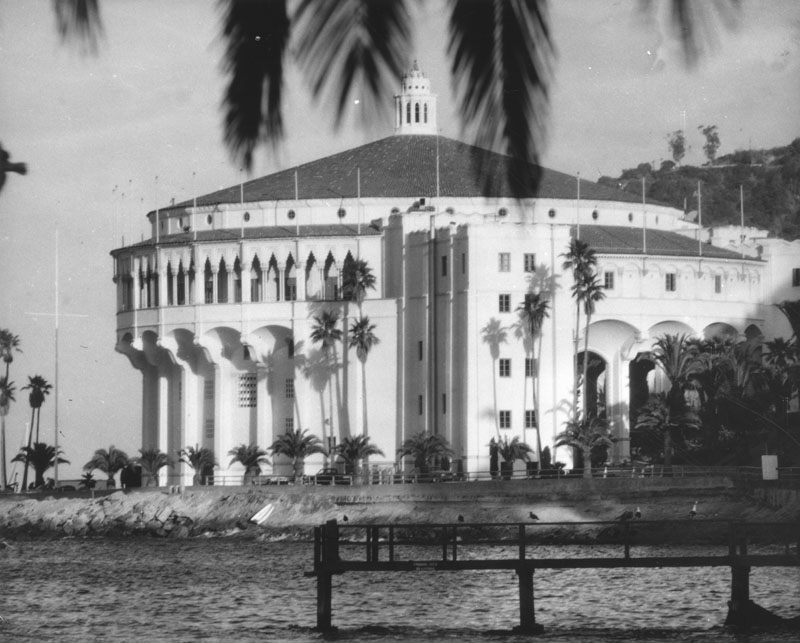
Exterior of the Casino Ballroom
Interior of Casino Ballroom
An important detail for dancers, the Avalon Ball website writes how the floor was constructed at the Casino Ballroom,
The ballroom dance floor was carefully constructed of maple, white oak and rosewood that rest on a layer of felt and acoustical paper. The felt and paper are installed over a subfloor of pine that floats above the support beams on strips of cork. Such careful attention was given to the dance floor to ensure a smooth and comfortable dancing experience for the building’s many visitors.
The Jazz Standard:
This part of the post is what I am assuming most swing dancers would be familiar with, the jazz standard known as ‘Avalon’. It was a 1920 popular song written by Al Jolson, Buddy DeSylva and Vincent Rose.
“A popular jazz standard, the song has been recorded by many artists, including Cab Calloway (1934), Coleman Hawkins (1935) and Eddie Durham (1936). The Benny Goodman Quartet played the song in their famous 1938 Carnegie Hall concert.The song was included in the biographical films The Jolson Story (1946) and The Benny Goodman Story (1956), and is also being noodled by Sam (Dooley Wilson) at the piano right before he plays As Time Goes By in the movie Casablanca (1942).“
In the original lyrics of the song there are two versus and a repeated chorus, though in most performances of the song that are non-instrumental only the chorus is frequently sung.
I found my love in Avalon
Beside the bay
I left my love in Avalon
And sail’d away
I dream of her and Avalon
From dusk ’til dawn
And so I think I’ll travel on
To Avalon
For reference here is a 1937 performance of ‘Avalon’ by Benny Goodman and his Orchestra:
In a modern context here is the Gaucho Gypsy Jazz band featuring Tamar Korn:
In Context with the Contemporary Swing Dance Community
The Casino Ballroom at Avalon is still used by the Lindy Hop community. Small events are sometimes sponsored there, but it is most notably featured by the Catalina Jazz Dance Festival.
Travel On
When I think of Avalon I get slightly nostalgic because of the history and meaning the place has in a myriad of ways. The song ‘Avalon’ is one of my favorite songs to Balboa to and for myself as a Southern Californian brings memories of home when I am away.
If you have any particular; thoughts, details I missed, or even fond memories of the place, I encourage you to share them in the comments section. If you get the chance I encourage you to travel on, to Avalon.
Footnotes:
[1]: Otte, Stacey; Pedersen, Jeannine (2004). “Catalina Island History”. A Catalina Island History in Brief. Catalina Island Museum. Retrieved January 8, 2012.
[2]: Williamson, M. Burton (December 7, 1903). “History of Santa Catalina Island”. The Historical Society of Southern California (Los Angeles: George Rice & Sons): 14–31.
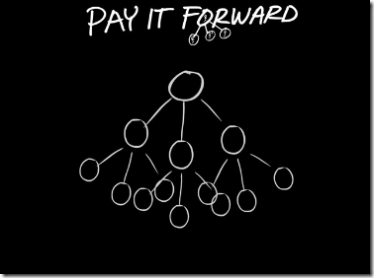
As the new year approaches I can’t help but reflect upon common themes of what has consisted my experiences of being a member of the swing dance community in years past. One I want to touch on in particular is the concept of paying it forward.
To quote wikipedia, paying it forward is defined as:
The concept of asking that a good turn be repaid by having it done to others instead.
When I first started dancing Southern California I went to a venue called Rock Harbor, which was a free venue that the instructors were local dancers who generously donated their time. One day I noticed two of the instructors there dancing Collegiate Shag, a dance I had seen previously and was intrigued by. Alas, my struggle though was like many people who want to learn Balboa, I had difficulty finding lessons. Those two instructors Alan and Amantha were nice enough to change the lesson the next week to teach Shag so I could learn the basic step and set me on the path to delving into the dance.
Last night when I was out dancing and I noticed a girl off on the side trying to figure out a Shag double rhythm basic and struggling with it. I offered to help and a few minutes later she was doing okay enough to follow a basic in open and closed position and seemed thrilled. It was only maybe five to ten minutes tops of my time at most.
Raldoph Waldo Emerson once wrote,
“In the order of nature we cannot render benefits to those from whom we receive them, or only seldom. But the benefit we receive must be rendered again, line for line, deed for deed, cent for cent, to somebody.”
For myself my best way of repaying the gift that Amantha and Alan gave me is to render the same gift they gave to me onto others. I encourage those of you who have experience in the dance community to do the same. It is a simple act that fosters growth in our community and invaluable to the individuals that it assists.
The number one request (besides aerials) that most swing dance instructors get from newer to intermediate dancers are flashy moves, flashy moves, and… flashy moves.
I’ll admit for awhile as a swing dance instructor I would teach nothing besides reinforcing technique in aboslute basic moves. While that had the advantage of drilling in solid fundamentals, it had the disadvantage of boring most of my class to death.
For the classes I taught that weren’t the first time dancer crash courses, I changed my methods of how I taught. I would choose moves that while they looked impressive/flashy, would be demanding of a certain technique point I wanted to drill in. Particularly on the point that they would fail spetacularly if people did something such as trying to run around their partner or if a lead tried to muscle a follow around.
This quote from Bug’s Question of the Day by Byron Alley hits the nail right on the head about how I feel about this topic as well,
But even then, it’s important not to imagine that people need to master their basics before attempting more advanced moves. Often it’s the opposite: people need to attempt, and quite possibly fail at, dancing at a higher level in order to appreciate the value of fundamentals. Show them moves that simply FAIL if the technique is not there. Failure is a necessary part of learning, especially a vernacular dance like Lindy Hop. It gives dancers a better understanding of the frontiers of the dance.
(Caveat: there’s a difference between encouraging failure and getting people hurt.)
I will admit though this method of teaching isn’t all rainbows and sunshine. I have recieved criticism in the past that teaching in this way creates an intimidating and discourging envionrment for students. Personally I beg to differ and think that doing this establishes a sense of humility in dancers and fosters a respect for technique because the students gain an context to understand why it is important.
In swing dance this is the idea of taking technique from other dances and attempting to apply it in way that is (usually) detrimental to making social dance work.
As a swing dance instructor whenever I get new students who have a background in areas such as ballet or gymnastics I am always excited, yet apprehensive. This is because, while they have a significant advantage over their peers in terms of experience with learning things visually, they have the unique challenges of separating technique (that does not apply well to Lindy Hop) from their past experience and in the cases of being a follow, allowing others to initiate motion versus using leads as a prop.
When you have too many frames, sometimes its hard to see the picture.
In the past I struggled how to teach people who went through this problem. I conveniently learned the answer when I took a semester of Ballroom dance. My difficulty in that class lied within the fact that I kept trying to apply Lindy Hop technique to dances that it didn’t make sense to, such as Rumba. What allowed me to get past this mental block was my Ballroom instructor at the time told me to picture dances like outfits such as formal wear or beach appropriate attire. Within those outfits certain characteristics and things worked within the idea portrayed. It sounds silly, but it worked. Whenever I did a different dance a mental switch would flick and I would utilize certain techniques, such as toes would become pointed in Irish step-dance.
For those of you who teach and have students who struggle with the idea of not mixing up technique from other dances with swing dance, give this analogy a shot. For individuals attempting to learn Swing Dance or perhaps dances outside your comfort zone such as Hip-Hop or Bhangra, the idea of picturing each dance as a separate entity can assist you greatly as well.









 It's The Way That You Do It